AI Silent Mode: Building AI Trust Pre-Launch
AI Silent Mode is a phased rollout framework that lets AI agents do real work while humans approve every external action until trust is earned — a safer path from supervised deployment to full autonomy, using measurable thresholds, human sign-off, and reversible stages.

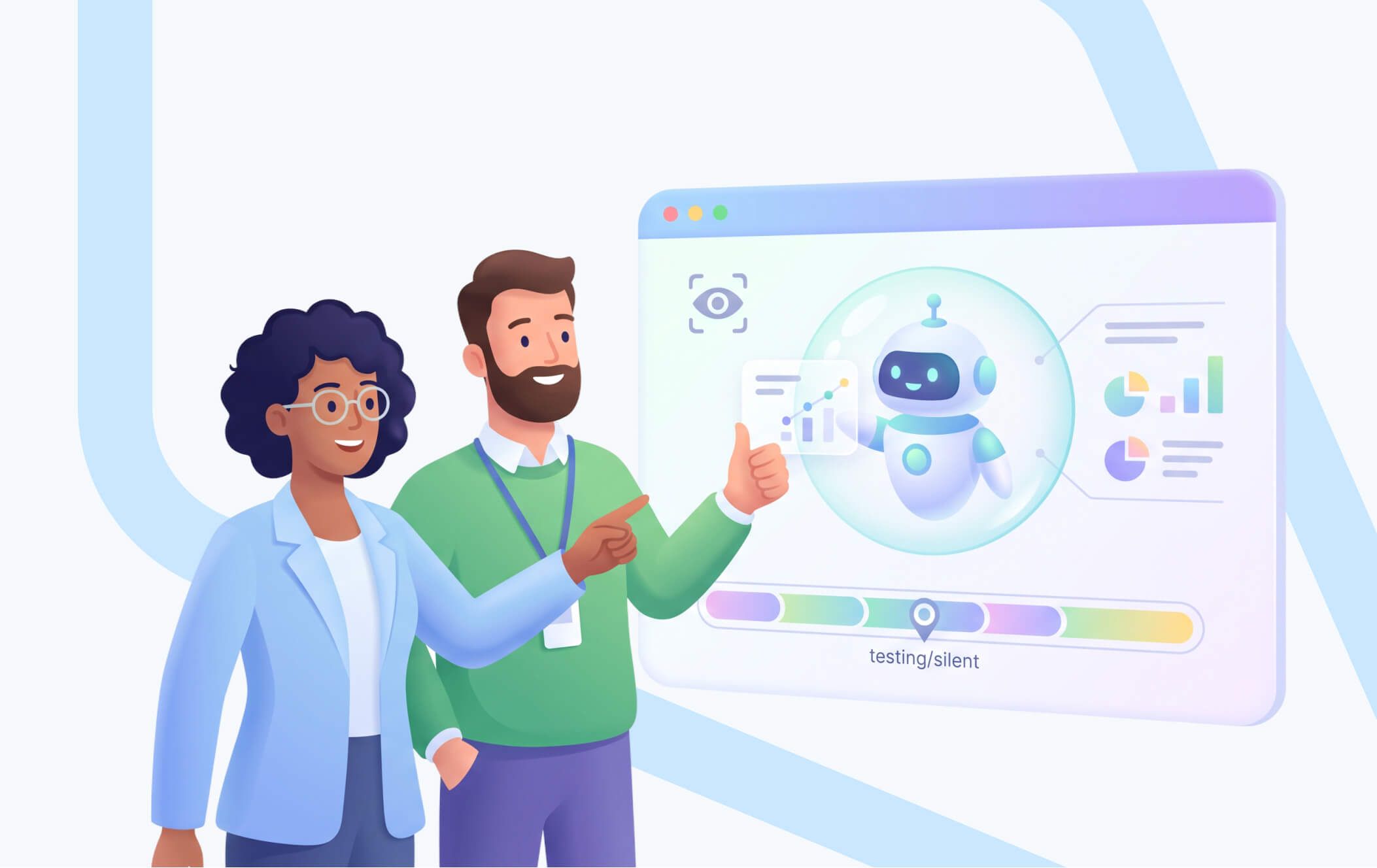
💡In short: The AI Silent Mode Rollout launches an AI agent doing real work immediately, but keeps a human approving every action until it earns full autonomy — graduated action by action, gated by a measurable accuracy threshold plus human sign-off, and reversible at any stage. It's our default approach to phased AI deployment whenever an agent's actions are visible to a customer, vendor, or partner.
Table of Contents:
- What Is the Silent Mode Rollout?
- Who This Approach Is For
- How We Apply This on Client Projects
- Big Bang Launch vs. the Silent Mode Rollout
- FAQ
- Getting the Sequence Right
The Silent Mode Rollout is a human-in-the-loop framework for launching AI agents: the agent starts doing real work immediately, but a person approves every action until it's earned full autonomy. In high-stakes industries like finance or healthcare, letting an agent run unsupervised from day one isn't the best move — one wrong or unregulated answer can do real damage to a customer relationship, a compliance record, or the project's credibility internally. Instead of making teams trust the AI right away, this approach lets them see what the agent would do—like which emails it would send or updates it would make—until they have real evidence of how it performs. That gap between "the model is good enough" and "we're comfortable removing the human" is normal, and it doesn't close on its own just because the accuracy numbers look good in a demo.
We call this approach the AI Silent Mode Rollout: the agent starts doing the real work from day one, but a human sits between every action and the outside world until the agent has earned its way out of that seat. Trust gets built in observable stages instead of assumed on launch day. It builds on the human-in-the-loop AI model, giving it a concrete, staged rollout sequence.
What Is the Silent Mode Rollout?
The framework has three stages. Each one is a deliberate reduction in how much a human has to touch before the agent's work reaches the outside world.
Stage 1 — Silent Mode. The agent handles the full task — drafting a reply, processing a form, proposing a database update — but nothing leaves the building without someone clicking approve. As we describe it to clients, the agent isn't sending anything automatically; it's showing what it would send, and a human decides whether it goes out as-is, gets edited, or gets rejected. For the person approving, the job shifts from "write this response" to "review this response," which is a much faster, lower-stress task — and it's the stage where the team builds a real, evidence-based opinion of the agent's judgment rather than a hopeful one.
Stage 2 — Limited-Blast-Radius Autonomy. Once approval rates are consistently high, the agent gets a narrower set of conditions under which it can act without a human — a specific time window (weekends, after-hours), a specific action type (order status lookups, not cancellations), or a specific customer segment. This stage matters because it lets the organization test unsupervised behavior where mistakes are cheap to fix, rather than testing it everywhere at once.
Stage 3 — Full Autonomy. The agent acts independently across the scoped use case, with humans handling exceptions and edge cases that the agent is designed to escalate rather than guess at. Notably, this graduation happens per action type, not as a single switch for the whole system — an agent might be fully autonomous for order-status replies while still drafting-for-approval on cancellations, because those two actions carry very different risks if the agent gets them wrong.
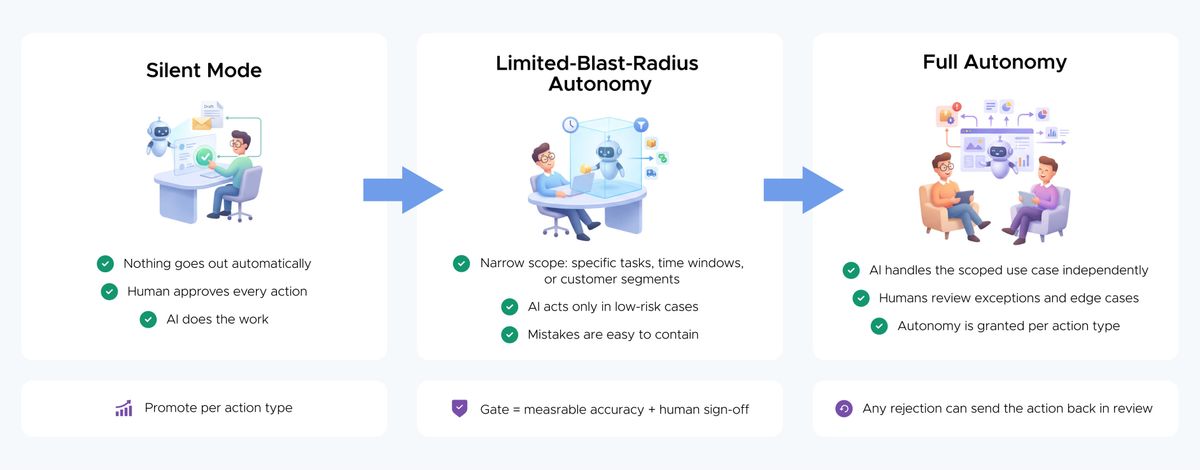
The stages aren't a one-way street, either. If an agent's proposed action is rejected, that specific thread or record drops back into human-reviewed mode until someone actively clears it — the system fails safe, not silent.
Who This Approach Is For
Silent Mode isn't the right rollout plan for every company or AI feature. A recommendation widget or an internal search tool doesn't need it — the cost of a wrong answer is low, and there's no external relationship at stake. We recommend Silent Mode specifically when an agent is about to take an action that a customer, vendor, or partner will see and react to: sending an email, updating a record a partner depends on, canceling or modifying a transaction, or writing to a system where a mistake creates real cleanup work.
How We Apply This on Client Projects
Example 1: Support automation for an e-commerce retailer
A client's support chatbot was already resolving the majority of website chat requests without human involvement, and the next step was to extend that same logic to email tickets — a channel with more history, more room for tone missteps, and directly tied to the brand's voice. Rather than turning email automation on for every ticket at once, we proposed the same three-stage sequence: start with the highest-confidence request type (order status, which the bot already handled reliably in chat), launch it on weekends first — with a clear disclaimer that the reply came from an AI assistant and a one-click path to a human — and only after that built a track record, extend it to full-time coverage.
Order status was chosen deliberately as the first use case precisely because it's structured, low-ambiguity, and easy to verify against source data, making it the safest place to prove the agent's judgment before trusting it with anything higher-stakes, like order cancellations.
Example 2: A vendor-coordination agent for an operations team
On a project automating purchase-order acknowledgments and vendor email chasing for an enterprise operations team, we built Silent Mode in as a first-class requirement, not an afterthought. Every external action the agent could take — sending a vendor email, writing a status update to the system of record — was proposed on a review dashboard rather than executed automatically. The graduation criteria were defined up front and made concrete: a given action type only flips from "requires approval" to "autonomous" once it's cleared with roughly 90% field-level accuracy against a labeled evaluation set and a project stakeholder has signed off after a multi-week observation window. Defining that accuracy bar is its own discipline — we treat evaluation as a first-class deliverable, not an afterthought (see our eval-first guide to LLM evaluation). Every flip is logged with a reason and can be reversed at any time. That combination — a numeric bar plus a human sign-off, applied action by action rather than to the whole system — is what turns "we think it's ready" into something a nervous stakeholder can actually approve.
The pattern also shows up earlier than go-live: on a separate initiative for the same operations team, a predictive-pricing agent is following the identical silent-launch approach before its next version ships. It's not a one-off tactic we used once — it's become the standard way we de-risk any agent that's about to start acting on a client's behalf.
Silent Mode also pairs naturally with the other controls we put around a production agent. The human-approval gate is one layer; enterprise AI guardrails and a deliberate approach to reducing hallucinations are the others. Together they let an agent do real work without the organization having to hold its breath.
Big Bang Launch vs. the Silent Mode Rollout
| TraditionalBig Bang Launch | BotsCrew's approachSilent Mode Rollout | |
|---|---|---|
| Risk exposure at launch | Full — every output reaches customers/vendors immediately | Zero — every output is reviewed before it leaves |
| Time to organizational trust | Fast if it works, catastrophic if it doesn't | Gradual, but earned and durable |
| Employee buy-in | Often resisted — feels imposed | Built in — employees stay in control during the riskiest phase |
| Cost of a bad output | High — public, hard to walk back | Low — caught before it ever reaches anyone |
| Rollback cost | High — trust damage outlasts a fix | Low — flip the action type back to review mode |
| What "done" looks like | A single go-live date | A series of small, evidence-based promotions |
FAQ
- How long should Silent Mode last?
Long enough to accumulate a representative sample of the agent's decisions, not a fixed number of days. In practice that's usually a multi-week window per action type — enough volume that a high approval rate reflects real reliability rather than an easy week. The signal to graduate isn't the calendar; it's a stable, high approval rate against a labeled evaluation set.
- How do you know when it's safe to remove the human?
We define the promotion gate before the rollout starts: a given action type only moves from "requires approval" to "autonomous" once it clears a measurable accuracy bar (on our vendor-coordination project, roughly 90% field-level accuracy against a labeled set) and a project stakeholder signs off after watching it during the observation window. A number alone isn't enough, and a gut feeling alone isn't enough — it's both, together, per action type.
- Is Silent Mode the same as shadow mode?
No. In shadow mode, the agent's output never reaches anyone — it runs in parallel purely to measure accuracy. In Silent Mode, the output does go out, but a human approves it first. Shadow mode answers "would this be accurate?"; Silent Mode answers "can this agent do real work while we build trust?" A phased AI deployment often uses a short shadow-mode period first, then moves into Silent Mode.
- Does this slow down time-to-value?
Less than people expect. The agent is doing real work from day one — drafting, processing, proposing — so the productivity gain from reviewing-instead-of-writing shows up immediately. What's deferred isn't the value; it's the removal of the human, which is the part worth being careful about.
- What happens if the agent gets something wrong during Silent Mode?
Nothing reaches the customer, because a person catches it at the approval step — which is the entire point. That rejected action is logged, feeds back into improving the agent, and drops that specific thread back into human-reviewed mode. The failure is contained and turned into training signal rather than into an incident.
Getting the Sequence Right
The technology to automate a given workflow is often ready well before the organization is ready to trust it unsupervised — and the Silent Mode Rollout exists to deliberately close that gap rather than hoping it will close on its own. If your team is sitting on an AI pilot that works in testing but nobody's comfortable turning loose on real customers or vendors, the fix usually isn't more model tuning — it's a rollout plan that lets the organization build evidence at its own pace. That's the conversation we have with every client before an agent goes anywhere near a "send" button, and it's usually a shorter conversation than people expect.
BotsCrew helps enterprise teams take AI from strategy through to production — scoping the right use cases, building custom agents on Claude, integrating with your systems, and rolling them out in a way your team and customers actually trust. Book a free consultation and we'll talk through your specific goals.
Book a free call