



AI Readiness Assessment

Find out where your organization actually stands, and the one thing blocking it.

How ready is your organization for AI?

Ten questions across six dimensions. You get your score, the pattern your answers match, and the one thing to fix first.

  • 10 questions
  • About 3 minutes
  • Results before any email

Trusted by global brands

  • Honda
  • EA Sports
  • Samsung
  • Virgin
  • Natera
  • Mars
  • FIBA

Definition

What is an AI readiness assessment?

An AI readiness assessment is a structured check of whether your organization can take an AI initiative into production and keep it there — not whether a model can do the task, but whether your company can run it once it works.

How it scores

It scores six dimensions: strategy and ownership, use cases and ROI, data readiness, systems and integration, governance, and adoption. Each score ranges from 0 to 100, and a dimension needs a score of 60 or above to reliably support production rather than one-off pilots.

What you get back

Most assessments hand you a number. This one returns a readiness profile: the pattern your answers match, what usually happens next to companies in it, and the first thing to fix. For the full picture — maturity models and a complete checklist — see our guide to enterprise AI readiness.

The framework

The six dimensions of AI readiness

Every question belongs to one of six dimensions.

DimensionWeightWhat it measuresWhat a low score costs you
Strategy & Ownership15%Who owns AI, whether it is funded, and how progress gets measuredEfforts stall at pilot stage, depend on individual champions, and lose funding whenever operational pressure rises
Use Cases & ROI20%How well-defined, quantified, and business-justified your AI pipeline isInvestment goes to whichever idea is best argued rather than best justified, and the same debate repeats every budget cycle
Data Readiness20%The quality, structure, and accessibility of the business data any model would depend onProjects get budgeted and staffed before anyone discovers the data is missing, burning months on pilots that quietly stall
Systems & Integration15%The core systems and integration capacity AI would need to plug intoEvery initiative pays the same integration tax, and the delays erode leadership confidence in the program
Governance, Security & Trust15%The policies and controls that let AI scale without creating new riskUsage spreads faster than policy, and the first real incident sets the whole program back
Adoption & Change15%Whether your teams are ready to work differently, not only to buy new toolsTools get deployed and ignored, and usage shows a launch spike followed by a flat line

The 60 threshold. A dimension score of 60 or above is the point at which, in our experience, it reliably supports production AI rather than one-off pilots. Below 60, initiatives still launch and tend to stop at the pilot stage. A company can average 65 and be blocked by one dimension at 30, because the weakest dimension sets the ceiling on what can ship.

Who it is built for. Executives, operations, IT, finance, and data leaders at organizations running several core systems, where integration and data ownership are genuine open questions.

The method

How the score is calculated

Every option maps to a fixed 0–100 score, and each dimension is the average of its questions — Use Cases and Data Readiness weighted at 20%, the other four at 15%. Your overall score places you in one of four readiness bands:

  • 0–24

    Exploring

  • 25–49

    Piloting

  • 50–74

    Operationalizing

  • 75–100

    Leading

From our engagements

What we see in the field

Most AI pilots stall before they scale. MIT found 95% of enterprise generative-AI pilots deliver no measurable return, and the share of companies abandoning most AI initiatives before production has jumped from 17% to 42% in a year. The reason is rarely the model — it’s the data beneath it, a process no one has written down, or the people asked to work differently. Gartner found 63% of organizations lack, or aren’t sure they have, the data practices AI needs. Here is what removing those blockers looks like in our work.

01Blocker: DataLuxury textiles & furnishings
Kravet

From under 60% to ~90% answer accuracy
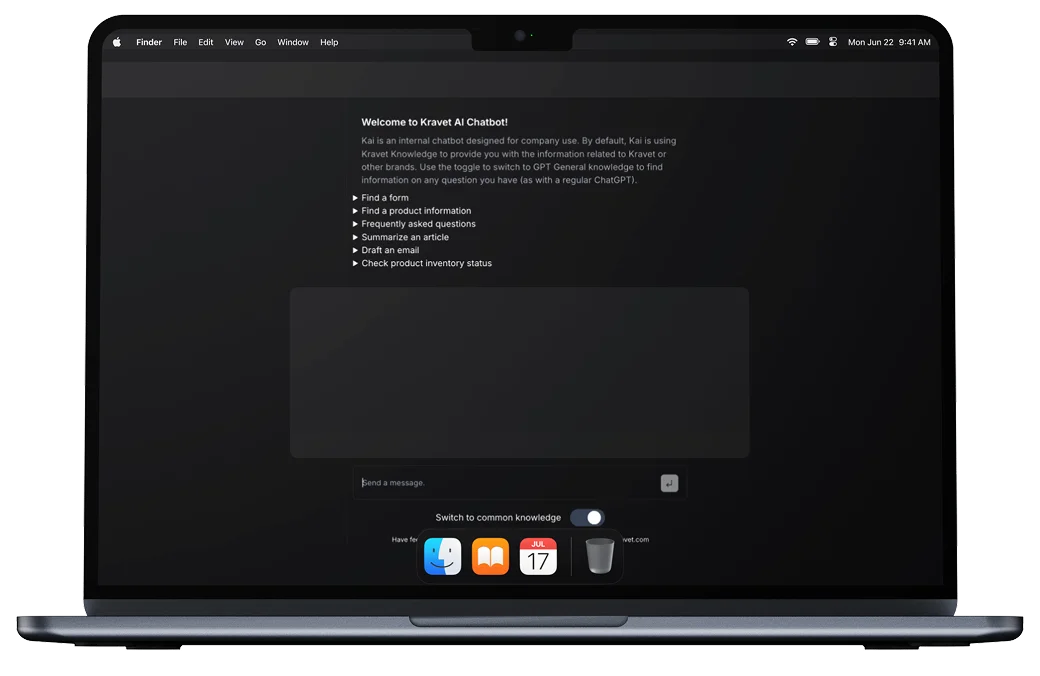
Kravet AI assistant showing an interactive sales report

Problem

AI answers were wrong six times out of ten. Knowledge sat in 1,000+ documents — outdated, duplicated, conflicting — and the business rules lived in people’s heads.

Solution

A zero-risk pilot on Kravet’s own data: audit what was missing, organize retrieval by query type, connect the catalog and live inventory, and clean the knowledge layer before scaling — what AI-ready data looks like in practice.

Results

  • <60% → ~90%

    Answer accuracy

  • 3 weeks

    To first working prototype

  • 100+ pages → seconds

    Sales reporting

The approach taken by the BotsCrew team is what allowed us to progress to a successful launch.

Jesse Lazarus · Chief Process & Innovation Officer, Kravet

02Blocker: Process & peopleDesign & furniture manufacturing

A large design and furniture manufacturer

12+ hours a week back from manual purchase orders

Problem

250 purchase orders a week handled by hand across three disconnected systems, with the real process living only in coordinators’ heads.

Solution

Documented the actual workflow in a working session, built a synced data layer instead of waiting for clean source data, enforced guardrails in code, and stood up an AI Center of Excellence to prioritize what to automate next.

Results (projected from the pilot)

  • 12+ hours/week

    Saved

  • 90%+

    Validation accuracy

  • 5.5 → under 4 days

    Vendor confirmations

03Blocker: Demo won’t shipAutomotive aftermarket mfg. & distribution
S&B Filters

From a 4–6 minute prototype answer to ~10 seconds

S&B Filters AI assistant answering a product care question

Problem

The CEO’s own prototype worked but couldn’t ship — 4–6 minutes per answer, a single prompt grown to ~40 pages, and order IDs that varied across channels.

Solution

Rebuilt it around direct ERP retrieval, streaming responses, and the company’s own business rules — then extended the same layer to customers and product support.

Results

  • 2–7 min → ~10 sec

    Order-status lookups

  • 83%

    Resolved with no human involved

  • 5,600

    Customer conversations handled

It has transformed our business, given us a lot of information very quickly, and really helped us handle our backorders.
Berry Carter · CEO, S&B Filters

The path

From your score to production

Not every organization needs the same depth. What does not change is the order: these questions get answered somewhere before the build starts. Here is the path most teams follow, from a free score to a system in production.

  1. 1

    Start with the assessment

    You get your band and the one dimension holding you back — enough to give a leadership team a shared starting point without spending a budget on it.

  2. 2

    Validate or map the gaps

    Pressure-test your top use case against cost, data, and return — or document the process and data that live in people’s heads. A working session or a scoped discovery, sized to how far the gaps spread.

  3. 3

    Take one pilot to production

    Build the highest-value use case on real data, with guardrails, and prove it against a metric that matters before you scale. This is where most programs either ship or stall.

  4. 4

    Scale what works

    Expand from the proven foundation into the next use cases, one at a time, so each new tool inherits the data and guardrails the last one earned.

Where do you go from a score?

Knowing your constraint is useful. Closing it is the work.

BotsCrew has been building enterprise AI since 2016, with 200+ AI solutions shipped for clients including Adidas, Honda, and Samsung. We start where you are: a 30-minute conversation about your strategy, your constraint, and where it makes sense to begin.

Testimonials

What our clients say

  • “BotsCrew was an incredible partner from inception to launch. The team was proactive, well-organized, and flexible. They are deeply committed to achieving successful outcomes and exceeding expectations. We’re delighted to have found such a dedicated partner and would recommend them to anyone looking for voice assistant experts.”
    Jacklyn Trejo

    Jacklyn Trejo

    Product Manager, Samsung NEXT

  • “BotsCrew's flexibility and dedication to the project are great; we’ve been extremely pleased working with them. We have three major KPIs, and we’ve performed well across those KPIs right off the bat.”
    Jason Lesniewicz

    Jason Lesniewicz

    Director of Cultural Tourism, Choose Chicago

  • “The whole process has been great. They’ve been really good with communication, keeping us up-to-date, and running the project on time. We’re really happy with the final product, the platform, the product’s ease of use, and our ability to tweak it.”
    Melissa M.

    Melissa M.

    Senior Manager at Natera

  • “BotsCrew's proactive approach to addressing potential issues and their responsiveness to our feedback demonstrated their dedication to ensuring a smooth project journey. We were genuinely impressed by BotsCrew's project management expertise and their dedication to ensuring our satisfaction with project delivery.”
    Digital Product Manager

    Digital Product Manager

    FIBA

  • “They're phenomenal and have never messed a beat with either their professionalism or ability to deliver. The quality of work is amazing, and BotsCrew is really smart. The solution is great. They're simply awesome people to deal with.”
    Afshin Saffari

    Afshin Saffari

    Client Director of Digital Solutions, Leo Burnett

  • “Engagements with external consultants can suffer if the external party is very linear in their approach. But the BotsCrew team was incredibly collaborative and eager to understand our use case. It made our team feel like we were truly partnered on our project.”
    Jesse Lazarus

    Jesse Lazarus

    Chief Technology Officer at Kravet

Recognition

  • Clutch Global 2026
  • Clutch Top AI Consulting Company, United States 2026
  • Clutch Top AI Strategy Company, United States 2026
  • Clutch Top Generative AI Company 2026
Select Services Partner, Claude Partner Network

BotsCrew is a Select partner in the Claude Partner Network Services.

Questions

FAQ

A structured check of whether your organization can take an AI initiative to production — across strategy, use cases, data, systems, governance, and adoption — and which of those would block a project today.

Have your score? Let’s talk about the next step.

A 30-minute call with our team, free.