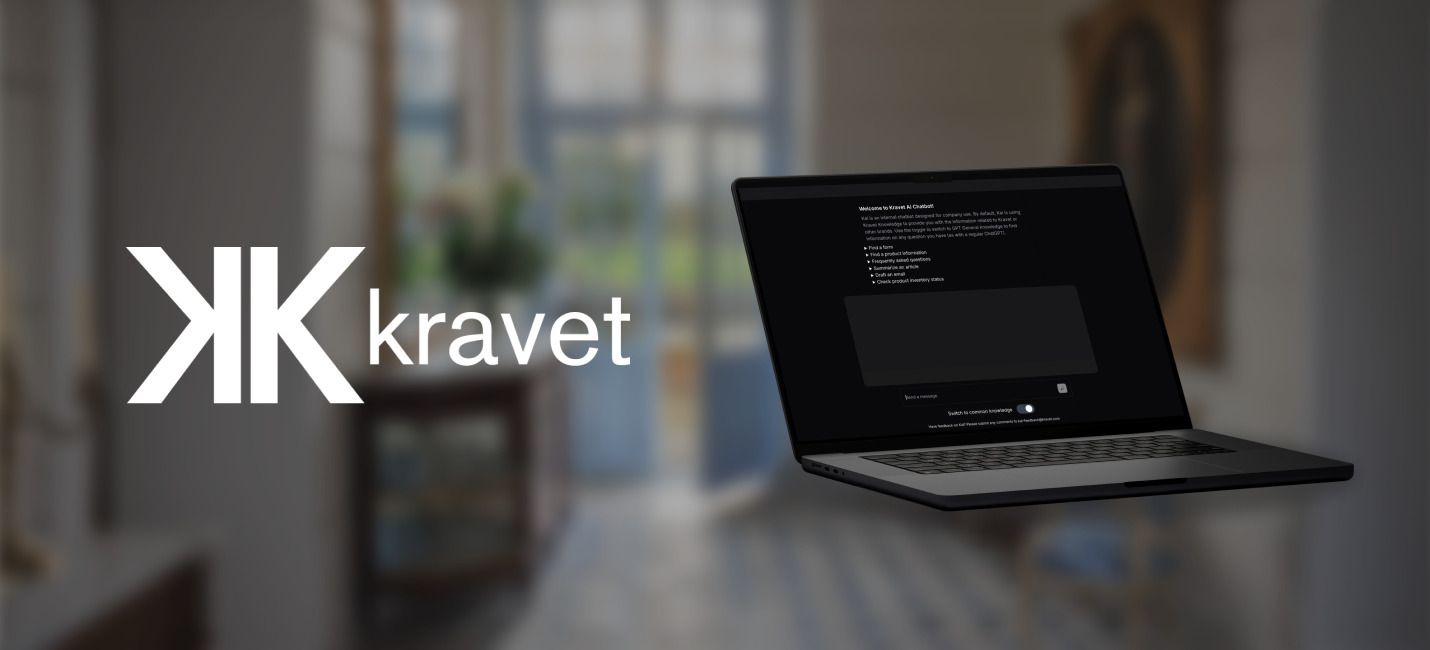
Kravet Internal AI: From 60% to Nearly 90% Accuracy in AI Outputs
increase in AI accuracy
product inquiries covered
static files of different formats added
weeks to deliver the first prototype
About The Client
Kravet Inc. owns Kravet, Lee Jofa, GP & J Baker, Brunschwig & Fils and Donghia — high end fabric houses that specialize in style, luxury and exceptional design.
A 5th generation family business, Kravet Inc. with locations in North America and worldwide, has become the world's largest purveyor of luxury fabrics, furniture, wall coverings, trimmings, carpets, and accessories, boasting the most extensive and revered design archive dating back to the 1760s. GP & J Baker proudly supplies exquisite fabrics to the Royal households, gracing the halls of Buckingham Palace, Windsor Castle, and Sandringham.
Key Challenges
Kravet, a distinguished global leader in home furnishings with a workforce of nearly 1,000 employees worldwide, aimed to harness AI to streamline knowledge retrieval and optimized internal processes across various sectors, including:
— Sales & Marketing
— Supply Chain
— Operations
— HR.
However, Kravet was quite skeptical that an off-the-shelf solution, with no flexibility to tweak AI settings or make customizations, could handle their data. Their data included unreadable formats and content, outdated and conflicting information, and thousands of product pages each with unique product specs.
We suggested a strategic approach — a zero-risk pilot that would include training AI on their data 'as is'. This stage would allow us to determine the key knowledge areas contributing to misleading AI responses and develop distinct strategies to tackle those challenges.
Different formats including unreadable formats and content that couldn't be processed out of the box.
Massive product catalog requiring accurate, real-time search and retrieval integration.
Outdated and conflicting information across sources, risking inaccurate answers to customers.
Not fit for off-the-shelf solutions, with no flexibility to tweak AI settings or make customizations.
Our Approach
We started off with the Pilot aiming to build a proof-of-concept prototype trained on Kravet's data with minimum effort to determine the key AI challenges.
BotsCrew Enterprise Platform with in-built RAG (retrieval augmented generation) infrastructure was ideal for this purpose as it allowed us to deliver the first version of the prototype in 3 weeks.
What was added to the assistant's knowledge base:
- 1,000+ static files of different format (pdf, docs, xlsx, etc.) from various business domains
- Kravet blog articles
- Kravet website with product pages.
With this data, the prototype was transferred to the client for the initial testing. And it revealed that:
- Files contained conflicting and outdated information which lead to incorrect replies
- Data with content in unreadable format (e.g., scans) was not aiding the AI responses
- Product-related information located on the Kravet website couldn't be fully accessed and did not enable exact-match search by the product SKU code
- The answers were unpredictable: each time, AI utilized a different knowledge source that could provide a wrong answer that was previously handled correctly
- Test questions could be grouped into a few distinct topics that revealed the areas where the AI assistant would be most helpful.
Moreover, we realized that the internal AI assistant could be helpful to the Kravet employees beyond knowledge retrieval.
With these findings, we regrouped with the client and suggested different approaches to handling these problem areas, which included utilizing the tools that existed in their ecosystem to better inform the AI answers.
Our proposed strategy is better described with this infographic:
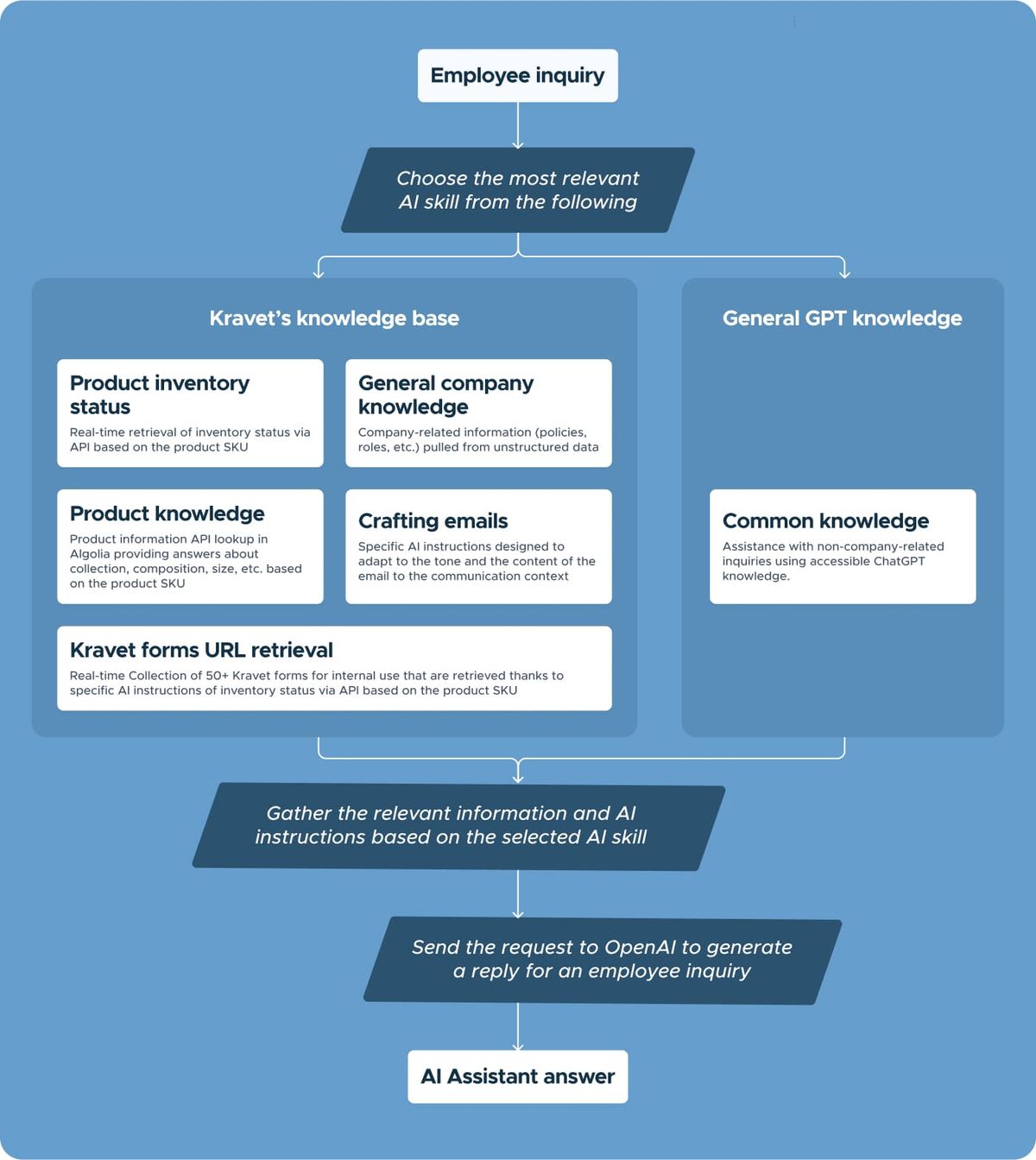
Additionally, we made the following tweaks:
✅ Adjusted the temperature setting to control the language model's output, balancing creative randomness and predictable accuracy.
✅ Switched to the GPT model with the largest context window (128k tokens).
✅ Increased the number of sources used in Retrieval Augmented Generation.
✅ Conducted data cleansing by removing outdated files and sources.
Technologies
 OpenAI
 Pinecone
 Algolia
 Kravet API
 BotsCrew Platform
Key Features
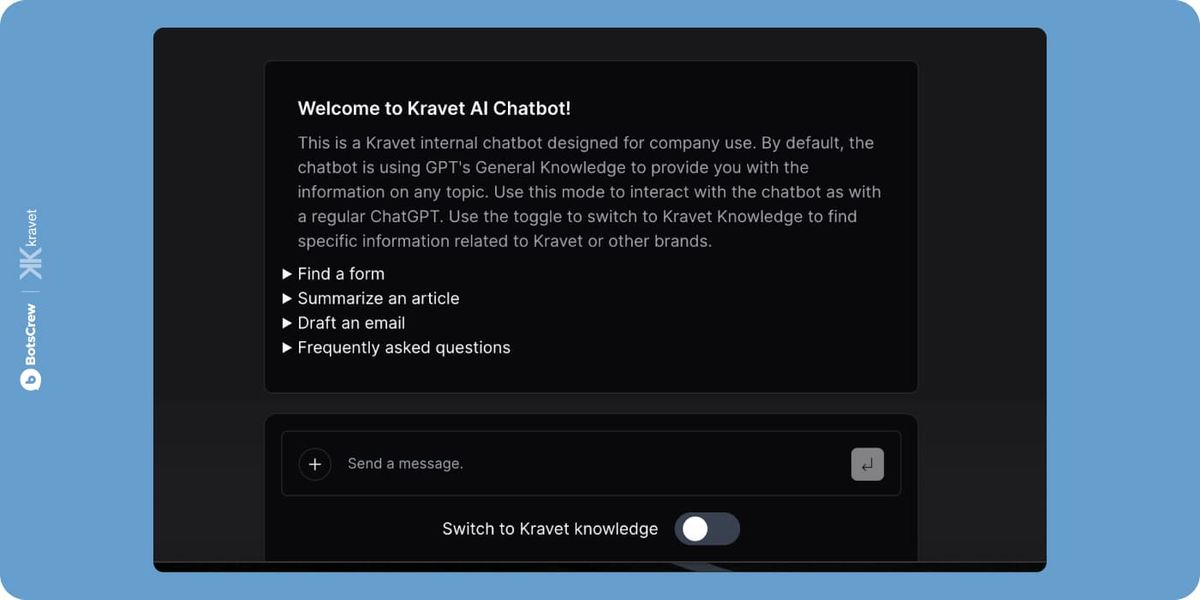
Managing inquiries about a vast product range. The AI assistant is designed to handle inquiries about an extensive range of over 125,000 products, covering specifics like product features, color options, fabric types, and the collection each item belongs to.
Inventory system integration & real-time status monitoring. It can seamlessly provide up-to-date information on inventory status, such as the quantity available in stock and estimated delivery times, acting as a valuable resource for employees seeking quick and accurate information.
Email capabilities. Client's internal AI assistant can choose the right tone of voice and content based on previous interactions. For instance, if an employee asked the AI agent about a fabric collection, it would tell him the composition, check the inventory status, and then, if needed, draft an email to a client to finalize an order.
Key Results
Our client’s main concern was the accuracy of the AI's output, given the unique nature of their data. We concluded that the most important metric to track during the pilot was AI Reply Accuracy.
To be able to measure that, we put a list of test questions together with the client. After each improvement iteration or change in AI logic, we marked AI output as correct, partially correct, or incorrect.
It was this data-driven strategy that helped us realize the substantial progress we've made, achieving nearly 90% accuracy.
That's a significant stride considering that we started at less than 60% AI accuracy.
"Engagements with external consultants can suffer if the external party is very linear in their approach. But the BotsCrew team was incredibly collaborative and eager to understand our use case. It made our team feel like we were truly partnered on our project. I believe the approach taken by the BotsCrew team is what allowed us to progress to a successful launch. A less collaborative or more rigid approach would probably have caused us to disengage and assume the pilot as unsuccessful before launch."

What's Next?
The successful launch of the internal AI assistant marked a significant milestone, and it's fair to say that it was well-received, garnering substantial positive feedback from Kravet employees.
Our main focus now is driving adoption of the solution. Also, we recognize the importance of guiding non-technical employees through their first experiences with AI. Our robust support system, built on a strong partnership with the client, ensures BotsCrew is actively engaged in:
- Rapid email support and prompt issue resolution
- Regular conversation reviews
- A dynamic feature backlog, updated based on usage trends
- Ongoing tracking of usage analytics.
We are confident that in a year, the AI agent's functionality will grow to meet the evolving needs of Kravet's team.
Stay tuned!
Partner with BotsCrew to build AI that is fair, transparent, and aligned with your company's values.
Contact us