The C-Suite Guide to AI Agent Orchestration
Most C-level sponsors signing off on AI agent deployments are flying blind — and a wrong refund approval with no explanation is just the beginning. This breaks down the frameworks, the failure taxonomy, and how much oversight you actually need.

Your team shipped an agent pilot six months ago. It looked great in the demo. Now it's stuck — not because the model is bad, but because nobody can answer basic questions the board is asking:
🤔 What happens when two autonomous AI agents disagree?
🤔 Who's accountable when one approves something it shouldn't have?
🤔 Can we produce an audit trail when the customer disputes what happened?
The hardest part is what happens between agents, and inside the system, when something goes wrong. That's orchestration, the layer that determines whether a failure shows up as a log entry an engineer catches at 2 a.m., or as a wrong refund, a bad customer email, or a compliance gap that surfaces three weeks later — with the system reporting success the whole time.
This piece covers what AI agent orchestration frameworks exist, the failure taxonomy every C-level sponsor should understand first, and AI agent maturity stages explained for figuring out how much orchestration you actually need.
How Multi-Agent AI Systems Actually Fail
One of the major reasons multi-agent AI systems fail is bad coordination and unclear instructions — it's almost never about the AI model being weak, rather about how the system around the AI is built. This holds whether the system is a customer service escalation flow, a healthcare intake agent, or an internal tool built for a digital agency client.
Agents step on each other
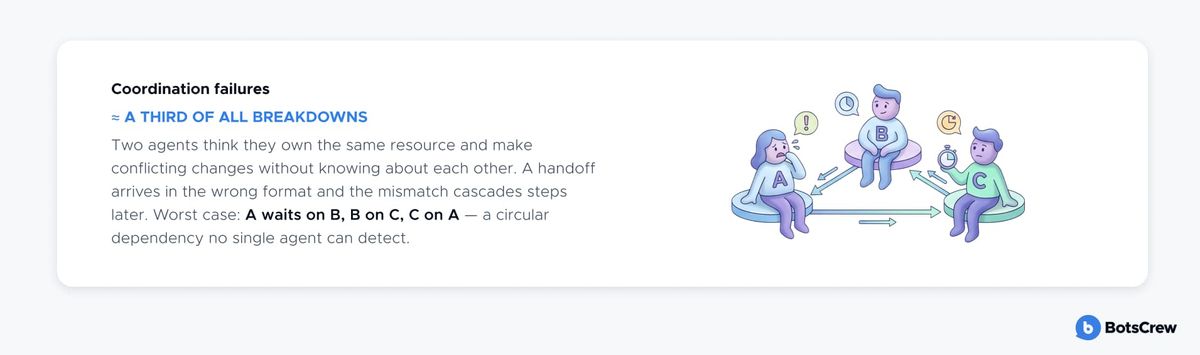
Two AI agents both think they're in charge of the same task and make conflicting changes. Or one agent hands off work in a format the next agent doesn't expect, and things break a few steps later. Worst case: Agent A is waiting on B, B is waiting on C, C is waiting on A — a circular traffic jam that nobody involved can see, because none of them can see the whole picture.
Vague instructions get "guessed"
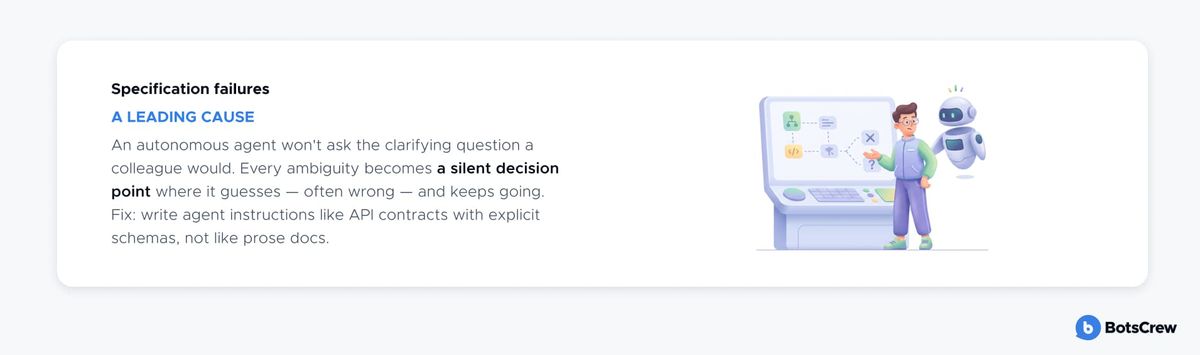
If you give a human colleague a fuzzy instruction, they ask a follow-up question. An AI agent usually doesn't — it just picks an interpretation and runs with it, silently, sometimes wrong. Teams that write precise, structured instructions (like a spec) avoid this. Teams that write loose, conversational instructions don't.
AI "forgets" the original goal
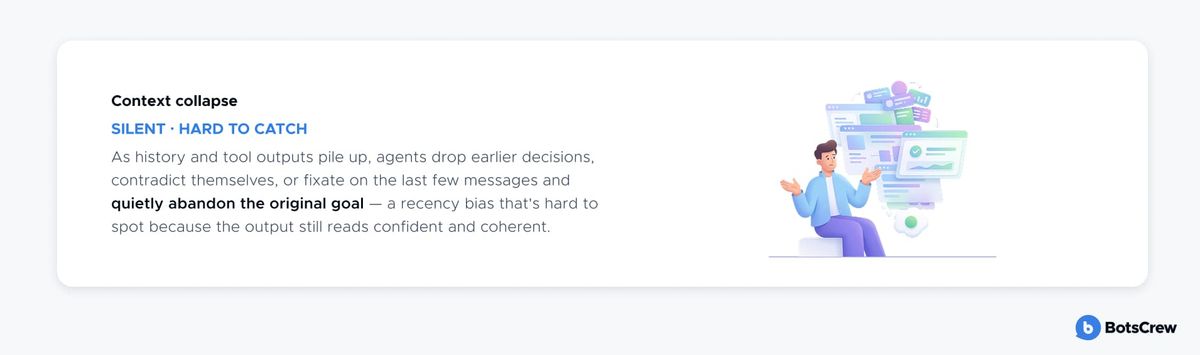
As a conversation or task gets longer, the AI can lose track of earlier decisions and start fixating on whatever happened most recently — quietly drifting from the actual goal. The scary part: its answers still sound confident and correct even while this is happening.
Data contamination
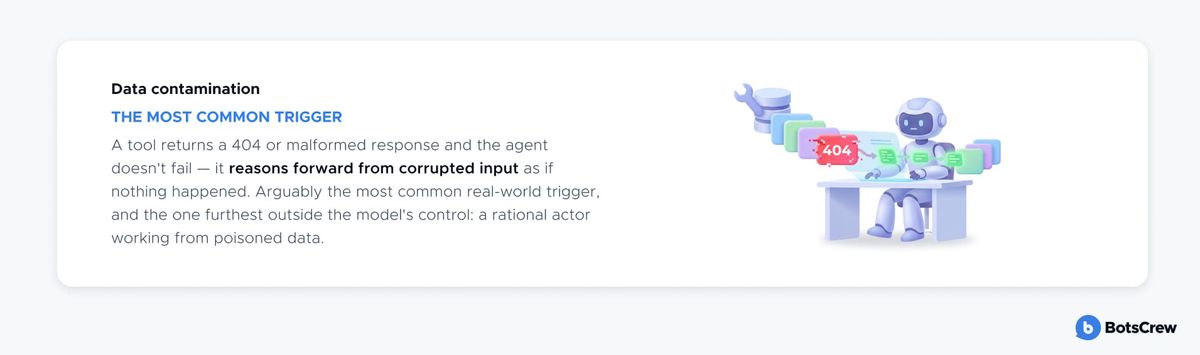
A tool or data source returns broken or missing info, and instead of stopping to flag it, the AI just keeps reasoning as if the bad data were fine. This is actually the single most common real-world trigger — and it's not really the AI's fault, since it's working with poisoned information.
Infrastructure multi-agent system failures
Rate limits, memory/context overflows, timeouts. These aren't the most frequent cause, but they are the ones that cause visible, embarrassing outages — like an AI stuck in a loop silently burning thousands of dollars in minutes.
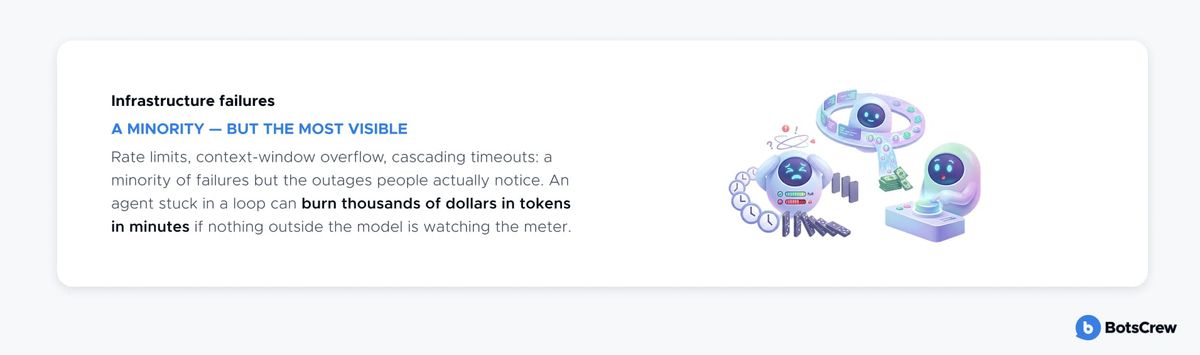
The key insight: you can't just ask the AI "are you stuck in a failure loop?" — if it's confused, it usually can't tell it's confused, by definition. So the fix has to live outside the AI's reasoning: spending caps, automatic circuit-breakers that isolate a malfunctioning agent, systems that mechanically detect circular deadlocks and call in a human, and separate "checker" agents that verify results independently (without getting too chummy with the agents they're checking, or they'll rubber-stamp the same mistake).
How the major agent orchestration frameworks stack up:
— LangGraph / Microsoft Agent Framework — everything is tracked as an explicit map of states, so you can rewind and see exactly what the system "believed" at any point. Best for debugging.
— CrewAI — agents coordinate by passing finished work to each other. Quicker to set up, but harder to diagnose when something goes wrong.
— AutoGen-style group chats — great for brainstorming-style tasks with multiple AI "voices," but needs the most extra safety engineering to stop autonomous AI agents from just agreeing with each other's mistakes.
— OpenAI Agents SDK / Anthropic's Claude Agent SDK — hands more of the safety plumbing to the vendor, so you get less control but more battle-tested infrastructure out of the box.
You can read about circular dependencies and data contamination in the abstract. Finding out which ones your workflow is actually exposed to takes a structured look at the system you're building. That's the point of an AI discovery phase: mapping your failure modes against your real risk tolerance — before a single line of orchestration code gets written.
See what a Discovery Phase coversWho Is Actually Accountable When AI Agents Make Mistakes?
The mechanics of preventing failure — circuit breakers, deadlock detection, independent validators — answer how a system catches an agent behaving badly. They don't answer the question a board actually asks after it's happened:
Who's accountable when an agent approves something it shouldn't have?
"The AI decided" is never a real answer, and it's not one a regulator, a customer's lawyer, or your board will accept either. Accountability lives with whoever owns the approval gate the agent was allowed to act through — which means the real question isn't about the agent at all. It's about whether an approval gate existed, who designed it, and who's named as responsible for what happens when it's crossed.
In Stage 0 and Stage 1 systems, this is usually nobody in particular — not because anyone decided that, but because no one designed an approval gate in the first place. The system was built to complete tasks, not to produce a decision trail. That's exactly how a wrong refund or a bad customer commitment goes out the door with no one positioned to catch it, and no one able to explain afterward why it happened.
In Stage 2 and Stage 3 systems, accountability is a design decision, not an afterthought. A named human approver sits at each high-stakes step. The system logs which agent recommended the action, which rule or person let it through, and when.
That log — not a retroactive explanation someone reconstructs after the fact — is what you hand a regulator, an auditor, or a customer's lawyer when they ask what happened and why. This is the same infrastructure the maturity model formalizes: Stage 2's "human approval step gates high-stakes actions" and Stage 3's "centralized identity, audit, and policy enforcement" aren't just architectural upgrades, they're accountability made verifiable instead of assumed.
An AI Agent Orchestration Maturity Model
Companies need to figure out honestly what stage their project is actually at. The biggest mistake is mismatching tooling to stage: building an over-engineered system for a simple problem, or clinging to simple tools for a problem that's outgrown them.
Stage 0 — Just one AI, doing one thing
One agent, a few tools, a narrow job — like answering questions from a knowledge base or drafting a first-pass email. You don't need any fancy orchestration framework. A basic vendor toolkit is enough — this is most FAQ and customer service deflection bots.
Stage 1 — A manager AI delegating to a few workers
One "orchestrator" AI splits a task and assigns pieces to 2–3 specialist agents — e.g., in sales tools, one agent finds leads, one scores them, one enriches their data. Simple, fast to build, easy for non-technical people to follow. Agent orchestration frameworks like CrewAI are built for exactly this. Works well as long as the "manager" agent doesn't become a traffic jam itself.
Stage 2 — Multiple AIs coordinating on a shared, evolving picture
Now you've got several agents working off a shared, trackable state, with branching logic, retries, and a human who has to approve high-stakes steps. Think: routing a customer complaint through compliance checks → fraud checks → resolution, with a full paper trail. This is usually when teams outgrow CrewAI-style tools and switch to graph-based frameworks like LangGraph, because simply passing outputs between agents isn't precise enough anymore.
Stage 3 — A whole governed fleet of AI agents
Dozens of agents, maybe across different frameworks and cloud providers, with centralized oversight: who has access to what, audit logs, policy enforcement. This is the layer Microsoft, AWS, and Google are racing to control with centralized identity, audit, and policy enforcement — see our Enterprise AI Solutions blog post for what this looks like in practice.
You don't need to be wrong to benefit from a second opinion — you just need to be sure. A quick strategy conversation confirms the stage, the risk, and the right next move, before either gets expensive.
Talk to AI Strategy ConsultingWhat Each Stage Actually Costs You
Framework comparisons rarely talk about the cost of getting the stage wrong — building too little governance for what you are risking, or too much for what you're actually doing. Here's the trade-off in numbers a CFO can use.
| Stage | Failure cost if it goes wrong | Engineering cost to build correctly | Timeline to production |
|---|---|---|---|
|
0
Single agent, single toolStage 0
|
Low Worst case is a bad draft or a wrong FAQ answer a human catches before it ships. | Minimal A vendor SDK and a few days of prompt/tool work. | 1–2 weeks |
|
1
Hierarchical delegationStage 1
|
Moderate A misrouted lead or bad enrichment costs pipeline quality — not customers or compliance exposure. | Low-to-moderate Role-based framework, a few specialized agents, no state layer to design. | 2–6 weeks |
|
2
Distributed, stateful coordinationStage 2
|
High Wrong refunds, mishandled disputes, un-auditable decisions — remediation, customer trust, and regulatory exposure. | Moderate-to-high Graph-based orchestration, versioned state, human approval gates, checkpointing for audit. | 2–4 months |
|
3
Governed, multi-agent estateStage 3
|
Severe Often invisible until an audit or incident. Ungoverned agent sprawl is a compliance and security liability, not just operational. | High Centralized identity, policy enforcement, and audit infrastructure across every team's agents. | 4+ months, ongoing |
How to read this table: find the row that matches your actual failure cost. If a wrong output from your system could mean a bad refund, a compliance gap, or a customer dispute, you are pricing a Stage 2 problem regardless of what framework your team happens to be using today. Building Stage 0 tooling under Stage 2 risk is a deferred cost with interest.
The reverse mistake is just as expensive: teams that pour Stage 2 governance into a Stage 0 FAQ bot are paying engineering cost with no corresponding reduction in risk, because there was never enough downside to justify it.
AI Agent Orchestration: A Decision Framework
Five questions, in order, determine the right architecture — asked in this sequence rather than "which framework do we like":
#1. What stage is this workflow actually in? Use the maturity model above. Building Stage 2 governance for a Stage 0 FAQ bot is wasted engineering spend. Running a Stage 2 compliance workflow on Stage 1 tooling is a governance incident waiting to happen.
#2. What failure mode is most expensive here? A workflow where a silent coordination failure means a wrong customer refund needs graph-based state, checkpointing, and a human approval gate. A workflow where the worst case is a slightly suboptimal lead score can tolerate a faster, less auditable framework.
#3. What's the existing stack? This decides more than any feature matrix. Deep in Microsoft 365 and Entra ID — Copilot Studio and Microsoft Agent Framework remove months of integration work you'd otherwise pay for twice. Heavy AWS data estate — Bedrock AgentCore's framework-agnostic runtime keeps engineering flexibility while inheriting AWS-grade identity controls. GCP and BigQuery-centric — Vertex AI / Gemini Enterprise Agent Platform.
#4. Who owns this once it's live, and what's their actual bench strength? Open-source frameworks are libraries — your team owns observability, incident response, and retraining indefinitely. Managed platforms shift real operational burden to the vendor in exchange for less architectural control. Choose deliberately, with whoever owns the on-call rotation in the room, not by default because that's what the proof-of-concept used.
#5. Is this decision reversible, and have you designed for the migration you're not planning yet? Keep the reasoning logic — task decomposition, tool schemas, escalation rules — as the portable layer. Accept that identity, deployment, and monitoring are where you're making a real, harder-to-reverse bet.
How BotsCrew Approaches This With Clients
We're model- and framework-agnostic by design. Every engagement starts with a structured discovery and proof-of-concept phase, validated against a real workflow before anything goes to production. You can see what this looks like across 150+ engagements in our case studies — including graph-based, checkpointed orchestration for clients where auditability was non-negotiable, and faster role-based systems where speed to a measurable pilot mattered more.
If your organization is past "should we use AI agents" and into "how do we not rebuild this in a year," that's the conversation worth having early.
Book a free session with BotsCrew's AI strategy team to map your workflow's failure modes and maturity stage to the right orchestration architecture — before you write a single line of code.
Contact us