System One Model vs System Two: Why Your AI Strategy Needs Both
Your AI pilot impressed everyone in week one. So why is nobody using it in month three? A longread for leaders deciding where AI belongs in their business and choosing between system one model vs system two.

Key takeaways:
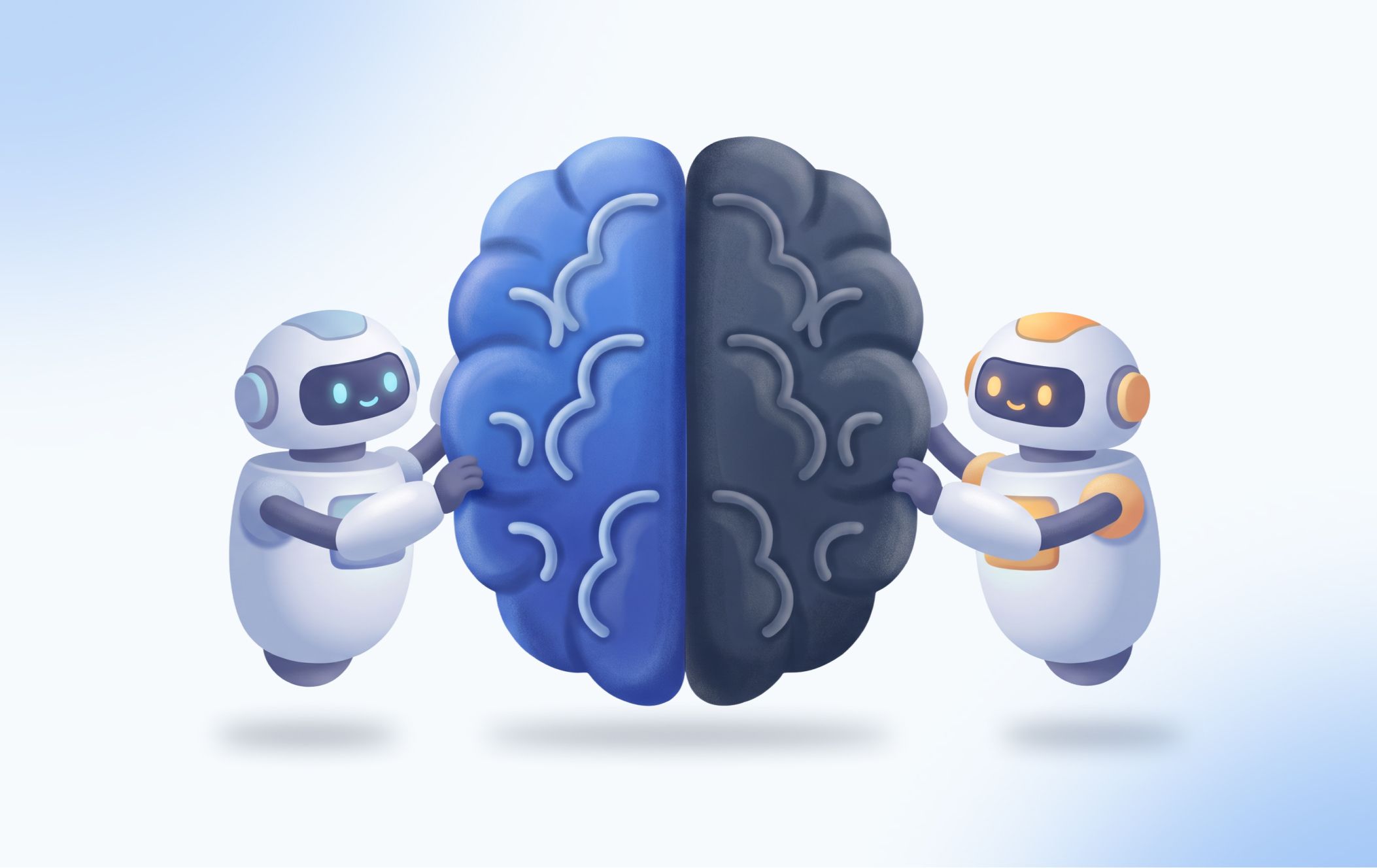
- System 1 is fast, intuitive, and pattern-based. System 2 is slow, deliberate, and rule-based. Both are essential.
- Language models behave like a very capable System 1. Production-grade reliability comes from the System 2 architecture built around them: retrieval, validation, tools, human review, and audit trails.
- A new class of System One models handles narrow, repetitive jobs faster and cheaper than a full LLM: decision models such as the OpenAI Decisions API pick from options you define, and extraction models such as Cloudflare's Clairic return typed values.
In week one, an LLM connected to a handful of documents answers questions fluently and confidently, and the room is impressed. Three months later, the pilot has gone quiet: it still answers 80% of questions well but invents the other 20% with the same confidence, slows down on messy data, and can't explain why it said what it said. The people it was built for drift back to their spreadsheets.
Daniel Kahneman's distinction between System 1 and System 2 thinking, popularized in Thinking, Fast and Slow, explains why. Your AI pilot dazzled you because of System 1. It stalled because the business needed System 2. This article explains the two systems: system one model and system two, shows how they play out in AI projects, and gives you a practical way to design AI that uses both on purpose.
System 1 and System 2 in two minutes
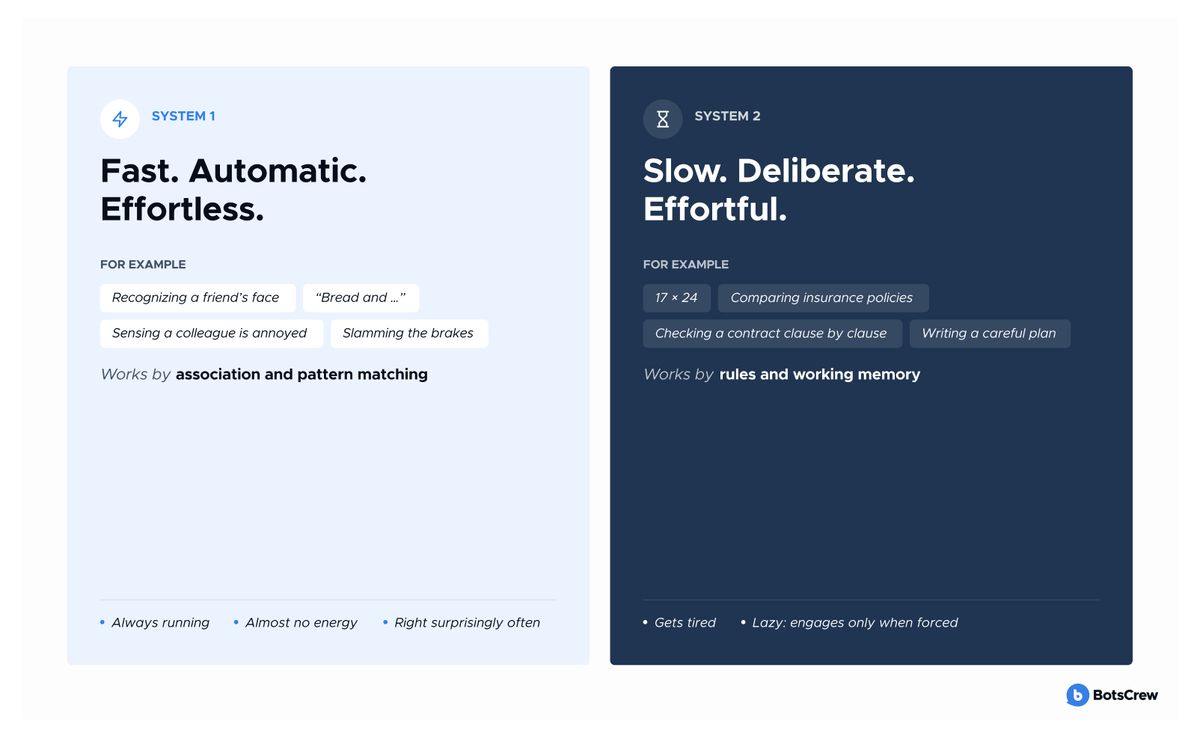
Psychologists Keith Stanovich and Richard West coined the terms System 1 and System 2 around 2000, but Kahneman turned them into household names with Thinking, Fast and Slow.
System 1 never clocks out, constantly churning out impressions and instant answers. System 1's fatal flaw is that it's a brilliant storyteller with zero interest in fact-checking. It weaves the most convincing tale it can from whatever's lying around and never asks what's missing. Kahneman summed this up as "what you see is all there is." That's the source of many of our favorite mental glitches: we judge how common something is by how quickly an example springs to mind, we let stereotypes trump the actual odds, we get hooked by random "anchor" numbers, and we start believing things simply because we've heard them enough times.
System 2 is supposed to fact-check the answers, but it's lazy and usually just signs off. The good news is that skills migrate from System 2 to System 1 with practice. For a professional angle, a junior accountant has to work through a balance sheet line by line, while a veteran can glance at it and immediately sense that something is off.
Your company has both systems too
Organizational System 1 is the accumulated, often unwritten knowledge: the account manager who knows which client will balk at a price, the support agent who recognizes a fraud pattern, the engineer who "has a feeling" about a supplier. It is fast and valuable, and it lives in people's heads.
Organizational System 2 is the structured machinery: approval workflows, compliance checks, audits, reconciliations, quality control, documented procedures. It is slow and expensive, but it is what catches expensive mistakes.
Most operational pain comes from a mismatch. Teams spend precious System 2 effort on work that should be routine, such as copying data between systems, triaging tickets, or drafting the hundredth near-identical document. Meanwhile, genuinely high-stakes decisions are made on gut feeling because nobody has time for proper analysis.
This is where AI becomes interesting, because it can serve both sides, if you are clear about which one you are building.
Find the processes where AI
can take over the routine, and the ones where it should back up your experts.
Start with a free use-case reviewAI through the two-system lens
A language model is not a human mind, and it has no consciousness or intuition. But as a way to reason about behavior, the comparison is useful. A plain language model behaves a lot like System 1. It generates the most plausible continuation almost instantly, based on patterns absorbed during training. It is astonishingly good at tasks that rely on pattern recognition: summarizing, classifying, rewriting, translating, extracting information from messy text, and conversing naturally. And like human System 1, it can produce a confident answer when it has no grounding. In AI, we call this hallucination. In Kahneman's terms, it is a coherent story built from what is available.
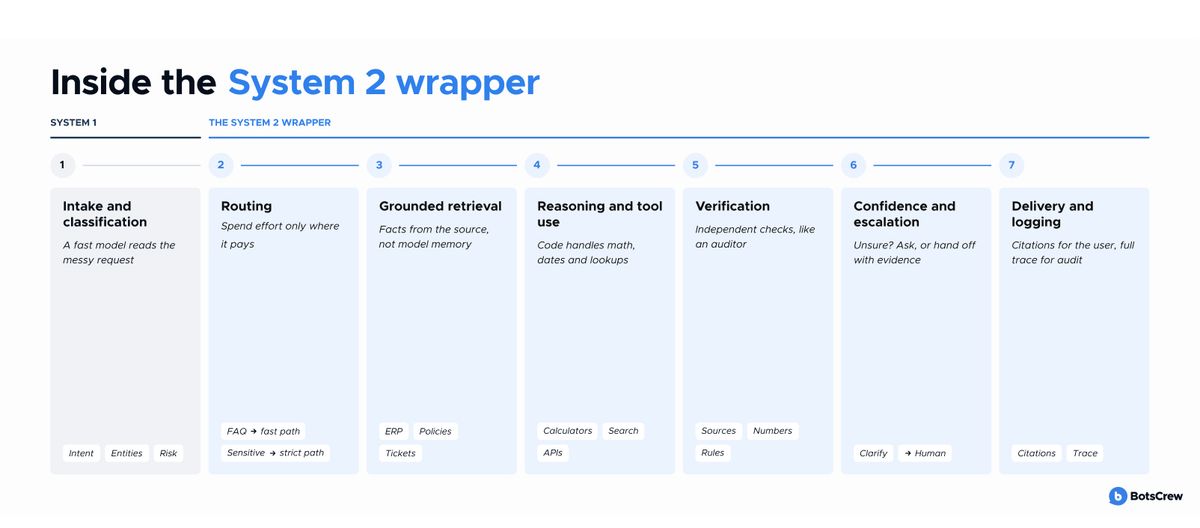
System 2 behavior comes from the system around the model. Newer reasoning models spend extra computation working through a problem step by step. But in enterprise settings, much of the "slow thinking" lives in architecture rather than in the model alone:
- Retrieval: pulling the right facts from your actual systems (ERP, CRM, knowledge bases) instead of relying on the model's memory.
- Planning and decomposition: breaking a task into steps and executing them in order.
- Tool use: calling calculators, databases, and APIs for things a model should not guess.
- Validation layers: checking outputs against business rules, schemas, and source documents before anything reaches a user or a system of record.
- Human review: routing uncertain or high-impact cases to a person.
- Logging and audit trails: making every answer traceable after the fact.
In short, a language model on its own is like System 1: quick, articulate, and occasionally wrong without realizing it. A well-built AI agent adds the System 2 part, surrounding the model with steps that check, verify, and escalate before an answer is used. That extra layer is what separates an impressive demo from a system you can actually rely on in day-to-day business.
A real example: when System 1 hit the wall
S&B Filters, a manufacturer, shows what this looks like in practice. Their team connected Claude directly to NetSuite through an MCP connector. It was a fast, impressive prototype, the kind of quick win that relies on the model's System 1 strengths. But once it met real work, the prompt had grown to 40 pages, responses took six minutes, and the company's data was too inconsistent for the model to pull reliable answers from it. The project never made it to production.
BotsCrew rebuilt the solution by adding the System 2 layer that was missing. Instead of cramming everything into one giant prompt, the new design pulled data straight from the ERP, checked purchase orders through several validation layers, streamed responses so users saw results right away, and connected a knowledge base through OneDrive. The model kept doing what it's best at: understanding requests and responding clearly. Everything that needed to be precise and verifiable was handed to components built for exactly that. First responses became 98% faster, the company saved $140k a year, and up to 50% of requests are now fully automated.
The opposite side: when System 1 is exactly what you need
Not every AI use case needs layers of retrieval, validation, and review. Picture a mid-sized online retailer whose support inbox gets around 500 emails a day. Two people spend most of their morning just sorting them before anyone can actually help a customer.
Every incoming email has to be categorized as a late delivery, return request, billing question, damaged item, or product question. Urgent cases need to be flagged so they can jump the queue, like a customer who was charged twice or someone who needs an order to arrive before a wedding. Finally, each ticket is routed to the right team with a short summary, so the person picking it up knows what's going on without rereading the whole thread.
Why it's System 1 territory:
✅️️️️️️️ It is pure pattern recognition. Understanding what someone is asking and sensing frustration in their tone is exactly what language models do best.
✅️️️️️️️ The setup is simple. A short prompt with the category list, a few sample emails, and instructions to return a topic tag, an urgency level, and a one-sentence summary, such as "Customer received the wrong size jacket and wants an exchange before Friday."
✅️️️️️️️ No heavy infrastructure. There's no ERP connection, no multi-step workflow, and no 40-page prompt.
✅️️️️️️️ It's fast. The model turns a rambling, typo-filled email into a clean label in a couple of seconds, so work that took half a day is done before the team finishes their first coffee.
Errors here are easy to spot and cheap to fix. The model might tag a refund question as billing or miss the sarcasm in a polite-sounding message, but the agent opens the full email anyway and corrects the tag in a second. Nothing irreversible happens along the way: no money moves, no records change, and customers never see the model's output directly.
Your prototype shines in demos but struggles with real data?
We know how to fix that.
Book a Free 30-Minute CallSystem One models: New tools for the fast lane
System One models are small, specialized models that answer a narrow question in one fast pass: they return a choice or a typed value instead of generated text. Each System One model does one job, so for that job it is faster and cheaper than a general-purpose LLM.
Over the past few weeks, several companies have released small, specialized models built to do System 1 work, and some vendors now literally call them "System One models."
Decision models came first. According to Cloudflare, the "System One model" idea was introduced by a company called TypeSafe alongside a model named Jev, and both Jev and Cloudflare's Clef take an input and a list of possible answers, then return a probability for each option. OpenAI followed with the OpenAI Decisions API, a dedicated endpoint that returns structured evaluations such as choices and scores instead of generated prose. In practice, you hand the model a customer email and ask whether it's a complaint, a question, or an order. The answer comes back as "complaint, 92% confidence."
What is the OpenAI Decisions API?
The OpenAI Decisions API is a dedicated endpoint, announced at OpenAI DevDay on September 29, 2026, that answers questions you define with answers from a fixed list instead of returning free text. It runs on GPT-6 Luna, OpenAI's general text model, rather than on a separately trained decision model, and it launched in limited preview for selected API customers.
Then Cloudflare added the missing piece. On October 19, 2026, it released a preview of Clairic, which it describes as the first model in a new class of System One extraction models. Clairic pulls specific values out of text or images in a format you define. Give it an invoice and ask for the total, the payment date, and the number of pallets, and it returns exactly those three fields. It can also handle simple calculations, like how many days late a delivery was. And when the information simply isn't there, it says so: a field the input doesn't determine comes back as null rather than as a fabricated value.
How do the first System One models compare?
All four return a choice or a value rather than prose. The difference is what they return and how mature they are.
| Model | Vendor | Type | What it returns |
|---|---|---|---|
| Jev | TypeSafe | Decision model | A probability for each answer in a list you supply |
| Clef | Cloudflare | Decision model | A probability for each answer in a list you supply |
| OpenAI Decisions API | OpenAI | Decision interface on GPT-6 Luna | One answer per question from a fixed list you define |
| Clairic | Cloudflare | Extraction model | Typed values (numbers, dates, text spans, forecasts), or null when the input doesn't contain the value |
Why does this matter? Nowadays, many companies often use large, expensive LLMs for small, repetitive jobs like sorting requests or pulling data from documents. That's like hiring a top consultant to sort the mail. The new approach splits the work into an assembly line:
→ An extraction model pulls out the facts.
→ A decision model, such as Clef or the OpenAI Decisions API, picks the right path from options you define.
→ An LLM writes a human-sounding reply, but only where one is actually needed.
In Cloudflare's insurance-claim demo, Clairic extracts the facts, Clef approves or rejects the claim, and an LLM writes the reply. The whole pipeline took 19.3 seconds versus 61.7 for an LLM-only version, and almost all of that time went to writing the reply. The fast models read and decide, leaving the big model to do the one job it's truly needed for.
A word of caution: as of November 2026, all of this is brand new. Clairic is still in preview, and Cloudflare itself admits that multi-step arithmetic isn't strong yet and forecasting is basic. The company also notes that the model's answers are guaranteed to be well formed (not to be right), and recommends using confidence scores to decide what to automate and what to route for review. Most of the speed and accuracy figures so far come from the vendors themselves. So treat this as a trend worth watching rather than a proven standard, and test it on your data before swapping out anything that already works.
A practical framework: match the thinking to the stakes
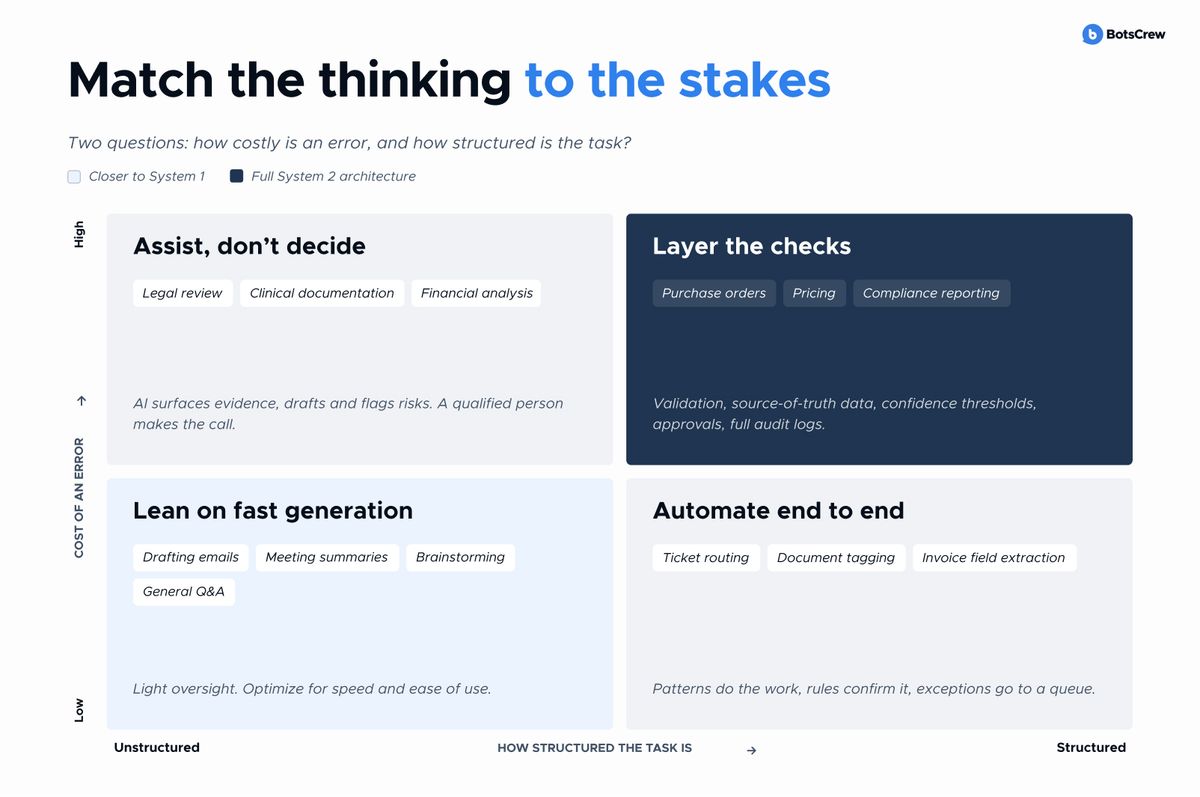
When we help organizations decide how to build an AI use case, we find it useful to ask two questions: how costly is an error? and how structured is the task? The answers suggest where on the System 1 / System 2 spectrum the solution should sit.
⚡ Low stakes, unstructured tasks: lean on fast generation. Drafting emails, summarizing meetings, brainstorming, first-pass content, general Q&A over public information. Light human oversight is enough. Optimize for speed and ease of use.
🤖 Low stakes, structured tasks: automate end to end. Routing tickets, tagging documents, extracting fields from invoices. Pattern recognition does the work, simple rules confirm it, and exceptions go to a queue. A System One model, such as a decision or extraction model, can often do this work faster and cheaper than a full LLM.
🧑⚖️ High stakes, unstructured tasks: assist, don’t decide. Legal review, clinical documentation, financial analysis. The AI surfaces evidence, drafts, and flags risks, while a qualified person makes the call. Retrieval with citations and visible sources is essential, so the human can check the reasoning.
🛡️ High stakes, structured tasks: layer the checks. Purchase orders, pricing, compliance reporting, anything that writes to a system of record. Use deterministic validation, source-of-truth data retrieval, confidence thresholds, approvals, and full audit logging. This is where System 2 architecture earns its keep.
Key 6 design principles for AI that thinks in both modes
#1. Ground answers in your data, not the model's memory. Retrieval from your systems of record turns a plausible answer into a verifiable one.
#2. Make the AI show its work. Citations, source links, and step-by-step traces let people engage their own System 2 when it matters, rather than trusting fluent text blindly.
#3. Build in uncertainty. A trustworthy system knows when to say "I'm not sure" and escalates.
#4. Separate generating from verifying. Let the model propose and let other components, such as rules, schemas, and second-pass checks, dispose. Independent verification catches errors that self-assessment misses.
#5. Measure on realistic data. Test against the messy, ambiguous, adversarial inputs your teams actually see, not only clean examples. Define success metrics before launch and track them after.
#6. Design for adoption. A tool that people do not trust or understand will not be used. Training, change management, and feedback loops are part of the system.
Measuring both systems
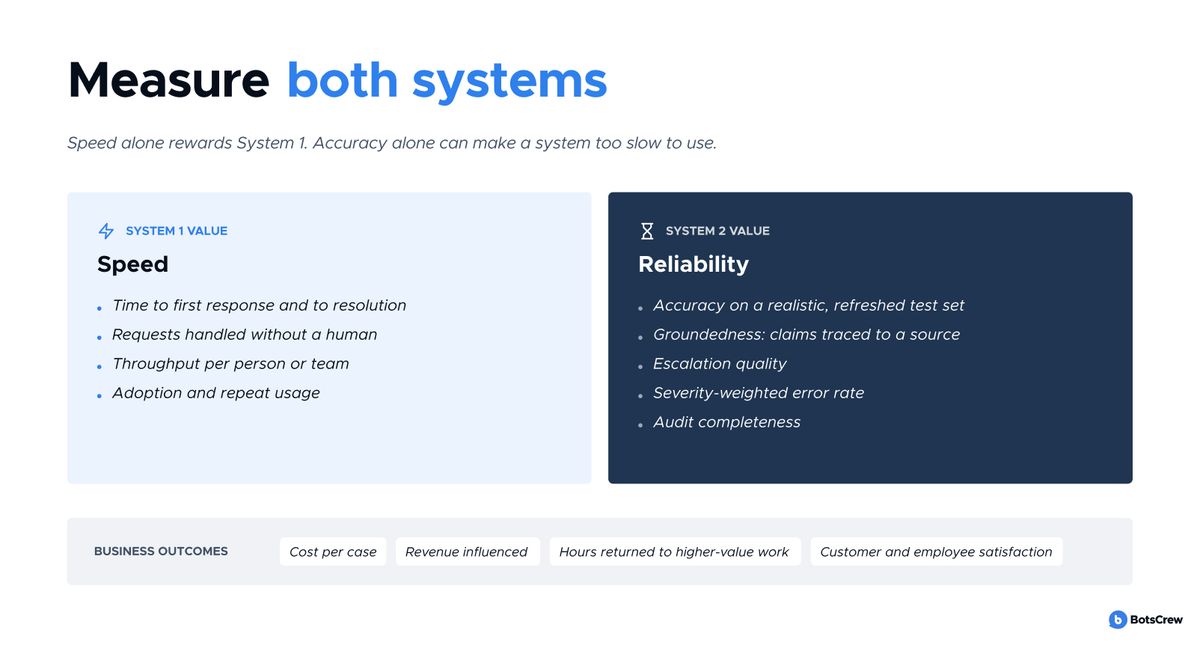
If you only measure speed and adoption, you reward System 1 behavior. If you only measure accuracy and compliance, you can end up with a system too slow to use. Healthy programs track both families of metrics and watch the trade-offs between them.
Speed-side metrics (System 1 value):
- Time to first response and time to resolution
- Share of requests handled without human involvement
- Throughput per person or per team
- User adoption and repeat usage
Reliability-side metrics (System 2 value):
- Task accuracy on a fixed, realistic test set, refreshed regularly
- Groundedness: the share of claims that trace to a cited source
- Escalation quality: how often escalated cases truly needed a human, and how often missed cases slipped through
- Severity-weighted error rate, because one wrong refund is not equal to one wrong greeting
- Audit completeness: whether any answer can be reconstructed after the fact
Business outcomes: cost per case, revenue influenced, hours returned to higher-value work, and customer or employee satisfaction.
Build the evaluation set from real, messy cases, including the awkward ones, before building the system. Also, keep a regression suite: every time a model, prompt, or data source changes, rerun it, so improvements in one area do not silently break another. Treat evaluation as ongoing operations.
A maturity path: from first pilot to AI-native operations
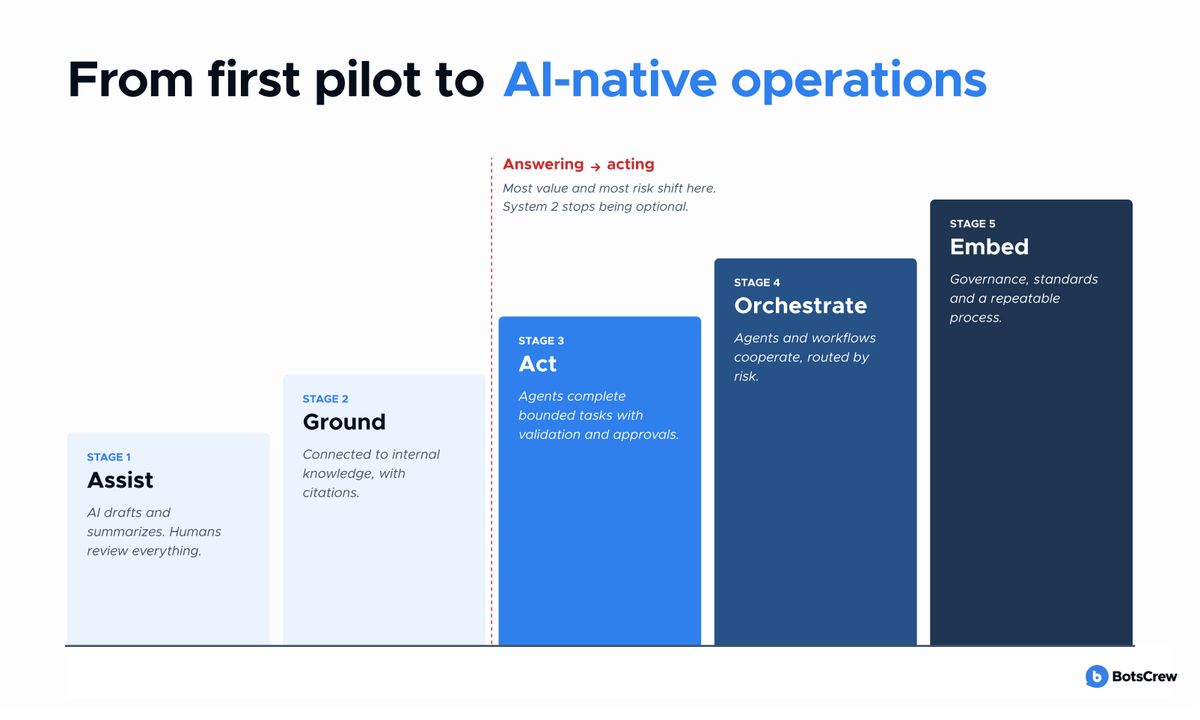
Organizations rarely jump straight to sophisticated, multi-agent systems, and they shouldn't. A staged path lets trust, data quality, and skills grow together.
Stage 1: Assist. AI drafts, summarizes, and answers questions for individual employees. Humans review everything. The goal is learning: which tasks benefit, what data is missing, how people react.
Stage 2: Ground. The assistant connects to internal knowledge and systems, with citations. Accuracy rises sharply, and teams begin to trust it for lookups and routine questions.
Stage 3: Act. Agents begin completing bounded tasks, such as updating records, preparing orders, or triaging tickets, with validation layers and approval steps. Audit trails and permissions become essential.
Stage 4: Orchestrate. Multiple agents and workflows cooperate across processes, with routing by risk and confidence. Humans manage exceptions and improve the system rather than performing the routine work.
Stage 5: Embed. AI capability becomes part of how the business is run: governance is routine, an internal center of excellence maintains standards, teams are trained, and new use cases are scored and shipped through a repeatable process.
Most value, and most risk, shifts between stages 2 and 3, the moment AI moves from answering to acting. That is where deliberate, System 2 engineering stops being optional. It is also where an experienced partner saves the most time, because the pitfalls are predictable and costly to discover alone.
What this means for choosing a partner
Good AI partners behave a bit like a well-run System 2 for your organization. They slow you down at the right moments: asking what the process looks like today, which data is actually reliable, who will use the system and why, what a wrong answer costs, and how success will be measured.
That is the logic behind the approach of BotsCrew, an enterprise AI consulting and implementation partner founded in 2016, with 200+ projects delivered. We start with readiness and use-case assessment, so you know what is worth building. We build production-grade agents with security, compliance, and auditability designed in from the first sprint, not retrofitted. We integrate into the systems you already run, such as CRM, ERP, and data pipelines. And we stay through adoption, because the test of an AI system is whether people use it six months later.
If you are weighing where AI fits in your business, a useful first conversation is not "what can the model do?" but "where does fast, fluent pattern matching create value, where do we need deliberate, verifiable process, and how do we build a system that knows the difference?"
FAQ
What is the difference between System 1 and System 2 thinking?
System 1 is fast, intuitive, and pattern-based; System 2 is slow, deliberate, and rule-based. Psychologists Keith Stanovich and Richard West coined the terms, and Daniel Kahneman popularized them in Thinking, Fast and Slow. System 1 produces instant answers without checking what's missing, and System 2 is supposed to verify them but often just signs off.
Are large language models System 1 or System 2?
On their own, large language models behave like System 1: they produce the most plausible answer instantly and can be confidently wrong. Reasoning models add some step-by-step thinking, but in business settings most System 2 behavior comes from the architecture around the model: retrieval, tool use, validation layers, human review, and audit trails.
What are System One models?
System One models are small, specialized models that answer a narrow question in one fast pass, returning a choice or a typed value instead of generated text. Decision models, such as TypeSafe's Jev, Cloudflare's Clef, and the OpenAI Decisions API, pick from options you define. Extraction models, such as Cloudflare's Clairic, pull typed values out of text or images.
What is the OpenAI Decisions API?
The OpenAI Decisions API is an endpoint that answers questions you define with answers from a fixed list, instead of generating free text. OpenAI announced it at DevDay on September 29, 2026. It runs on GPT-6 Luna, OpenAI's general text model, and launched in limited preview. It suits classification, routing, and choosing an agent's next step.
Ready to find out which of your processes
need fast thinking, which need slow thinking, and which should be left to humans?