9 Signs Your Company Needs an AI Center of Excellence
No clear ROI story? No full picture of AI spend? Here are the first signs you need an AI Center of Excellence (CoE).

💡In short: Enterprise AI keeps failing not because the technology is weak, but because no one owns it. When departments run their own pilots with no shared strategy, no defined success metrics, and no unified data or governance standards, companies end up with scattered experiments instead of real business value — and no way to prove ROI when leadership asks. An AI Center of Excellence fixes this by centralizing standards, ownership, and risk management, while still letting teams experiment and innovate at the business-unit level.
For CEOs, CFOs, and COOs, AI has become a matter of survival: will you outpace your competitors, or lose margin while others automate? And yet enterprise AI initiatives get launched all the time — only to fail. Why? Because every department pulls AI in its own direction, with no unified strategy, no shared priorities, and no single owner accountable for the outcome.
An AI Center of Excellence solves this problem: it brings scattered initiatives under one roof, sets clear prioritization criteria, and assigns ownership to specific people — so every AI project has an owner, a success metric, and a path to production.
In this article, we cover:
- The 9 signals that your company already needs an AI CoE — and the pain points behind them
- How to set up an AI center of excellence and how to avoid the common traps that turn a CoE into a bureaucratic bottleneck instead of a growth engine.
What is an AI center of excellence & Why an AI CoE matters
Artificial intelligence is no longer just a technology experiment or a side initiative owned by IT. It directly shapes how a company creates value, makes decisions, serves customers, manages costs, and competes in the market. That's exactly why organizations need an AI Center of Excellence (AI CoE).
An AI CoE doesn't have to be a large, standalone department. More often, it's a cross-functional governance model that brings together business, IT, data, cybersecurity, legal, risk management, and finance. Its job is to turn scattered AI experiments into a managed system — from selecting priority use cases to scaling solutions, controlling risk, and measuring results.
For the CEO, AI is tied to competitive positioning, the company's ability to respond quickly to change, and the pace of long-term growth. Without a centralized approach, an organization risks falling behind the market: competitors may automate processes faster, personalize customer interactions better, or use data more effectively.
An AI CoE helps the CEO answer the strategic questions that matter most: where will AI create the greatest value, which capabilities are business-critical, and where does the company need to act right now.
For the CFO, artificial intelligence is a question of potential savings and investment discipline. AI projects often carry hidden costs — licenses, cloud compute, data preparation, integrations, model maintenance, cybersecurity, and staff training.
An AI CoE establishes a consistent framework for evaluating business cases, helps calculate total cost of ownership (TCO), compares expected impact against actual results, and tracks ROI after launch. The end result: finance sees not a collection of flashy demos, but a real investment portfolio with clear assumptions, metrics, and accountable owners.
For the COO, AI is about speed, stability, and operational quality. Automating a single task doesn't automatically improve the entire process. If a model isn't integrated into the operational workflow, employees end up duplicating data entry, manually verifying results, or juggling multiple incompatible systems.
An AI CoE treats AI not as a standalone tool but as part of an end-to-end process — defining exactly where value is created, which actions stay with humans, how quality is controlled, and what happens when the model gets something wrong.
For the CIO and CTO, AI brings a whole set of architectural and technical challenges. Which models should the company use? Where should data be stored and processed? How does AI integrate with existing systems? How is access controlled, how are model versions tracked, and how do you avoid over-dependence on a single vendor?
Technical debt is a separate concern of its own: a prototype built quickly might perform fine on test data but prove unfit for scaling, auditing, or stable production use. An AI CoE establishes shared architectural standards, MLOps principles, and clear rules for moving from experiment to production.
For Legal, Compliance, and Risk, AI raises questions of privacy, explainability, auditability, and accountability for the system's decisions. It matters what data a model uses, whether the company has the right to process it, whether the algorithm produces discriminatory outcomes, and who is accountable for a decision made with AI's involvement. An AI CoE helps build these requirements into the solution's lifecycle from the start — rather than checking for them after the fact, once the system is already in use.
When every function looks at AI in isolation, the organization doesn't get transformation — it gets a pile of local optimizations. One department buys its own tool, another builds a separate chatbot, a third trains a model on unvetted data, and a fourth tries to figure out security on its own. These initiatives might deliver short-term wins, but they also create duplicated spending, incompatible approaches, fragmented data, and new risks.
An AI CoE creates a shared language for every stakeholder involved. Before launching any initiative, the organization should align on at least five questions:
| Question | What needs to be defined |
|---|---|
| What problem are we solving? | The specific business process, its constraints, and why AI is the right fit |
| How do we measure success? | Financial, operational, customer, and quality metrics, plus a baseline for comparison |
| What risks are we accepting? | Privacy, security, error, bias, regulatory, and reputational risks |
| Who owns the outcome? | The business process owner, technical owner, data owner, and oversight function |
| What's needed to scale? | Data, integrations, infrastructure, budget, skills, user support, and monitoring |
A generative AI center of excellence also enables reuse. A company can build shared model components, risk assessment templates, data preparation standards, a library of vetted vendors, and a common approach to monitoring. This shortens the time it takes to launch new initiatives and reduces the odds that every team ends up repeating the same mistakes.
At the same time, an AI CoE shouldn't turn into a bureaucratic bottleneck. Its role isn't to pull every decision away from the business and centralize it — it's to create the conditions for teams to experiment quickly and safely. The most effective model usually blends centralized standards, platform, and governance with a decentralized hunt for opportunities across business units.
Below are nine signals that most often indicate a company already needs this model.
1. Leadership has no clear ROI story and no full picture of AI spend
The AI budget is already allocated, several pilots are running, and teams regularly report on new capabilities. But when the CFO or the board asks about the financial impact, the answer often comes down to the number of experiments run, demos delivered, prompts tested, or active users.
AI activity is not the same as AI value. Pilot count reflects how innovative a company looks — it doesn't answer whether the company has actually become more profitable, faster, or more resilient.
At the C-level, AI needs to be treated as an investment portfolio with assumptions, risks, expected impact, and a clear decision at the end: scale, adjust, or shut down. If the company never established a baseline, a target metric, and an expected value-creation mechanism, there's no way to prove — once the pilot wraps — that any change in results is actually tied to AI.
A separate risk is not having the full cost picture. The real cost of a solution includes far more than a license or API usage — it also covers data preparation, integration, infrastructure, evaluation, security, support, training, human review, and the cost of errors.
Without provable ROI, AI investment gets treated as innovation spend. That makes budgets harder to defend, creates friction between the CFO and technical teams, and leaves strong solutions unscaled simply because the numbers behind them aren't trusted.
The financial impact can also be indirect: if AI cuts the time it takes to find information, that doesn't necessarily mean headcount reduction — a team might serve more customers without hiring, make decisions faster, or shift focus to higher-value work.
What the company should do
Before launching any use case, build a short value case. It should describe the problem, the business outcome owner, the baseline, the target metric, the expected financial impact, the total cost of ownership, and the criteria for moving the pilot into production.
Leadership should have visibility into a single AI cost-and-value dashboard showing spend, the stage of each use case, projected impact, actual results, and the decision on further investment.
What leadership should be checking
The right question isn't "how many AI projects have we launched?" It's: "What result is each project supposed to deliver, when will we see it, and what happens if that result doesn't materialize?"
2. AI initiatives are scattered across departments
Marketing is testing AI for personalization, support is piloting a chatbot, sales has a copilot, HR is trying a recruiting tool, and finance is automating reporting. Each team may be acting rationally within its own context, but at the company level, this creates duplication, incompatible approaches, and no shared priorities.
Decentralization can speed up the first round of experiments, but without shared standards, it quickly turns into fragmentation. One department builds a RAG solution, another buys a knowledge assistant, a third builds its own search layer. They're all solving a similar problem, but the company never gets a single reusable capability out of it.
AI also tends to cut across traditional functional boundaries. Customer data is needed by marketing, sales, and support alike, and the same knowledge layer could serve multiple departments. When ownership is defined only within a single department, disputes over access, priorities, and accountability follow.
What the company should do
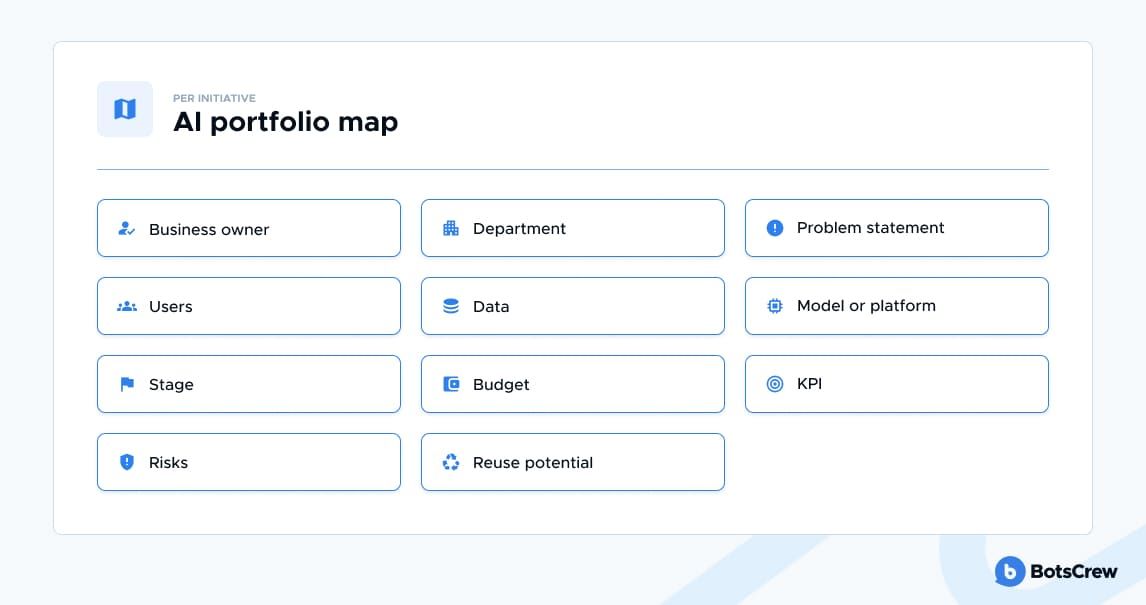
Build an AI portfolio map. For every initiative, capture the business owner, department, problem statement, users, data, model or platform, stage, budget, KPIs, risks, and reuse potential.
From there, establish a single intake process, a monthly review of active initiatives, a catalog of approved models and integrations, and clear criteria for when a local initiative should be elevated to the enterprise level. Standards, security, and transparency should be centralized — delivery should stay wherever the necessary domain expertise lives.
What leadership should be checking
Executive reviews shouldn't just show a list of projects — they should show a dependency map: which initiatives rely on the same data, where functionality is being duplicated, which capabilities could become a shared platform, and what should be shut down.
3. There's fear of falling behind competitors, but no AI roadmap
At the executive level, there's a general sense that the company needs to "do something" with AI. What's missing is clarity on which scenarios are actually strategic for its specific business model, which ones could deliver a quick win, and which require more mature data, process changes, or significant investment.
FOMO often masks the absence of real strategic choice. Leadership sees dozens of competitor case studies but has no way to tell which of them are actually relevant. A scenario that works well for a bank or an e-commerce company may deliver far less value in manufacturing, logistics, or B2B services.
An AI strategy shouldn't start with "which model should we use?" It should start with: where is the company losing money or speed, which decisions are made too slowly, where does repetitive manual work pile up, and which customer or operational bottlenecks are limiting growth?
Reactive decision-making sends a budget toward trendy but secondary scenarios. The company might end up with an impressive demo that doesn't move a single critical process. Meanwhile, a use case that looks unremarkable at first glance — automating internal knowledge flow, for example — can create far more value but never get funded.
What the company should do
Build a roadmap around the following horizons:
- Early KPIs
- Prototypes
- Risk controls
- Proof of value
- Workflow integration
- Active users
- Measurable operational impact
- An enterprise platform
- Reuse across teams
- New business models
To evaluate use cases, apply a scoring model across five dimensions: strategic value, financial impact, data readiness, integration complexity, and risk.
What leadership should be checking
The key question is: "What competitive advantage does this initiative create if it succeeds?" "Everyone else already has AI" isn't a good enough reason to invest.
BotsCrew can help you turn FOMO into a prioritized, scored AI roadmap.
Book a Free 30-Min Consultation4. There's budget, but no Definition of Success
"Launch AI" is not a business goal. Success has to be defined through concrete outcomes: lowering cost per ticket, cutting the time it takes to prepare a management report, speeding up time-to-resolution, increasing conversion, or driving adoption of an internal tool.
When there's no Definition of Success, different stakeholders end up with different expectations. The CEO may expect transformational impact, the CIO a stable MVP, the CFO cost savings, and the business user a smoother workflow. Everyone formally supports the project, but they're all judging it by different standards. As a result, the company can't shut down a weak initiative in time, reallocate budget, or prove the value of a solution that's actually working.
What the company should do
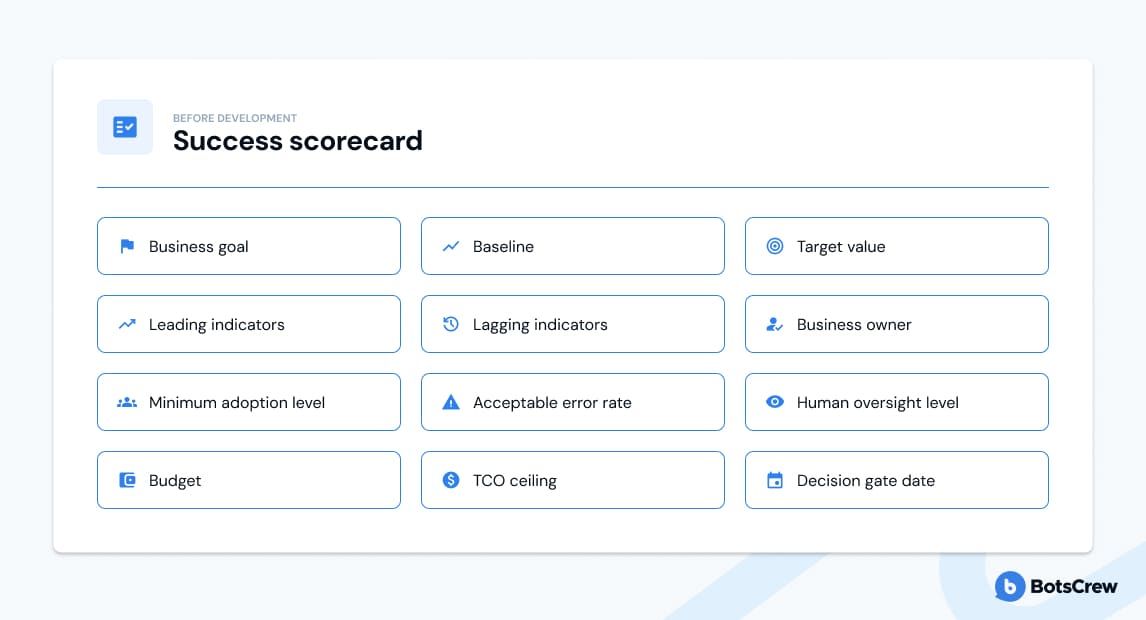
Before development starts, build a success scorecard that includes the business goal, baseline, target value, leading and lagging indicators, business owner, minimum adoption level, acceptable error rate, level of human oversight, budget, TCO ceiling, and decision-gate date.
Evaluate the solution on three levels: whether people are actually using it, whether the process has genuinely improved, and whether a financial or strategic impact has shown up.
What leadership should be checking
Every quarterly review should end in one of three decisions: scale, redesign, or stop. If a project can't be sorted into one of those three buckets, it's missing evaluation criteria.
5. Tool sprawl is driving up costs and technical debt
When different teams independently pick their own models, platforms, and SaaS tools, the result is a technology "zoo." It multiplies the number of contracts, complicates support, creates access-management headaches, and raises hard questions about where data is stored and who's accountable for how it's processed.
During the experimentation phase, some tool diversity is genuinely useful — teams compare approaches and quickly find what works. The problem starts when those experimental choices harden into permanent enterprise architecture without ever being reassessed for TCO, reliability, portability, or vendor dependency.
TCO and vendor lock-in both climb, and there's a real risk that scaling ends up costing more than the pilot itself. Different tools may also apply different rules around data handling, logging, retention, and whether information gets used to train models.
Build an enterprise AI reference architecture and a vendor scorecard. Score every tool on security, output quality, integration, latency, cost at scale, portability, support, observability, and policy compliance.
It helps to sort technologies into three tiers: approved core, controlled experimentation, and prohibited. A quarterly review should check license usage, functional duplication, changes in vendor terms, and the economics of scaling.
What leadership should be checking
The CFO and CTO should have visibility into an AI cost dashboard showing spend on models, infrastructure, licenses, support, and human review, broken out by use case.
6. The data isn't ready for AI at scale
A company can have plenty of AI ideas and still lack data that's high-quality, accessible, and well-governed enough to support them. Information sits scattered across different systems, in different formats, duplicated, full of errors, or with no clear owner.
At some point, the "AI problem" becomes a data-readiness problem. If teams are each separately cleaning data, negotiating access, defining sources of truth, and building their own integrations, the company doesn't yet have a shared foundation for scaling AI.
Data quality isn't just about accuracy. Timeliness, completeness, context, lineage, access rights, and update reliability all matter too. A technically strong model can still produce unreliable results if its sources are inconsistent or out of date.
The result: AI pilots produce inconsistent results, and every move to production requires significant manual rework. The company can't reuse data or knowledge components across initiatives, so the cost of each new project keeps climbing.
What the company should do
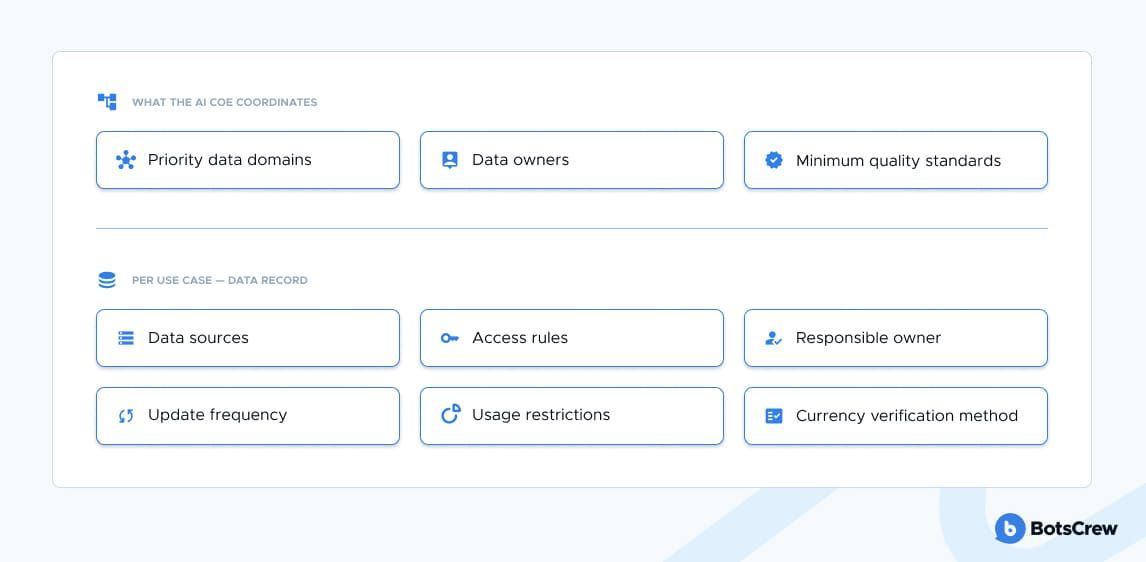
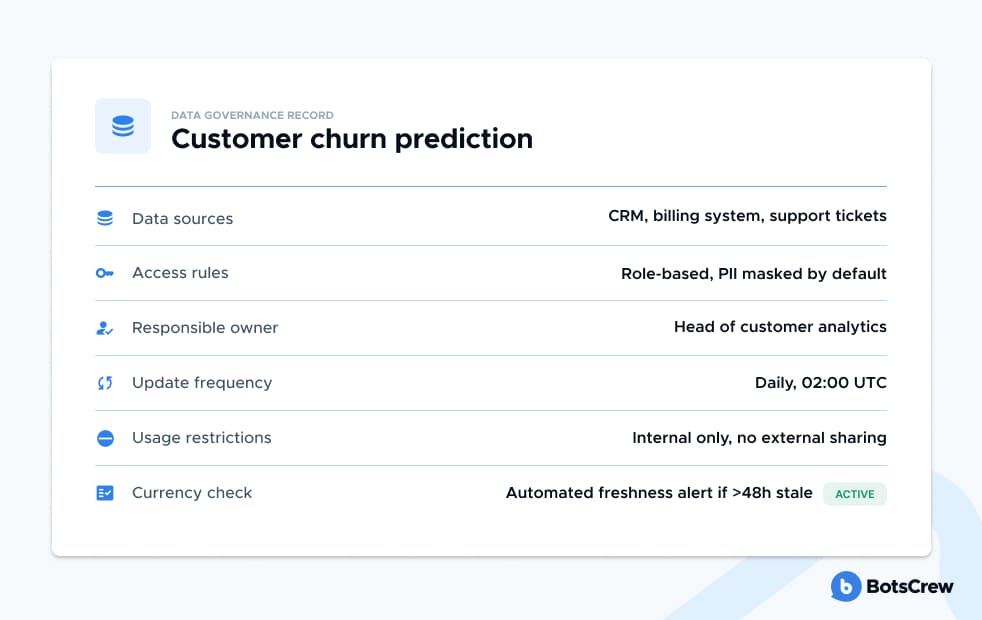
The AI CoE should coordinate the selection of priority data domains, data owners, and minimum quality standards. For every use case, document the data sources, access rules, the responsible owner, the update cadence, usage restrictions, and how currency is verified.
Example of a completed data governance record for a customer churn prediction use case, with real values across all six fields:
It's also worth investing in reusable data components: catalogs, knowledge bases, retrieval layers, classification rules, and standardized access-control mechanisms.
What leadership should be checking
The question to ask is: "Can we reuse this data across other scenarios, and who's accountable for its quality after launch?" If the answer depends on manual work from one specific team, the data foundation still isn't mature enough.
7. Shadow AI is creating uncontrolled data and compliance risk
When the official process for approving AI tools is too slow or too cumbersome, employees will find a faster way to work regardless. They may upload internal documents to unapproved services, use personal accounts, or connect AI to corporate data without proper vetting. Banning AI outright, with no viable alternative, almost never works.
The risk here isn't limited to a possible document leak. The company can lose track of where personal data is being processed, how long logs are retained, who has access to the outputs, and how to trace the origin of a decision during an audit.
What the company should do
Build a safe path to AI adoption: an approved corporate AI workspace, clear data classification, easy-to-follow usage rules, a fast-track risk review for common scenarios, a log of approved use cases, employee training, and an incident-reporting channel.
Governance should be risk-based. A low-risk internal search tool and an AI system that influences a credit decision or a medical recommendation cannot go through the same approval process.
What leadership should be checking
Track not just how often policies get bypassed, but why. If employees are routinely working around the rules, the fix isn't only policy — it's also the availability of approved tools that actually meet their needs.
8. AI solutions lack business context, and users don't trust them
Engineers can build a technically elegant solution that performs beautifully in the lab but never fits into users' actual workflow. At the same time, even an accurate, secure tool creates no value if employees simply don't use it day to day.
AI projects often start from the technology: "let's use RAG," "let's build an agent," "let's integrate a model." But the business isn't buying a model or an agentic workflow — it's buying a faster process, lower cost, fewer errors, higher conversion, or a better customer experience.
AI adoption isn't a communications campaign that happens after launch — it's part of product design from day one. Employees will only use AI when they understand what problem the tool solves, trust its output, know the limits of what it can do, and aren't afraid of what happens if it gets something wrong.
When development optimizes for functionality instead of outcomes, the company ends up with a solution that technically works but never changes the workflow, the P&L, or the customer experience. Low adoption means the projected ROI never materializes — the old process keeps running in parallel, and a failed tool erodes trust in the next AI initiative.
What the company should do
Every team should start with workflow discovery: identify the user, the decision they're making, the most painful step in the process, the data available at that moment, edge cases, and the boundaries of human oversight.
Discovery should involve the process owner, a domain expert, finance, security, and end users. After launch, measure completed tasks, repeat usage, completion rate, time-to-complete, how much manual editing is still required, and user satisfaction — not just login counts.
What leadership should be checking
Distinguish adoption from engagement. User counts can grow while the tool is still only used once — in which case there's no real business impact.
BotsCrew runs workflow discovery with your end users so adoption is designed in from day one — not bolted on after launch.
Talk to us9. Governance gets pulled in too late
When Legal, Risk, and Compliance only learn about an AI project right before launch, they're forced to block it or scramble to rework it at the last minute.
Responsible AI can't be a final checklist item — it has to be a principle baked into the architecture and the process from the start. At the same time, governance shouldn't become a bureaucratic wall that strips the company of its speed.
A mature approach uses risk tiering: low-risk scenarios go through a lightweight review, while decisions that affect lending, employment, medical recommendations, pricing, or customer rights get deeper evaluation and ongoing oversight.
What the company should do
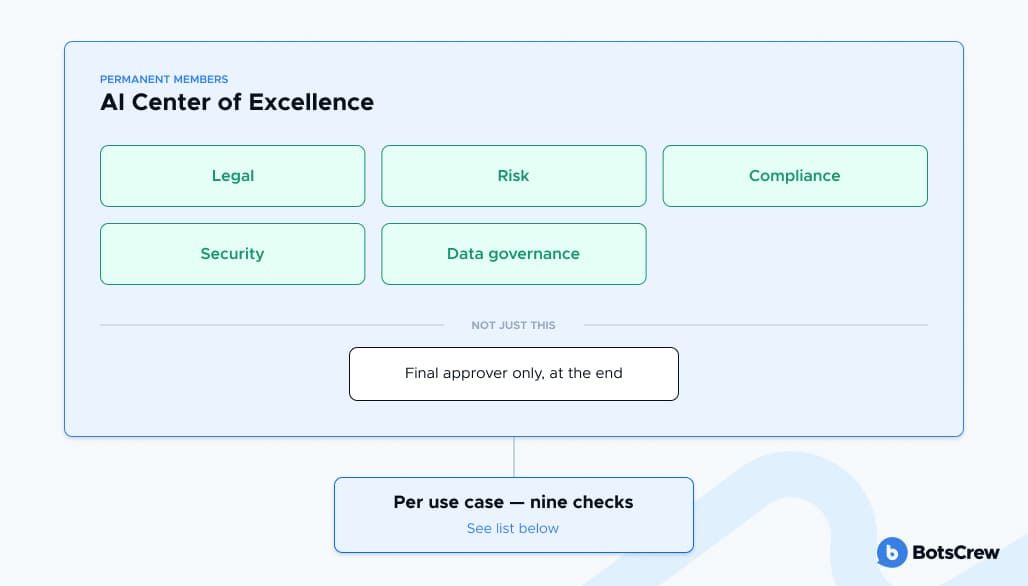
Bring Legal, Risk, Compliance, Security, and Data Governance into the AI CoE as permanent members — not just as final-stage approvers. For every use case, assess the data type, information owner, sensitivity level, the role AI plays in the decision, whether users need to be notified, logging requirements, human oversight, incident response, and the ability to contest an outcome.
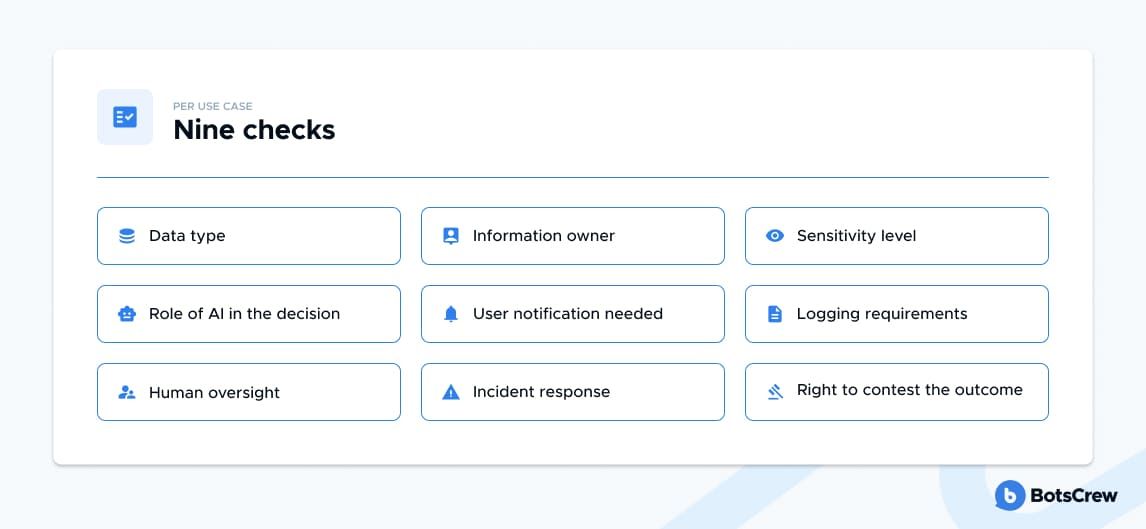
Build an AI risk register, an approval matrix, standardized assessment templates, and a fast track for common low-risk scenarios.
What leadership should be checking
The question shouldn't be "did Legal sign off on this project?" It should be: "Is this risk acceptable to the business, who owns it, and how will we find out if something goes wrong after launch?"
What Ties All Nine Pain Points Together
Across every scenario above, the same pattern shows up: the problem is rarely the technology itself. It emerges at the intersection of strategy, process, data, accountability, finance, and human behavior.
Click a symptom to reveal what's most likely missing.
Lots of pilots, few production solutions
A stage-gate process and production ownership
Lots of tools and contracts
Enterprise architecture and portfolio governance
High activity but unclear ROI
A baseline, a value case, and financial discipline
Employees bypassing policy
A fast, safe path to approved AI
Low usage of finished solutions
Change management and workflow integration
Blockers at the final stage
Risk-by-design and early Legal involvement
Technically strong but business-weak solutions
Shared discovery and business ownership
How BotsCrew Can Help
BotsCrew combines AI strategy consulting, discovery, enterprise AI development, and custom AI agent implementation. We've been building AI-powered solutions since 2016, working with global brands, delivering more than 150 projects, and developing more than 25 products using generative and agentic AI.
For C-level leaders, this matters in a practical way: most companies don't need another strategy deck. They need a partner who can connect boardroom decisions to production architecture, integrations, adoption, and measurable results.
BotsCrew can help run executive discovery workshops, assess AI readiness, validate use cases, calculate ROI, build a roadmap, develop prototypes and quick-win pilots, and manage the move from pilot to production and company-wide rollout. We handle customization for your workflows, integration with your existing technology stack, security, compliance, and ongoing improvement of your AI systems.
Our Discovery Phase carries particular value — a structured way to align on business goals, user scenarios, ROI, risks, architecture, budget, roadmap, and a first prototype before full-scale development begins.
Ready to Move from AI Experiments to a Real Strategy?
Book a call with BotsCrew to talk through your current AI initiatives, leadership priorities, and what an AI Center of Excellence operating model could look like for you: book a call.
If you're still shaping your vision or want to pressure-test a specific idea with no strings attached, book a free 30-minute consultation with BotsCrew's AI experts. We'll walk through your key pain points, evaluate potential use cases, and map out the first practical steps.