Top Automotive AI Companies: The Complete 2026 Guide
From ADAS chips processing sensor feeds at nanosecond speed to conversational agents closing car deals at 2 a.m., AI now touches every layer of the automotive value chain. This guide profiles automotive AI companies reshaping how dealerships and fleets operate.

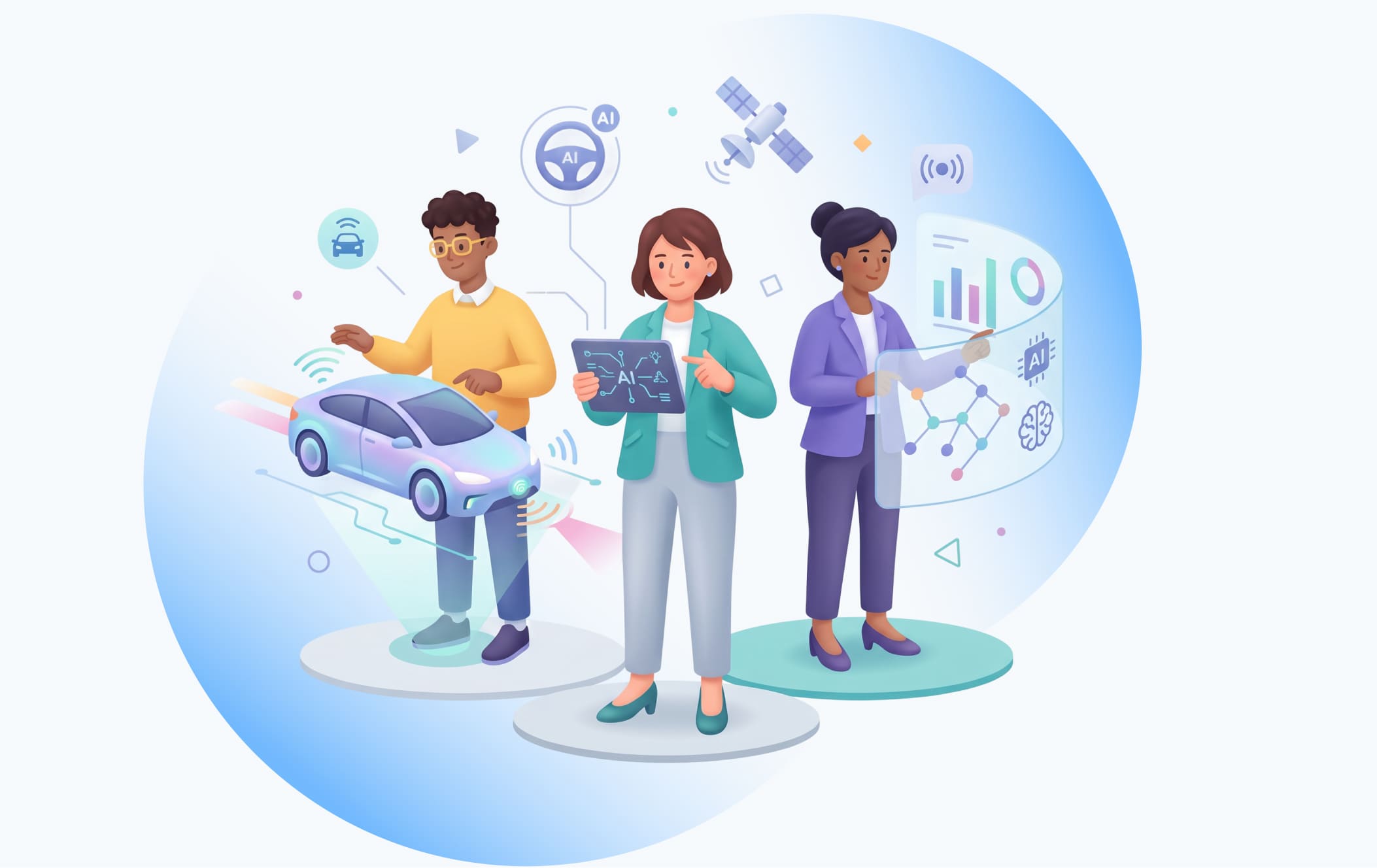
💡In short: Automotive AI in 2026 splits into three layers: vehicle intelligence (NVIDIA, Intellias), in-cabin voice (Cerence, SoundHound AI), and dealership operations (BotsCrew, Impel, Master of Code Global). Every company on this list has moved past proof-of-concept into production — real deployments, named clients, and stated compliance. This guide profiles all seven: what each is built for, where they differ, and what an experienced automotive AI partner changes in practice.
Why are automotive AI companies reshaping the industry right now? The global automotive AI market is projected to reach $38.45 billion by the end of 2030, driven by surging demand across three fronts:
1️⃣ vehicle intelligence (ADAS, autonomy, perception)
2️⃣ in-cabin experience (voice assistants, personalization)
3️⃣ business operations (dealership automation, predictive maintenance, supply chain).
Over 90% of U.S. dealerships now use chat or messaging tools to engage buyers online — a figure that was near zero a decade ago.
What changed? The convergence of a several forces: massive gains in compute power (NVIDIA's GPU architectures), the LLM revolution (GPT-4 and its successors enabling genuine reasoning in vehicles and chatbots alike), and the practical maturation of autonomous sensing (lidar, radar, and camera fusion at scale).
The result is an industry where the software stack is becoming as important as the powertrain — and where one of the right generative AI automotive companies can be a decisive competitive advantage.
List:
Automotive AI Companies That are Defining the Industry's AI in 2026
What every company on this list of top automotive AI companies has in common is that they have moved beyond the proof-of-concept stage. They are operating at production scale, with real customers, live deployments, and measurable results. In today's market, that filter matters far more than any pitch deck.
#1. BotsCrew: Enterprise AI for Dealerships and Automotive MaaS
Headquarters: USA, Ukraine (with global delivery)
Focus: Generative AI Development, AI Agent Development, Conversational AI Development, Custom AI solutions Development, AI Consulting, dealership automation, MaaS platforms
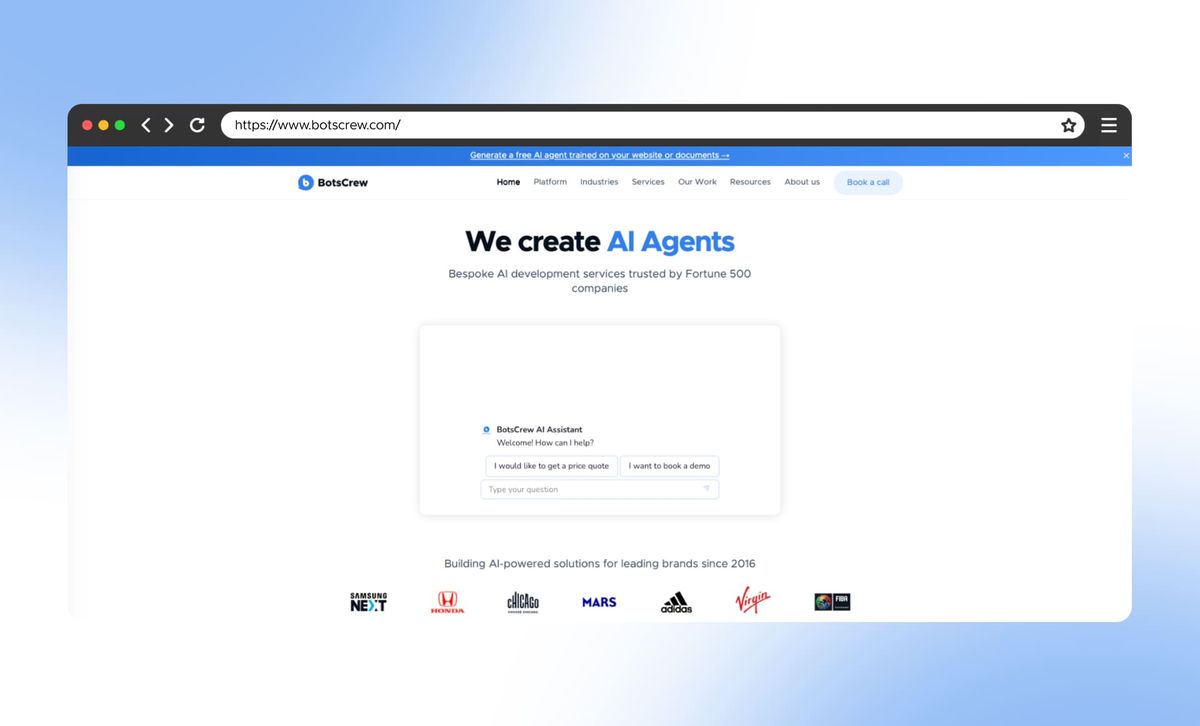
BotsCrew is an enterprise AI development company recognized as a Top AI Consulting Firm globally by Clutch in 2025–26, with over 200 AI solutions shipped worldwide and more than 10 years of AI development experience. In the automotive vertical, BotsCrew builds tailored conversational AI and agentic systems for car dealerships, automotive brands, and Mobility-as-a-Service providers — with GDPR compliance, SOC 2, and ISO 27001 for enterprise deployments.
BotsCrew's automotive work addresses the full customer lifecycle. The company's approach goes beyond chatbots: their team builds end-to-end agentic workflows that integrate with DMS (Dealer Management Systems), CRM platforms, and omnichannel messaging, creating seamless experiences from first inquiry to repeat service visit.
For dealerships, their conversational AI solutions for automotive handle 24/7 lead qualification, test drive scheduling, financing inquiries, and post-sale service booking.
For a major automotive brand's campaign in Australia, BotsCrew deployed an AI voice and text chatbot — Honda Harvey — that gave buyers a character they could actually talk to across the website, Facebook Messenger, and Google Assistant. 15,000 users engaged within three months, with conversations spanning more than 300 topics, from fuel economy to test-drive bookings.
For a leading Asian automaker, BotsCrew built a dual-agent platform that replaced static dealership brochures across a national dealer network: one agent guiding buyers through vehicle discovery and test-drive booking, a second equipping sales consultants with real-time support on the floor.
What separates BotsCrew in a crowded market is their combination of deep LLM expertise — including fine-tuning large language models on automotive data — and enterprise implementation experience. Their solutions are genuinely integrated into dealership operations, not bolted on. For MaaS providers, BotsCrew designs AI systems that handle fleet inquiries, driver onboarding, ride coordination, and customer support at scale.
#2. NVIDIA: The Backbone of Automotive AI Compute
Headquarters: Santa Clara, CA, USA
Focus: AI compute platforms, autonomous driving infrastructure
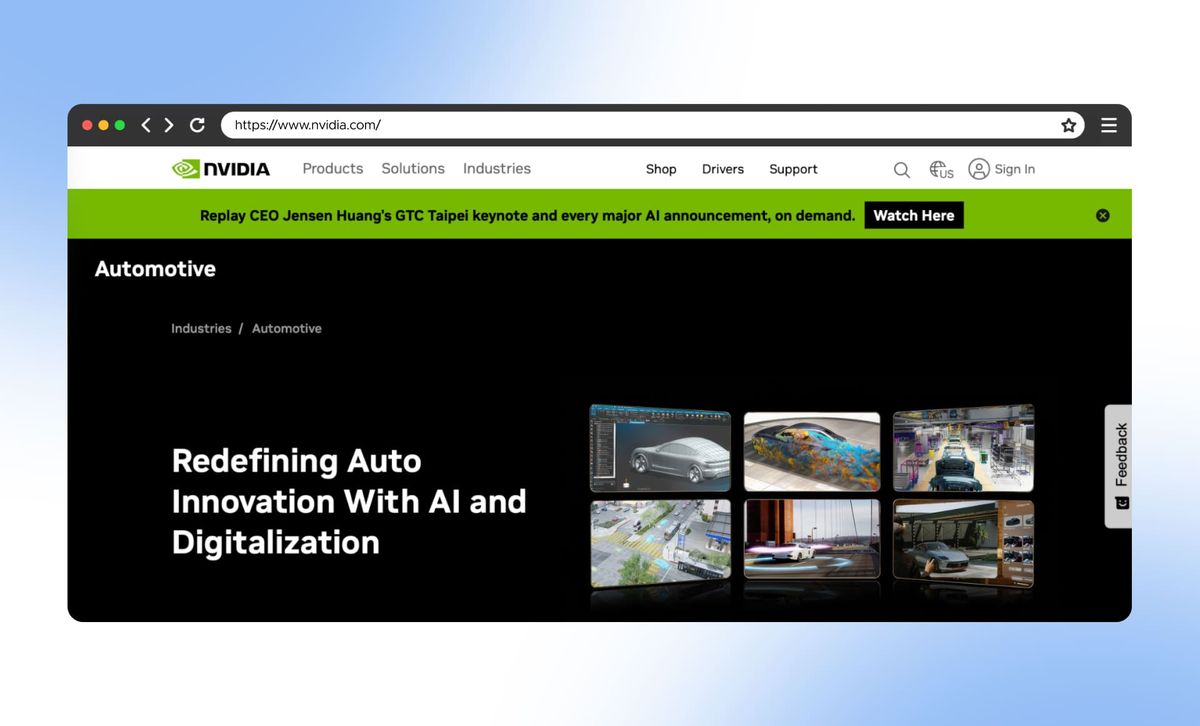
NVIDIA provides the full-stack AI compute environment that powers autonomous vehicles, ADAS systems, and in-vehicle AI solutions for automotive across dozens of OEM programs globally. The DRIVE AGX Orin and the newer DRIVE Thor system-on-chips handle sensor fusion, real-time decision-making, and deep learning inference at the edge — inside the vehicle.
In early 2026, NVIDIA CEO Jensen Huang unveiled the Rubin platform, the company's next-generation six-chip AI architecture now in full production, alongside Alpamayo — an open reasoning model family built specifically for autonomous vehicle development.
The company also sells simulation software for autonomous vehicle training, making it not just a chip supplier but an AI training infrastructure provider. Self-driving cars are NVIDIA's second most important growth category after AI infrastructure — and with robotaxi fleets scaling globally, the timing is right.
#3. Master of Code Global: Custom-Built GenAI for the Full Automotive Lifecycle
Headquarters: Global (offices in USA, Canada, and Europe)
Focus: Custom AI agents, LLM-powered chatbots, voice assistants, automotive sales and service automation
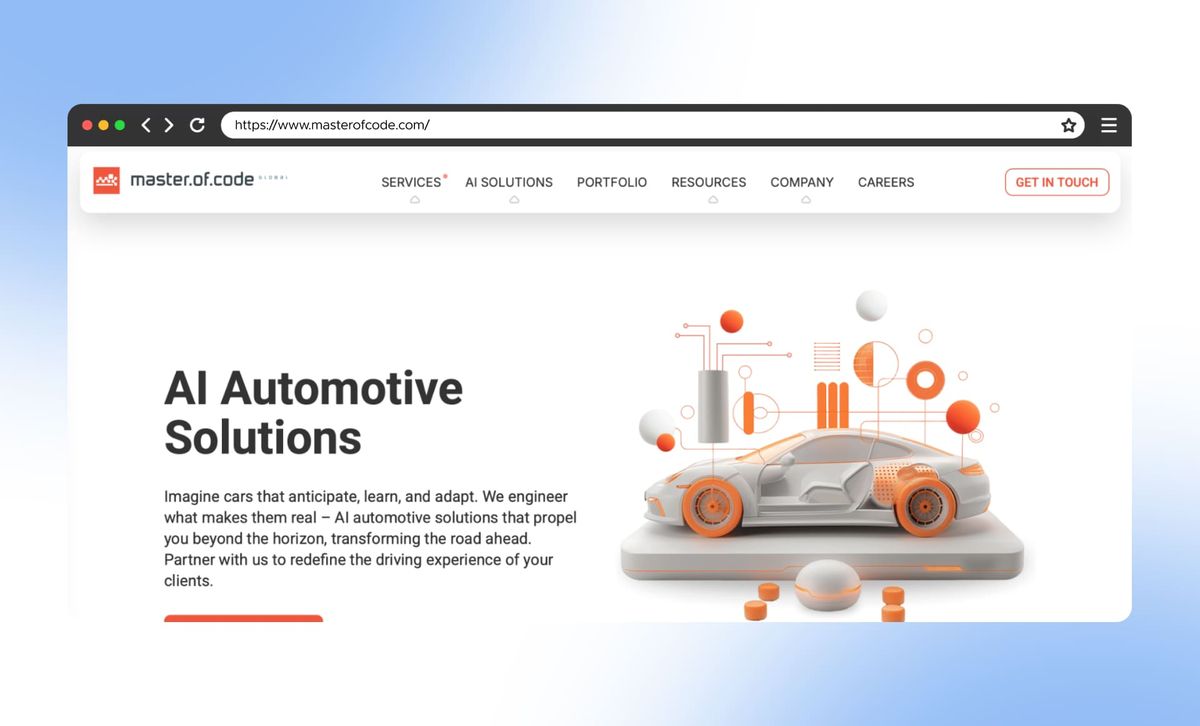
Master of Code Global builds a wide range of AI solutions adapted to unique business demands — from AI agents and chatbots to voice assistants and LLM-powered tools covering AI-driven sales optimization, streamlined after-sales services, and enhanced customer engagement and retention strategies. Their technology-agnostic approach means solutions integrate cleanly with existing tech stacks, and their ISO 27001 certification provides the security compliance assurance that enterprise automotive deployments require.
What separates Master of Code Global in a crowded market is their proprietary LOFT (LLM-Orchestrator Open Source Framework): their ISO 27001-certified processes and LOFT framework reduce setup effort by 43%, optimize budgets by up to 20% before MVP launch, and enable 3x faster support. In a domain where AI projects routinely stall between pilot and production, those are structural advantages that translate directly into fewer failed implementations and faster time to measurable value.
Across 1,000+ delivered projects, Master of Code Global clients have achieved results including 80%+ CSAT, 80%+ chatbot accuracy, 10–50% higher AOV, 60%+ engagement rates, 3x higher conversions, and up to 15x revenue growth.
#4. Impel: The Automotive AI Operating System for Retail
Headquarters: New York, NY, USA
Focus: AI operating system for dealerships, agentic AI for sales and service, automotive retail automation
Impel is one of the most operationally proven AI automotive companies in the retail layer, with a scale that few competitors can match. To date, Impel has delivered 40 billion shopper interactions, influencing over $10 billion in sales and service revenue across 51 countries.
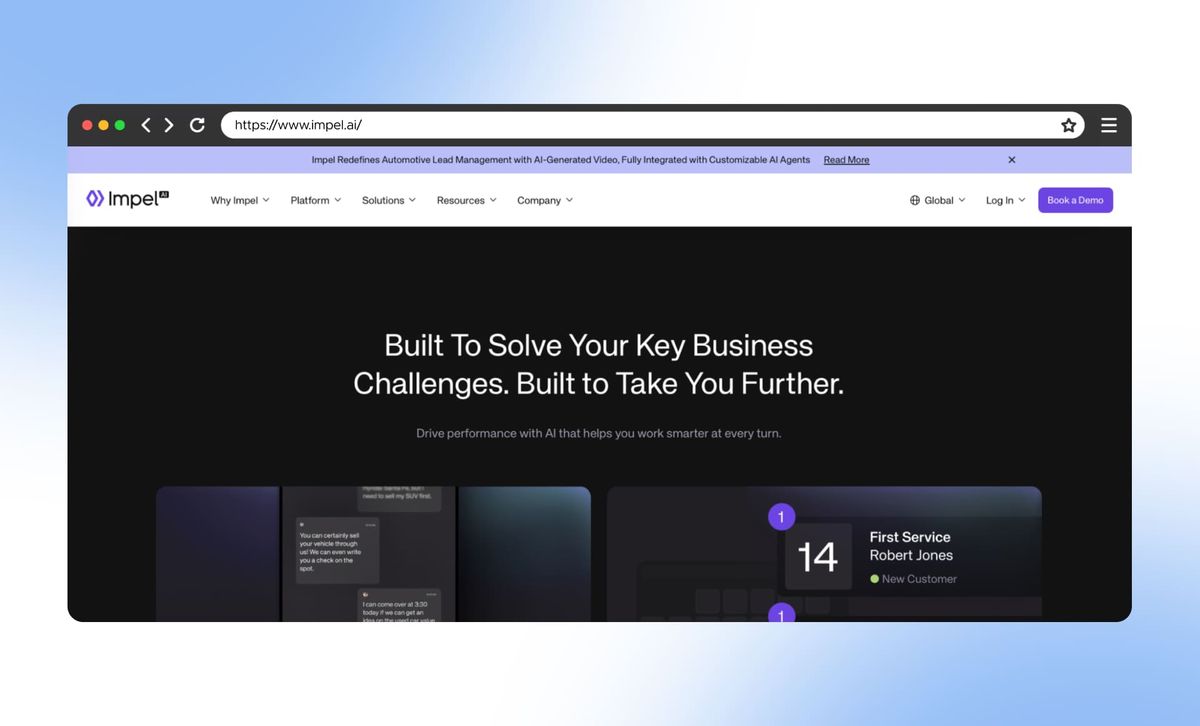
The company describes its platform as an Automotive AI Operating System — not a chatbot but a unified system connecting sales, service, marketing, merchandising, voice, and chat into one coordinated AI layer that runs the entire customer lifecycle.
It is trained on dealer-specific data: VIN-level inventory, service intervals, ownership history, and 51-day buying cycle patterns. Purpose-built for the domain, proven across tens of thousands of dealers, and actively expanding into every touchpoint of the car-buying and ownership experience.
#5. Intellias: Engineering the Software-Defined Vehicle from Chip to Cloud
Headquarters: Chicago, IL (global delivery across Europe and USA)
Focus: Automotive software engineering, SDV platforms, ADAS, embedded systems, digital cockpit, eMobility
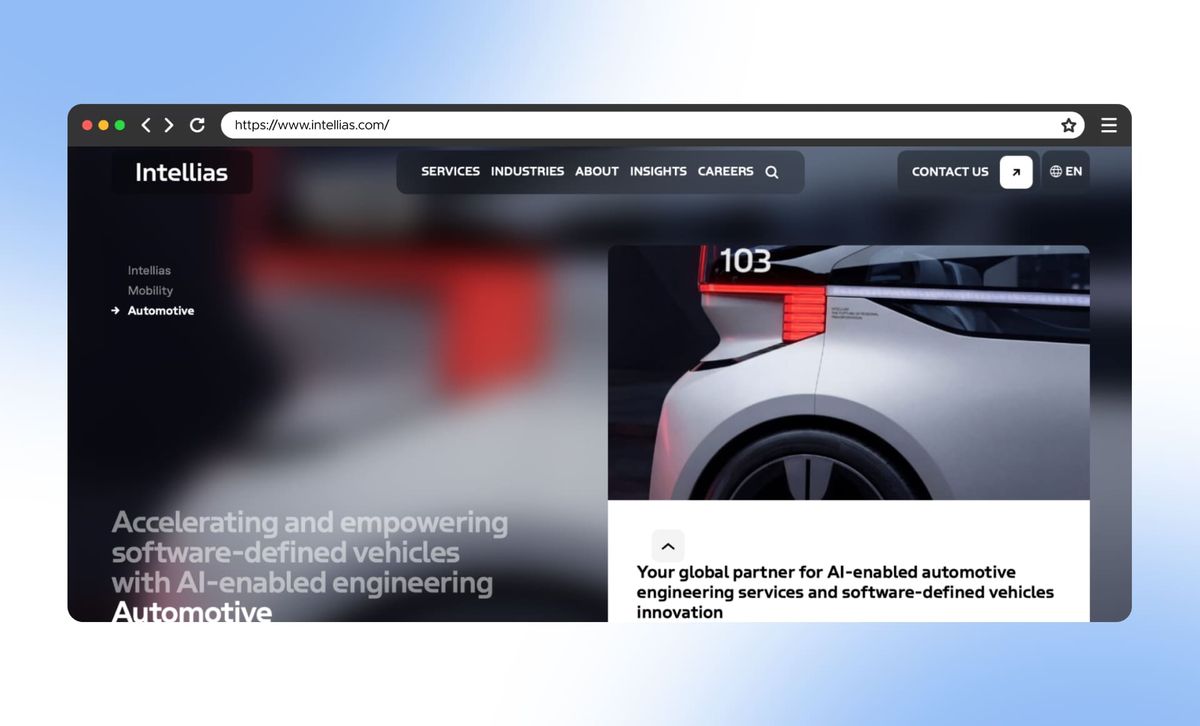
Intellias delivers end-to-end automotive software engineering services from consulting to integration and operation, enabling OEMs, Tier 1 suppliers, and semiconductor providers to meet today's software-defined vehicles market demands.
The company covers the full software-defined vehicle stack: digital cockpit, ADAS, connectivity and telematics, eMobility (EV routing, charging, OTA updates), embedded platforms, cloud/DevOps, and location-based services. Crucially, they deliver against automotive compliance frameworks — ASPICE, ISO 26262, and cybersecurity standards.
#6. Cerence AI: The In-Cabin Intelligence Leader
Headquarters: Burlington, MA, USA
Focus: Voice AI, in-vehicle assistants, conversational experiences
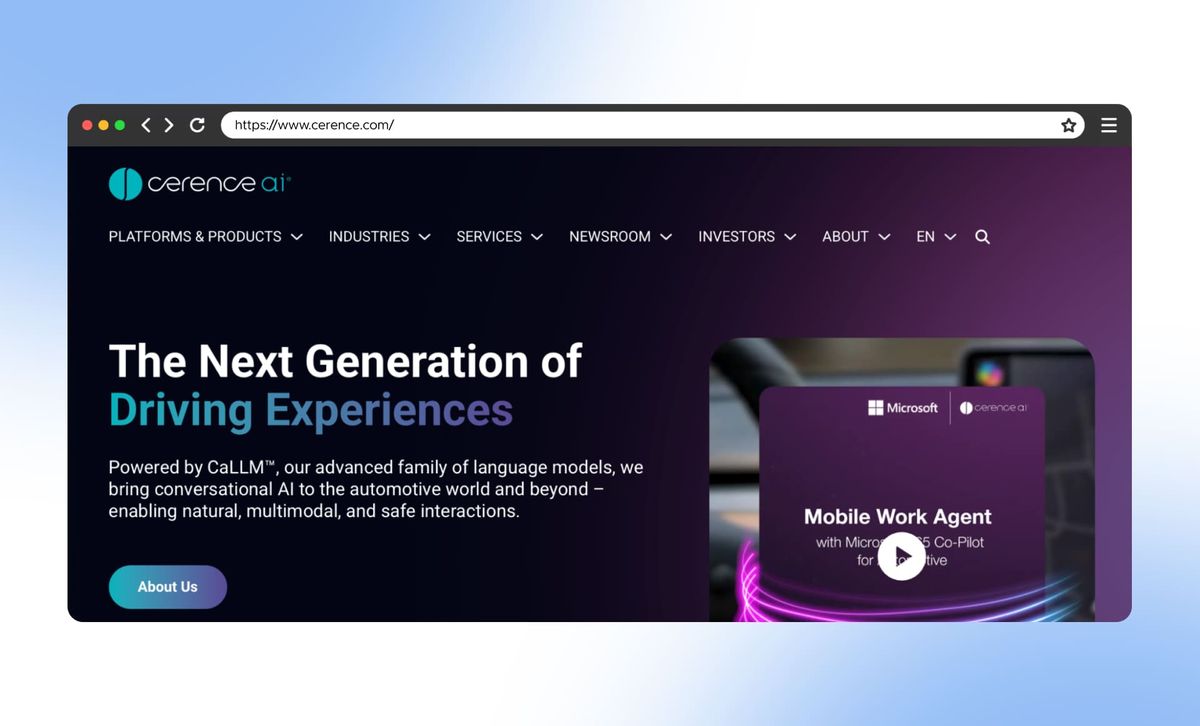
Cerence is the world's leading provider of AI-powered in-car conversational systems, with its technology deployed across hundreds of millions of vehicles from virtually every major OEM. The company's core strength is deep automotive domain knowledge — understanding how voice interaction works differently when someone is driving at 70 mph, wearing sunglasses, with a crying child in the backseat, versus a quiet home assistant scenario.
#7. SoundHound AI: Voice Commerce and Agentic In-Vehicle AI
Headquarters: Santa Clara, CA, USA
Focus: Voice AI, agentic automotive assistants, in-vehicle commerce
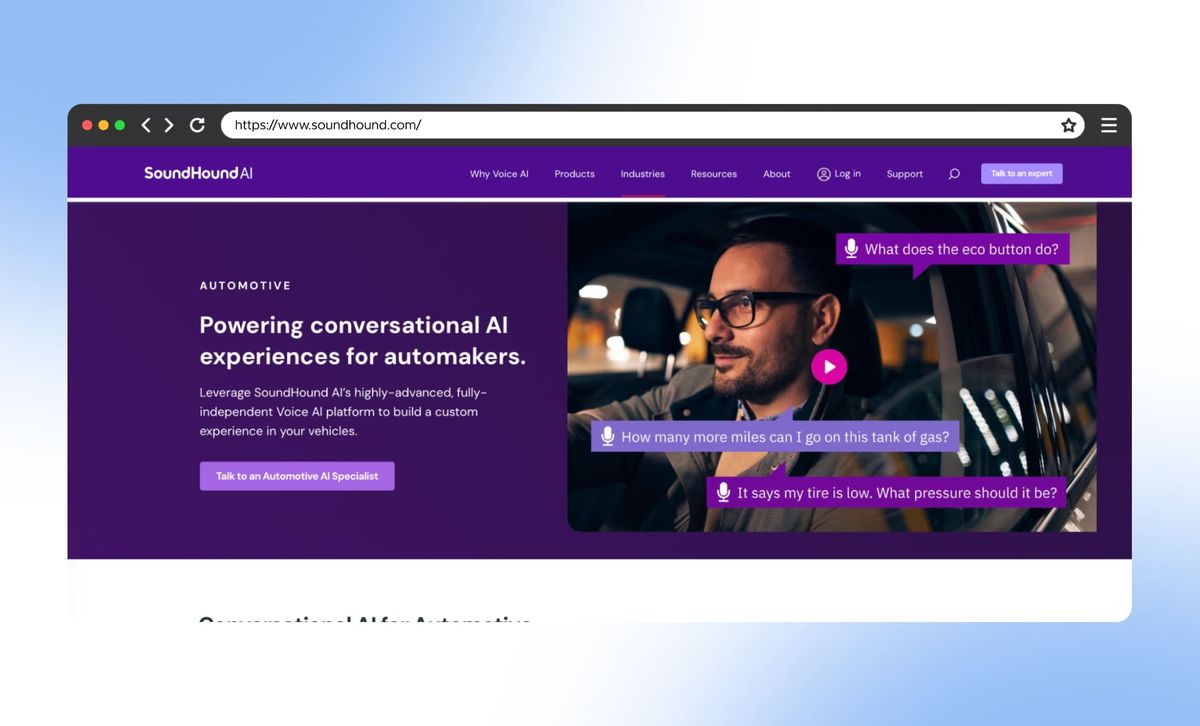
SoundHound AI has emerged as one of the most fast-growing voice AI automotive companies. Its automotive vertical reported 88% core revenue growth (excluding acquisitions) in Q1 2026, driven by wins across Japanese, Korean, Italian, Chinese, Vietnamese, and Indian OEMs alongside a major multi-year renewal with one of the largest American automakers.
The company's platform supports full agentic AI capabilities: multi-agent orchestration, generative AI responses, and deterministic safety checks.
SoundHound is also pioneering in-vehicle voice commerce — enabling drivers to order food, reserve parking, and pay for services using only their voice through integrations with merchants like Parkopedia and OpenTable. The company is advancing voice commerce pilots with large automotive brands in Europe and the U.S. and confirmed the first major global automaker to roll out voice commerce in vehicles.
Seven companies, seven different layers of the automotive stack. Here's the whole field side by side — best fit, delivery model, compliance, and track record in one view — so you can compare on the criteria that matter for your project.
| Company | Best for | Delivery model | Compliance (stated) | Track record | Standout strength |
|---|---|---|---|---|---|
| BotsCrew | Full-journey AI partner for dealerships, brands and MaaS | Strategy and implementation — from readiness assessment to production rollout | GDPR, SOC 2, ISO 27001 | 200+ AI projects, since 2016 | Decade of enterprise AI delivery, combining strategy and implementation with deep DMS and CRM integration for dealerships and MaaS |
| NVIDIA | Vehicle-embedded compute (ADAS, autonomy) | Chip and platform (DRIVE AGX Orin/Thor), OEM partnerships | Automotive-grade safety platform (DRIVE); certification at the OEM program level | OEM programs incl. Mercedes-Benz, Volvo, JLR, GM, Hyundai, Nuro | Full-stack compute plus AV training and simulation (Omniverse, DRIVE Hyperion) |
| Master of Code Global | Custom GenAI chatbots and voice, full lifecycle | Framework-based (LOFT); fixed-scope 30-day AI Pilot | ISO 27001 | 1,000+ projects, 250+ staff | Productized pilot-to-MVP path with fixed budget and timeline |
| Impel | Dealership retail AI operating system | Unified SaaS platform | SOC 2 (Type II), GDPR, CCPA | Operates across 51 countries | Purpose-built dealer OS trained on VIN-level and buying-cycle data |
| Intellias | Software-defined vehicle engineering | Consulting and integration, chip-to-cloud | ASPICE, ISO 26262, AUTOSAR; TISAX facility | OEM / Tier-1 / semiconductor engagements | Full SDV stack under automotive safety standards |
| Cerence AI | In-cabin voice assistants | Embedded software licensed to OEMs/Tier-1s | Embedded in OEM vehicle programs; certification at the automaker level | 525M+ cars shipped, 80+ OEM/Tier-1 customers, 25+ yrs | Deepest automotive-specific voice UX record |
| SoundHound AI | Voice commerce and agentic in-vehicle AI | Platform plus merchant integrations | Enterprise security: SOC 2 / ISO, GDPR alignment, encryption, PII redaction | Automotive revenue up 88% YoY (Q1 2026); OEM wins across Asia and Europe plus a major US automaker renewal | In-car voice commerce — ordering, payment and parking by voice |
How we chose: this guide only includes companies with proven production deployments — named clients and live systems, not pilots or press releases. We looked at what each vendor is actually built for, how they engage (from chip supplier to consulting partner to SaaS platform), the compliance certifications they publish for enterprise data, and the depth of their automotive-specific track record.
Emerging Themes Across Automotive AI
From assistance to agency. The consistent trend across companies is the shift from AI that assists humans to AI solutions for automotive that acts autonomously on their behalf — whether that's a robotaxi navigating without a driver, a BotsCrew agent closing a service appointment without a human scheduler, or a solution completing a restaurant reservation mid-commute.
The dealership AI opportunity is enormous and underserved. While autonomous driving gets the headlines, the largest near-term ROI in automotive AI is in the commercial layer — dealership customer engagement, lead conversion, service scheduling, and CRM automation. AI automotive companies like BotsCrew are addressing this market with production-ready enterprise solutions that deliver measurable results today.
Data is the new engine. Tesla's camera data advantage, crowdsourced REM mapping, labeled datasets, and voice interaction corpuses — across the industry, proprietary data is becoming the most defensible competitive moat.
The automotive AI landscape in 2026 is defined by agentic and generative AI automotive companies that have moved beyond proof of concept — companies operating real robotaxi fleets, shipping millions of ADAS-equipped vehicles, and handling millions of dealership customer interactions. The window for experimentation has closed; the era of deployment is here.
What an Experienced Automotive AI Partner Actually Changes
According to S&P Global Market Intelligence research (Voice of the Enterprise: AI & Machine Learning, Use Cases 2025), only 48% of AI projects ever make it into production. The proportion of companies abandoning most of their AI initiatives before they reach production has risen from 17% to 42%. The difference between an automotive AI project that fails and one that delivers measurable ROI is almost never the underlying model or algorithm. It's the partner.
An experienced automotive AI partner brings things that can't be acquired during an engagement: deep familiarity with the systems that automotive businesses run on, prior integrations with the DMS and CRM platforms already in use, an understanding of what dealership staff will actually adopt versus resist, and a track record of getting AI from demo to production across the finish line.
What does that look like in practice? Imagine:
A major automotive manufacturer replaced static dealership brochures with a dual-agent AI platform — one guiding buyers through vehicle discovery and test-drive booking, one equipping sales consultants in real time. It went live across a national dealership network, and executive sign-off on the results has triggered active discussions about expansion into new markets.
A global car brand's new model campaign deployed an AI voice and text chatbot that gave buyers a character they could actually talk to — across the brand website, Facebook Messenger, and Google Assistant. 15,000 users engaged in three months, with average sessions running over four minutes and conversations spanning 300 topics from fuel economy to test-drive bookings.
A logistics marketplace deployed a WhatsApp chatbot that automated 60% of the 200 daily operational requests its drivers were generating manually — check-ins, fuel requests, incident reports, rescue requests — all routed through the channel drivers already used, integrated directly with the company's support desk and internal database. Over 500 drivers now use it company-wide.
None of these outcomes happened because the underlying AI was exceptional in isolation. They happened because the integrations were right, the channels matched how users already communicated, and the deployment was scoped to workflows that people would actually change their behavior for. That's what an experienced partner brings — and what no amount of model capability replaces.
BotsCrew has been building conversational and generative AI for automotive and logistics clients since 2016. Across nearly a decade of deployments, we've developed the domain knowledge, integration playbooks, and implementation discipline that turn AI pilots into production systems — and production systems into measurable business results. If you are evaluating an automotive AI initiative, we'd rather show you what we've built than tell you what we could build.
FAQ
- What is automotive AI used for?
Automotive AI covers three layers: vehicle intelligence (ADAS, autonomy), in-cabin voice assistants, and dealership operations (lead qualification, scheduling, service). The market is projected to reach $38.45 billion by 2030.
- Who are the top automotive AI companies in 2026?
BotsCrew, NVIDIA, Master of Code Global, Impel, Intellias, Cerence AI, and SoundHound AI — each with proven production deployments rather than pilots.
- What's the difference between a compute provider and a dealership AI partner?
Compute providers like NVIDIA power in-vehicle systems (chips, autonomy). Dealership AI partners like BotsCrew build customer-facing agents — lead qualification, test-drive booking, service scheduling — integrated with DMS/CRM.
- Where is the biggest near-term ROI in automotive AI?
Dealership customer engagement and service scheduling, not autonomous driving. Over 90% of U.S. dealerships already use chat or messaging tools to engage buyers.
- What should you look for in an automotive AI partner?
A production track record, stated compliance (SOC 2, GDPR, ISO 27001, or ASPICE/ISO 26262 for vehicle systems), and prior DMS/CRM integration experience.
- Why do most automotive AI projects fail to reach production?
Only 48% of AI projects reach production, per S&P Global Market Intelligence, and abandonment rose from 17% to 42%. The usual cause is a lack of integration and implementation experience, not model quality.