Conversational AI in Manufacturing: 4 Customer-Facing Mistakes to Avoid
The mistakes that sink manufacturing customer-facing AI before it reaches production. The reason is almost always a decision made in the first few weeks, long before anyone's testing prompts or measuring response times.

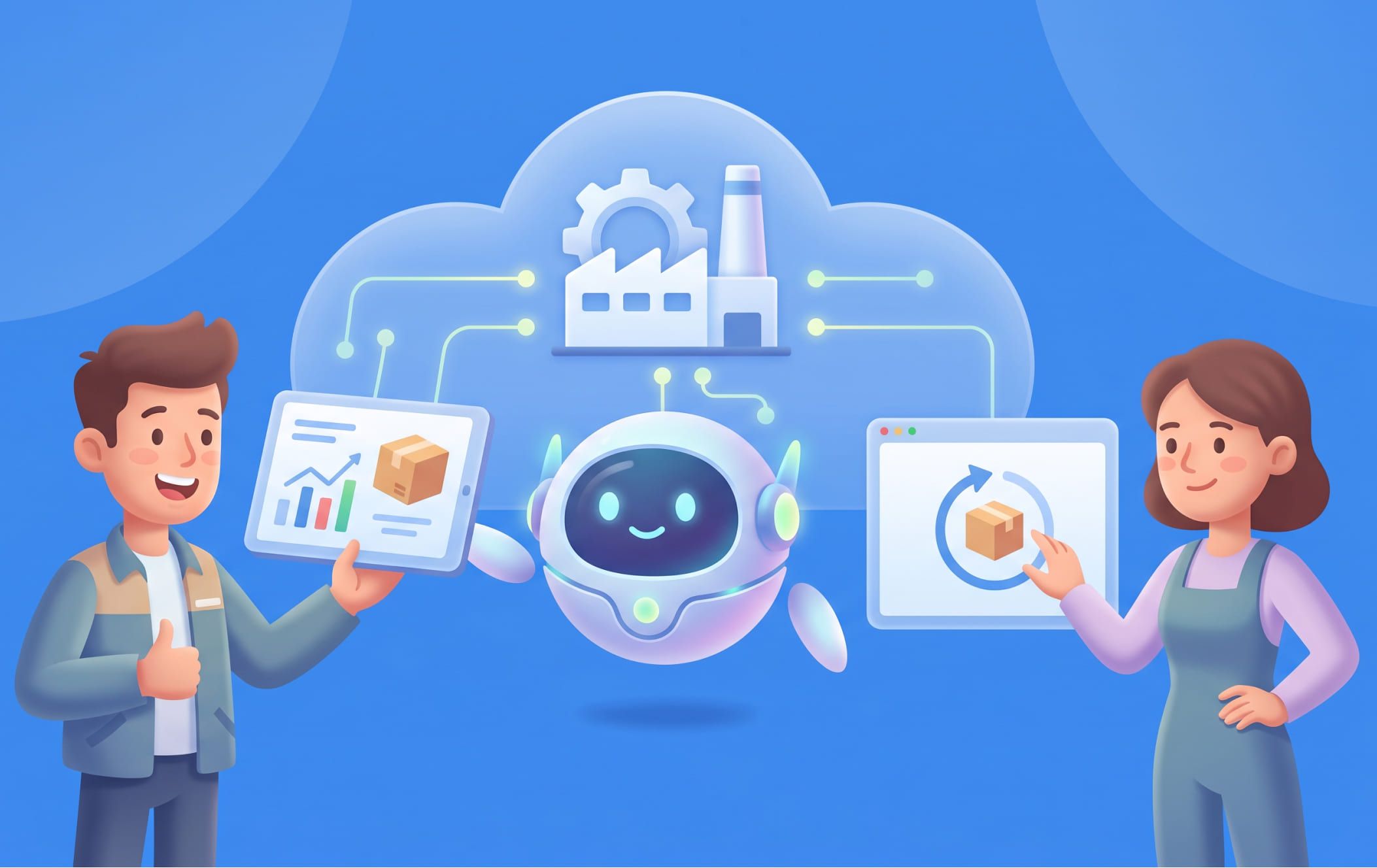
A distributor calls asking where their backorder stands. A dealer emails about a part that failed inspection and needs an RMA. A technician pings your site chat at 11 PM because a compatibility question is holding up an install. For manufacturers running multi-channel operations, this is just Tuesday — and all three usually land in the same overloaded queue, handled by the same three or four people who happen to be the only ones who really know the ERP.
This article covers what it takes to build customer-facing AI manufacturers that can actually run in production — across order status, automated returns, and technical support, plus where these projects tend to fail.
Why Conversational AI in Manufacturing Is (Suddenly) Everywhere
Manufacturing support has a structural problem retail and SaaS don't share to the same degree: the data customers ask about — order status, backorders, production schedules, part compatibility — doesn't sit in a single customer-facing system. It's scattered across an ERP (NetSuite, SAP, Dynamics), a separate e-commerce storefront, a dealer portal, and, more often than anyone wants to admit, a shared spreadsheet somebody's been maintaining for years.
That fragmentation is why conversational AI in manufacturing has moved from "interesting pilot" to a genuine operational priority:
📦 Order volume outgrows headcount faster in manufacturing than in most industries, because a single order can touch procurement, production scheduling, and shipping — three separate systems, three separate places where a question can go unanswered.
🔄 The support team doubles as the ERP's only translator. Representatives spend more time navigating a system built for internal operations than actually talking to customers.
💬 Inquiries repeat with painful regularity. "Where's my order," "is this part compatible," and "how do I return this" make up the overwhelming majority of manufacturing support volume — exactly the kind of repetitive, structured-but-messy workload AI is good at absorbing.
None of this means manufacturers need to reinvent their ERP. It means they need an AI layer on top of it — one that can read messy, real-world inputs (a PO number typed three different ways across Shopify, phone, and email) and turn them into clean answers instantly, for both customers and the internal team supporting them.
Key Support Workloads Manufacturers Need to Solve at Scale
Most manufacturers asking about "AI for customer support" are really asking about three distinct problems lumped together.
Order Status Across Fragmented Systems
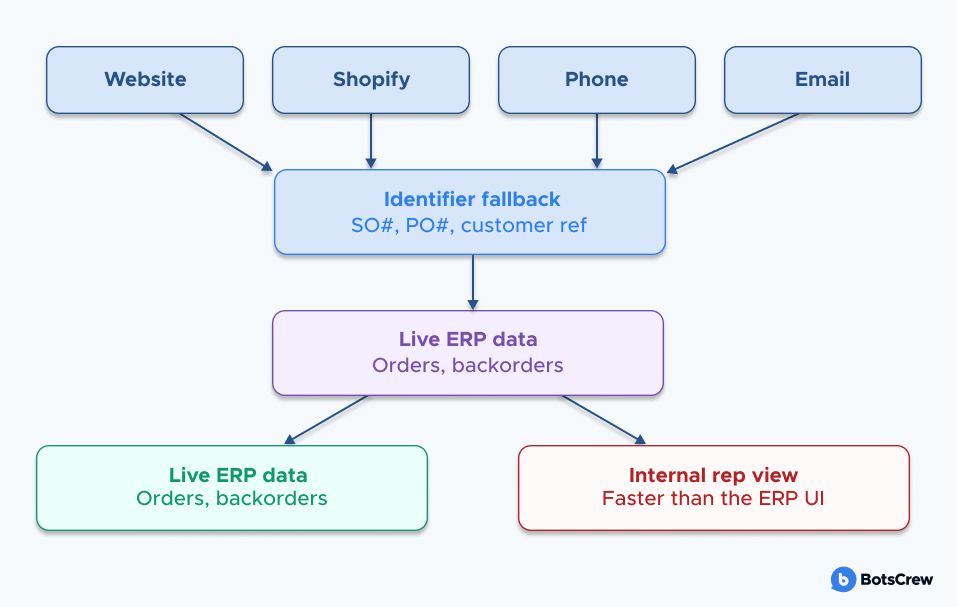
This is almost always the first use case worth solving — highest-volume, most mechanical. A production-grade order status assistant needs to:
- pull live data directly from the ERP — sales orders, backorders, production and shipping dates — rather than a stale nightly export;
- work across every channel an order can originate from (website, Shopify, phone, email), each formatting identifiers differently;
- fall back gracefully across identifiers — sales order number, PO number, customer reference — when the first one doesn't match cleanly;
- serve two audiences from one foundation: customers checking their own order, and internal reps who need the same data faster than clicking through the ERP manually.
Automated Returns Processing (RMA)
Returns and RMA requests are where manufacturers lose the most invisible time. A single RMA typically touches product verification, a reason code, a shipping label, warehouse or QA sign-off, and a refund or replacement — and most of that chain still runs through a person re-keying the same information into two or three systems.
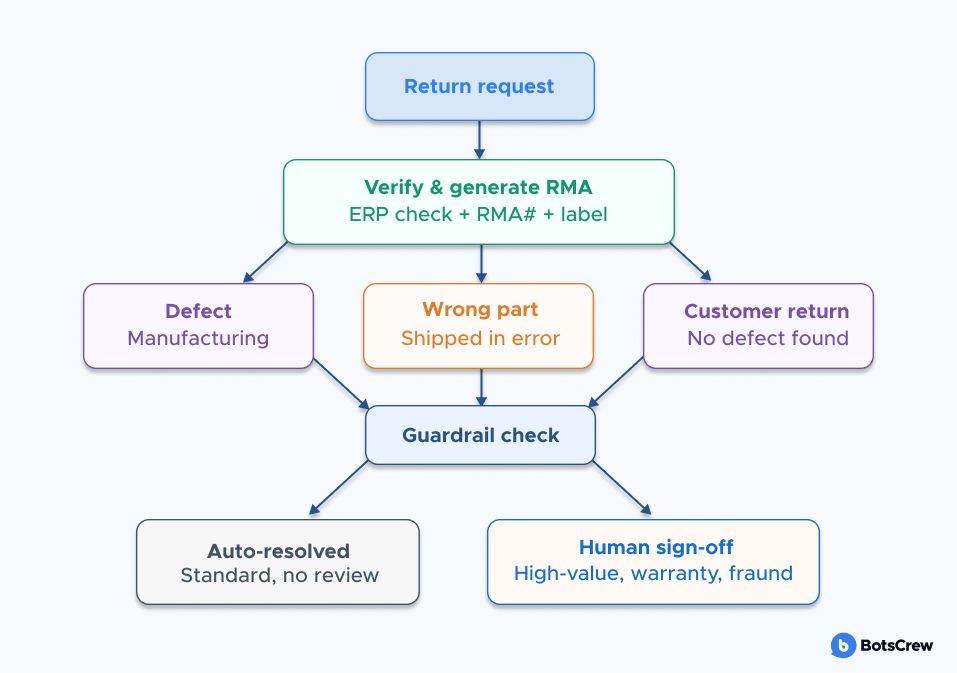
Automated returns processing done well executes the workflow end to end:
- verifies the order and eligibility against your actual ERP or warranty data, not a generic policy page;
- generates the RMA number and any required shipping label or instructions automatically;
- routes the case correctly — a manufacturing defect, a wrong part shipped, and a customer-caused return each deserve a different path;
- keeps a human in the loop exactly where judgment is genuinely needed (high-value claims, warranty disputes, fraud risk) and nowhere else.
In most enterprise support environments, 70–80% of inquiries — including a large share of returns — are standard enough to be resolved without a person ever touching the case.
Technical Support That Actually Knows Your Products
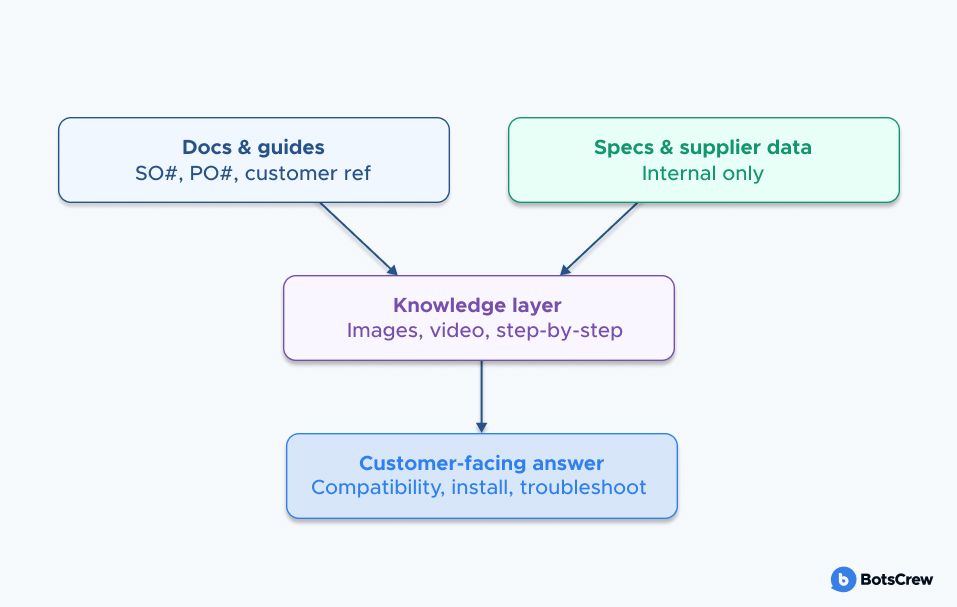
This piece separates a customer-service chatbot from a genuine product expert. Manufacturing customers don't just want to know where their order is — they want to know if a part is compatible, how to install it, and why it isn't working the way the manual implied. That requires a knowledge layer, not just a data connection:
- documentation, installation guides, and compatibility tables kept current — ideally editable by the client's own team without a redeployment every time a product changes;
- responses enriched with images, videos, and step-by-step instructions, not just text pulled from a PDF;
- clear visibility rules so internal technical detail (specs, tolerances, supplier data) never leaks into a customer-facing answer built from the same knowledge base.
Case Study: From a CEO's Weekend Prototype to a Production AI Layer
A U.S. manufacturer of high-performance automotive aftermarket filters with 700+ employees (NDA), illustrates a common challenge in enterprise AI. The company's CEO built an internal AI assistant for order status by connecting Claude directly to NetSuite. While the prototype validated the idea, it wasn't suitable for production due to slow response times, complex prompt engineering, and difficulty handling inconsistent order data.
BotsCrew rebuilt the solution as a production-ready AI layer integrated with NetSuite and the company's knowledge base, serving both support agents and customers.
Results in the first year:
Impact figures: about 50 percent of support requests fully automated, 24 times faster first response time, $140K in annual cost savings, and about 250 percent return on investment.
Support requests fully automated
Faster first response time
Annual cost savings
Return on investment
The takeaway is that prototypes prove what's possible, but delivering reliable customer support at scale requires production-grade architecture, robust integrations, and workflows built for real business operations.
Not sure if your prototype can actually carry production volume? If your team has already built something internally — a Claude or GPT connector, an internal assistant, a proof of concept — and you're trying to figure out what it takes to make it customer-grade, that's a very specific, answerable question.
We'll walk through your architecture and tell you honestly what's reusable and what needs to be rebuilt.
We'll walk through your architecture and tell you honestly what's reusable and what needs to be rebuilt.
Book a free AI consultationWhere Manufacturers Go Wrong
A few patterns show up again and again in manufacturing AI projects that stall before reaching production. Here is what each one actually looks like on the ground.
#1. Treating the ERP Connection as the Whole Project
Everyone assumes the hard part is wiring the AI into NetSuite, so that's where the budget and timeline go. While in reality, the harder part is everything the ERP just doesn't handle for you.
Take order numbers. The same order might show up as a sales order number on your site, a PO number on a dealer's paperwork, and a confirmation number buried in a forwarded email. Somehow all three need to point back to the same record, every time.
Then there is the customer who doesn't have any number at all — "I ordered filters last week, I think it was a Tuesday" is a real message you'll get, and if your system only works when someone hands it a clean ID, it's going to fail on exactly the inquiries you most wanted to automate. Add in years of accumulated mess in the ERP itself — custom fields, discontinued order types, exceptions nobody remembers the reason for — and you can see why a system built and tested against clean sample data falls over the moment it meets the real thing.
#2. Trying to Automate Everything With One Tool
There's a temptation to pick a philosophy — full AI agent, or just keep it simple with rules — and run every inquiry through it. Rules alone are fine for the 70–80% of cases that are genuinely routine, but they break down hard on the rest: the return that doesn't fit any predefined reason code, the compatibility question that actually requires reasoning instead of keyword matching.
Those all get kicked to a human, which quietly undoes the point of automating in the first place. Go the other direction — a fully autonomous agent handling everything — and you're paying several times more to solve problems a basic rule already handled fine.
What actually works is splitting the load: rules handle the predictable, high-volume stuff — order status, standard returns, common compatibility checks — and an AI agent, with a human in the loop for anything genuinely ambiguous, takes the harder 20–30%. Looked at over a year or two of running the thing, this usually ends up cheaper than either extreme, not just a reasonable middle ground.
If you're not sure how messy your non-standard cases really are, start with a copilot — AI drafts the response, a human approves it — before committing a real budget to a full agent.
#3. Skipping Discovery
If a vendor hands you a fixed-price quote before anyone's actually looked at your order data, your exception rate, or how inquiries break down across channels, that's worth pausing on. Either they guessed, and the real costs show up later when they're much more expensive to deal with — or they've padded the number to cover risks they haven't bothered to measure, and you're paying for that padding either way.
Getting the scope right means someone actually sitting with your data first: how often exceptions come up, what a support mistake actually costs, how many systems the AI needs to touch. That's what the discovery phase is for — usually a week or two — and it should be a real, paid phase of work, not something thrown in to sweeten the pitch.
#4. Mistaking a Prototype for a Production System
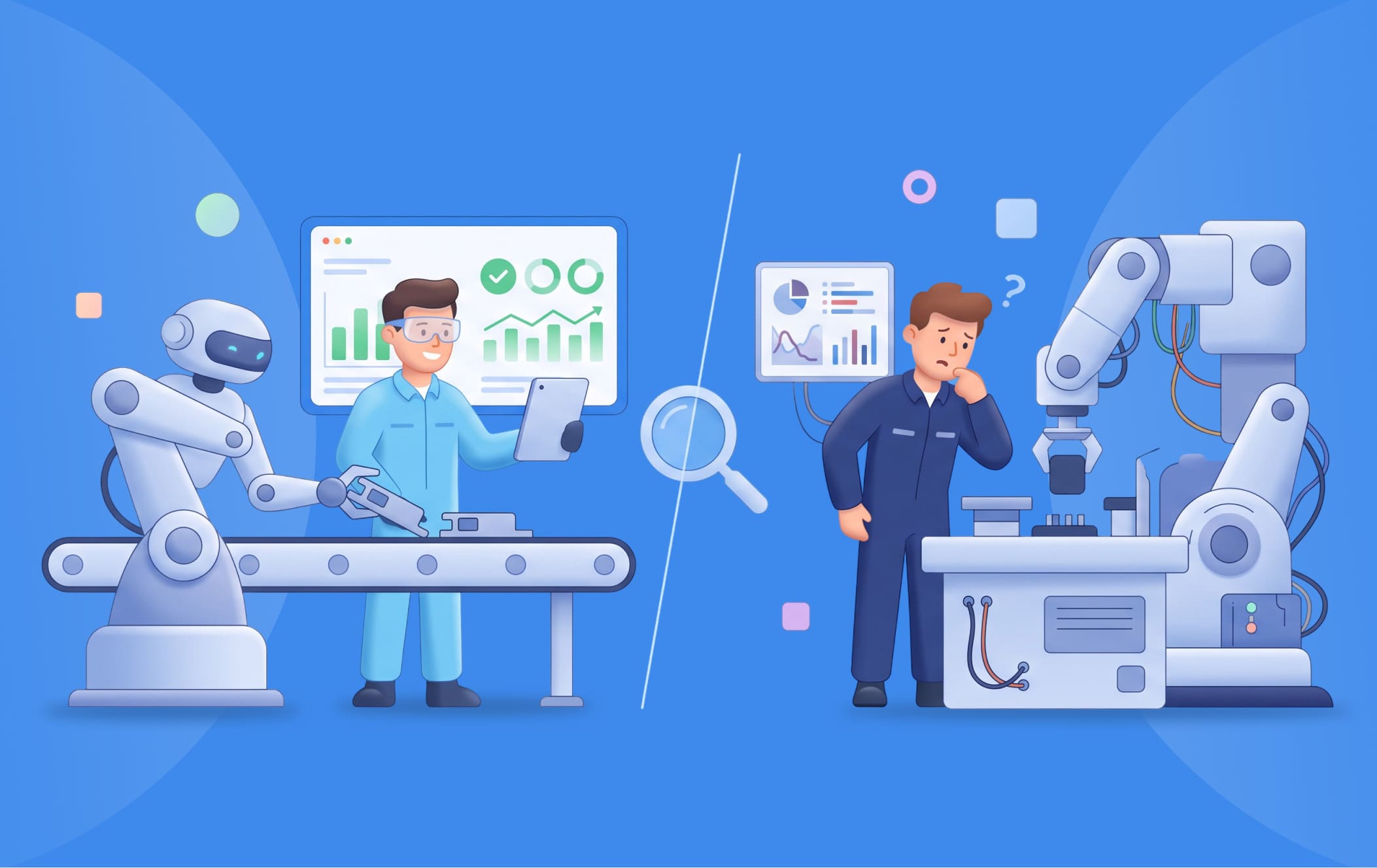
This one's easy to fall into precisely because the prototype worked. Our clients' CEO built a genuinely useful tool himself, wiring Claude's MCP connector straight into NetSuite. It answered order-status questions correctly. It just fell apart under real customer volume.
A 40-page prompt is manageable when one person is holding it all in their head and can patch it as needed. Hand it to a whole team, or let the underlying data shift a little, and it stops being manageable. Response times matter differently too — a couple of minutes feels fine when you're the one testing it and know what's happening under the hood; it's unacceptable when a customer is sitting there waiting on a chat window. And an internal tool doesn't need guardrails built in.
Want a straight answer on what it would take to productionize it? Our AI Strategy Consulting sessions start with exactly that diagnostic — no generic proposal, just an honest read on your architecture.
Want a straight answer on what it would take to productionize it? Our AI Strategy Consulting sessions start with exactly that diagnostic — no generic proposal, just an honest read on your architecture.
Book a strategy consulting sessionIs Your Support Operation Ready for This?
If your team is fielding growing volume across channels that don't talk to each other — or you've already built something internally and are hitting a wall trying to make it customer-ready — the underlying question is the same one we walk through with every manufacturing client: what's actually reusable, and where does it need a rebuild to survive real volume?
BotsCrew has spent 8+ years building production AI systems for manufacturers, distributors, and enterprises, with 200+ completed projects for clients like Honda, Adidas, Mars, and Samsung NEXT. We start every engagement with a diagnostic of your actual data and exception rate, not a generic proposal, because that's the only way to tell you honestly what will deliver a measurable return.
What that conversation covers:
✅ AI Strategy Consulting (starting from one session) — we look at your order, returns, and support data and tell you plainly which workload above is worth solving first.
✅ Enterprise AI Solutions — end-to-end development from MVP to a production system, built around your ERP, your channels, and who will maintain it after launch.
Every quarter spent routing order-status and RMA questions through an overloaded support inbox is a quarter you won't get back — and a competitor with a faster answer is one search away from your customer.