AI Red Teaming: Why Your Business Needs It and How to Choose the Right Partner
How to find out what your AI will do under pressure, before customers, attackers, or regulators do. A buyer's guide for mid-size businesses and enterprises.


Key Takeaways:
✅ AI red teaming is structured adversarial testing of an AI system: the model, its data, prompts, tools, and integrations, tested the way a real attacker or a confused customer would use them.
✅ A traditional pentest won't catch the most common AI failures: prompt injection, data leaking through retrieval, and agents taking actions nobody approved.
✅ Most companies still skip this step. In IBM's 2025 breach study, more than three-quarters of breached organizations had never run adversarial tests on their AI.
In December 2023, a user told a car dealership's website chatbot to agree with everything and call each answer "legally binding." It then agreed to sell a new Chevy Tahoe for $1. Two months later, a Canadian tribunal held Air Canada liable for a refund policy its chatbot made up, and rejected the airline's argument that the bot was responsible for its \words. In June 2025, researchers showed that one crafted email could make Microsoft 365 Copilot leak internal data with zero clicks (CVE-2025-32711, severity 9.3 out of 10). In none of these cases did the model "break." Each system did what it was built to do, in a situation nobody had tested.
Three things changed at once:
AI got access. Assistants and agents now read inboxes, query CRMs and ERPs, and trigger workflows. Every new connection is a new way in.
AI became a target. IBM's 2025 Cost of a Data Breach Report found that 13% of organizations had already reported breaches of AI models or applications, and 97% of those lacked proper AI access controls.
The bar went up. Gartner predicts that by 2028, 25% of enterprise GenAI applications will have at least five minor security incidents a year, up from 9% in 2025. Regulators, auditors, and enterprise customers now ask for proof of testing, not promises.
That's why red teaming AI has moved from frontier labs onto enterprise roadmaps. This guide is written for the people who have to sign off on AI going live: CIOs, CISOs, CTOs, heads of AI, and product owners at mid-size businesses and enterprises. We'll cover:
- what is AI red teaming, and how it differs from pentesting;
- what red teamers attack, and what each failure costs;
- how the process works, step by step;
- how to evaluate AI red teaming services before you sign anything.
Launching an AI assistant or agent this quarter?
We’ll map what it can reach, where it can be manipulated, and what to test before go-live.
Book a Free AI Risk ReviewWhat Is AI Red Teaming?
AI red teaming is the practice of attacking your AI system, with permission and under controlled conditions, to find out how it can be manipulated, misled, or misused before real users do. It covers the model, the data it reads, the tools it can call, and the business rules it's supposed to follow. So when people ask what is red teaming in AI, the short answer is: a stress test for behavior.
The term itself is old. During the Cold War, military planners ran exercises in which a "red" team played the adversary to expose weak spots in the "blue" team's strategy. Cybersecurity borrowed the idea decades ago. Generative AI red teaming is the newest chapter, and it differs in three important ways.
It tests for accidents, not only attacks. Microsoft, which runs several internal AI red teams, describes the practice as an umbrella for both security and responsible-AI failures, triggered by malicious and benign users. A confused customer who gets a made-up refund policy is as much a finding as a hacker who extracts your system prompt.
It deals with probability. Ask a traditional application the same thing twice and you get the same answer. Ask an LLM the same thing 20 times and an attack might work once. That's why LLM red teaming repeats each test many times and reports success rates.
It tests the system, not just the model. Frontier labs red-team their foundation models before release. Your risk sits one level up: in the system prompt, the documents your assistant retrieves, the APIs your agent can call, and the permissions it holds. A safe model wired into an unsafe workflow is still an unsafe product.
AI red teaming doesn't replace your existing security program. It plugs a gap that pentests, model benchmarks, and guardrails each leave open.
AI red teaming vs. penetration testing vs. traditional red teaming
The terms get mixed up in vendor proposals, but they answer different questions and lead to very different scopes.
| Penetration testing | Traditional red teaming | Red teaming | AI systems |
|---|---|---|---|
| Main question | Can someone get in? | Would we notice a real attacker? | Can someone make our AI say or do something it shouldn't? |
| What gets tested | Networks, servers, apps, APIs | People, processes, detection and response | Prompts, retrieved data, tools, memory, outputs, guardrails |
| What a failure looks like | Unauthorized access | Attacker reaches the goal undetected | Data leak, harmful or false answer, unapproved action |
| Who does it | Security engineers | Security engineers Offensive security team | Security + ML engineers + domain experts |
Red teaming vs. evaluations vs. guardrails
Three more terms that often get blurred:
→ Evaluations (evals) measure how well your AI performs on average: accuracy, relevance, tone.
→ Guardrails are the controls you put in place: input filters, output filters, permission limits.
→ Red teaming looks for the worst case and checks whether those guardrails hold when someone pushes on them.
What AI Red Teamers Actually Test For
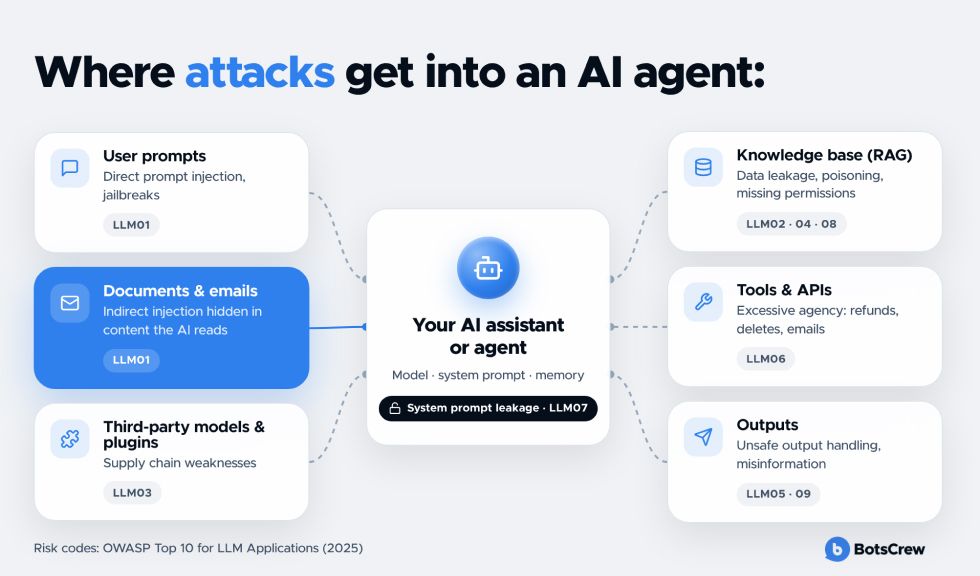
A good red team starts with your system: who uses it, what data it can see, and what it's allowed to do. Then it tries to break each of those assumptions. Most OWASP AI red teaming work maps findings to the OWASP Top 10 for LLM Applications (2025), the closest thing the industry has to a shared vocabulary. Here's what that list looks like in business terms.
Direct prompt injection and jailbreaks (LLM01). A user tells the assistant to ignore its rules, play a role, or "agree to everything." The result can be off-brand or harmful answers, or commitments your company never approved.
Indirect prompt injection (LLM01). Here the attack hides inside content the AI reads, such as an email, a web page, a PDF, or a support ticket. The assistant follows the hidden instructions, and data can be stolen or actions taken without any user noticing.
Sensitive information disclosure (LLM02). The assistant reveals salaries, contracts, personal data, or patient records simply because it can technically reach them. That means GDPR or HIPAA exposure and a serious loss of customer trust.
Supply chain weaknesses (LLM03). A third-party model, plugin, or MCP server behaves differently than its provider promised. It's risk you inherit but don't control.
Data and model poisoning (LLM04). Someone plants misleading content in your knowledge base or fine-tuning data, and the AI starts giving wrong answers that look completely authoritative.
Improper output handling (LLM05). AI output gets passed straight into SQL queries, HTML, emails, or code without checks. Classic injection attacks come back, only now your own AI delivers them.
Excessive agency (LLM06). An agent is talked into issuing refunds, deleting records, making purchases, or sending mass emails. The cost is direct financial loss and operational disruption.
System prompt leakage (LLM07). Competitors or attackers extract your instructions, business rules, or even API keys. You lose intellectual property and hand over a roadmap for the next attack.
Vector and embedding weaknesses (LLM08). Retrieval ignores document permissions or mixes data between tenants, so one customer ends up seeing another's records.
Misinformation (LLM09). The assistant gives confident but wrong answers about pricing, policy, or medical and financial topics, which leads to liability, complaints, and regulatory attention.
Unbounded consumption (LLM10). Attackers flood the system with expensive requests, leaving you with surprise cloud bills or outages.
Two patterns stand out. First, the most damaging findings are rarely about the model itself; they come from what the model is connected to. Second, the risk profile changes sharply once an assistant becomes an agent. IBM found that supply chain compromise, which covers apps, APIs, and plug-ins, was the most common type of AI security incident (30%).
A full AI red teaming engagement also tests for failures that aren't attacks at all. It checks for bias and fairness, making sure the assistant doesn't treat customers differently based on their name, accent, or zip code. It looks at whether someone can push the system into harmful or off-policy territory, such as medical, legal, or investment advice it was never meant to give.
It tests brand and tone of voice, to see whether the assistant stays on-message when a customer is angry, sarcastic, or deliberately probing it. Last but not least, it examines overreliance: whether employees accept the AI's answers without checking, even in workflows where a wrong answer is expensive.
What changes by industry
🏥 Healthcare: PHI exposure, unsafe clinical suggestions, and patients treating an assistant like a doctor.
🏦 Financial services and insurance: advice that sounds like a recommendation, KYC bypasses, and decisions that could be discriminatory.
🏭 Manufacturing and distribution: agents with write access to ERP data, supplier pricing leaks, and purchase orders created from poisoned documents.
🛍️ Retail, travel, and consumer brands: discounts and refunds the bot shouldn’t promise, and screenshots that go viral.
Is security review the thing standing between your AI pilot and production?
We’ll test your assistant or agent on your real data and hand you the evidence your security, legal, and compliance teams ask for.
Talk to Our AI Security TeamHow the AI Red Teaming Process Works, Step by Step
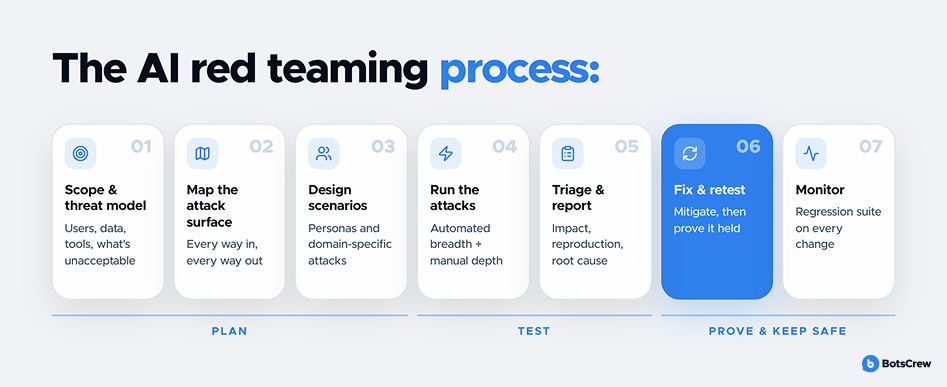
Every vendor draws this process a little differently, but a credible AI red teaming engagement always covers the same stages:
#1. Scope and threat model. Agree on what the system is for, who uses it, what data and tools it touches, and what "unacceptable" means for your business. Is a rude answer a low-severity issue? Is a leaked contract critical? This is also where you sign the rules of engagement: test environment, test accounts, and written authorization.
#2. Map the attack surface. List every way content gets into the system and every way actions get out: the system prompt, user inputs, retrieved documents and their permissions, tools and APIs, memory, file uploads, and hand-offs to humans.
#3. Design attack scenarios. Build personas (a malicious outsider, a curious employee, an angry customer, a compromised supplier document) and the scenarios each would try. Good red teams write domain-specific cases.
#4. Run the attacks. Combine automated testing for breadth with manual testing for depth. Test multi-turn conversations, chained attacks, and repeat each test many times, because a 5% success rate on a refund agent is still a problem.
#5. Triage and report. Rate every finding by business impact, show how to reproduce it, and identify the root cause. Is it the prompt, a permission, the retrieval layer, or the architecture?
#6. Fix and retest. Apply mitigations such as least-privilege access, permission-aware retrieval, output validation, human approval for risky actions, and input and output filters. Then run the same attacks again to prove the fix works.
#7. Monitor continuously. Turn the attacks into a regression suite that runs on every model, prompt, or data change, and watch production for new patterns.
Whatever the scope, you should walk away with an executive summary your board, auditors, or customers can read, a findings registered with severity, reproduction steps, and attack success rates. Also, with a prioritized fix plan, mapped to OWASP and, where relevant, the EU AI Act or NIST AI RMF, a retest report showing which fixes held, and a reusable test suite that you own and can run again.
Build In-House or Hire? How to Choose AI Red Teaming Services
Security firms, AI security platforms, crowdsourced bug-bounty programs, and AI engineering partners all use the same words on their websites. The differences show up in how they work, so evaluate the work.
| Option | Fits when | Watch out for |
|---|---|---|
| In-house team | You run many AI systems and already have a security team with ML skills | Hard to hire for; testers grow too familiar with the system |
| Specialist security firm | You need deep offensive expertise for a high-stakes launch | Strong on attacks, weaker on how AI apps are built and fixed; "report and leave" |
| AI security platform | You need continuous automated coverage across many apps | Someone still has to configure it, read the results, and fix things |
| AI engineering partner | You want testing, fixes, and retesting from one team that knows how AI systems are built | Ask for a testing team that is separate from the one that built your system |
| Hybrid | Most mid-size and enterprise teams | Clear ownership of the test suite after handover |
For most companies, hybrid wins: an expert-led engagement before launch, then an automated test suite your team runs on every change, with periodic manual retests.
Want to know how your AI holds up under pressure?
Get a scoped AI red teaming plan for your assistant or agent: what we’d test, how long it takes, and what you’ll get at the end.
Request an AI Red Teaming AssessmentThe concerns we hear most from buyers
These come up on almost every first call with AI red teaming companies:
🤔 "Will they understand our business, or just run a scanner?" Many providers run the same automated attack library against every client and call it a red team. That catches generic jailbreaks, but it misses the failures that would actually hurt you: a procurement agent approving a duplicate invoice, or a support bot promising a refund your policy doesn't allow. Ask how they build scenarios and who writes them. A good answer starts with your users, workflows, and business rules, and includes test cases written for your industry.
🤔 "Can we trust them with our systems and data?" A red team needs deep access to do its job, so this question deserves a detailed answer. Look for NDAs, a separate test environment, and test accounts with limited permissions. Use synthetic or masked data wherever real data isn’t essential. Check for certifications and practices such as SOC 2-aligned delivery, ISO 27001, and HIPAA or GDPR experience. Also ask what happens to prompts, logs, and findings after the engagement ends: where they are stored, who can see them, and when they're deleted.
🤔 "Will we get a 200-page PDF and nothing else?" Raw attack transcripts look impressive and help no one. Your security team needs reproduction steps, your engineers need root causes, and your leadership needs to know what the risk means for the business. Ask to see an anonymized sample report before you sign. The best reports open with an executive summary in plain language. They rank findings by business impact, show attack success rates, and end with a prioritized fix plan.
🤔 "Will they help us fix it?" Finding problems is half the job, and often the easier half. Fixing them can mean changing permissions, redesigning how the assistant retrieves data, or adding human approval for risky actions. If the provider leaves after the report, your team carries all of that alone. Ask who implements the mitigations, whether a retest is included in the price, and how they prove a fix actually holds rather than just moving the problem somewhere else.
🤔 "Why are the quotes so different?" Price depends on the number of systems, and on whether they are chatbots or agents that can take actions with real tools. It also depends on the number of integrations, the share of manual versus automated testing, and how many retest rounds are included. Before you compare prices, line the proposals up side by side and check what each one actually tests, delivers, and leaves out.
Green flags vs. red flags
Tap any green flag to flip it to its red-flag opposite.
Start by asking what they'd need to know about your system before they could scope the work. Then clarify how they test agents that can take actions, not just chatbots that answer questions, and how they protect your data and production systems during testing. Ask to see an anonymized report from a similar engagement, and find out who fixes what they find and whether a retest is included.
Then, it's important to understand what you'll own at the end, whether that's findings, test cases, or scripts. Finally, ask how you'll know, three months later, that you are still protected.
How BotsCrew Approaches AI Red Teaming
We've been building AI for enterprises since 2016, from customer-facing assistants to agents wired into ERPs and CRMs. That's the advantage we bring to AI red teaming: we know where these systems break because we've spent a decade making them hold.
Here's how an engagement usually runs:
→ Scope. We map your system, users, data, and tools, and agree on what "unacceptable" means for your business.
→ Threat-model. We list every way content gets in and actions get out, and rank them by business impact.
→ Attack. Automated testing for breadth, plus manual, domain-specific scenarios for the failures scanners miss, including agents with real tool access.
→ Fix. We don't stop at the report. Our engineers implement the mitigations: permission-aware retrieval, least-privilege tool access, output validation, and human approval for risky actions.
→ Prove. We rerun every attack to show which fixes held, and hand you the evidence your security, legal, and compliance teams need.
→ Monitor. You keep the test suite. We can run it on every model, prompt, or data change, or train your team to run it themselves.
What that gives you:
Enterprise-grade from day one. SOC 2-aligned delivery, ISO 27001, HIPAA and GDPR experience, plus SSO, RBAC, and audit logging built into everything we ship.
Model-agnostic. We test and secure systems built on Claude, GPT, Llama, or open-weight models. BotsCrew is a Select partner in the Claude Partner Network.
A track record you can check. 200+ AI projects shipped, a 4.8 average rating on Clutch, and clients including Samsung NEXT, Honda, Natera, and Kravet.
Enterprise-grade from day one
Security and compliance are built into everything we ship.
- SOC 2-aligned delivery
- ISO 27001
- HIPAA experience
- GDPR experience
- SSO
- RBAC
- Audit logging
Model-agnostic
We test and secure systems built on any of these models.
- Claude
- GPT
- Llama
- Open-weight models
A track record you can check
Clients include
- Samsung NEXT
- Honda
- Natera
- Kravet
Whether you need a pre-launch test for one assistant or a repeatable program across an AI portfolio, we'll start with the system that carries the most risk, prove value fast, and only scale what works.
FAQ
- What is AI red teaming?
The short AI red teaming definition: structured, authorized adversarial testing of an AI system to find out how it can be manipulated, misled, or misused before real users or attackers do. It covers the model, its prompts, the data it retrieves, the tools it can call, and its guardrails.
- What is red teaming in AI, compared with penetration testing?
A pentest checks whether someone can break into your infrastructure and applications. AI red teaming checks whether someone can make your AI say or do something it shouldn't, such as leaking data, inventing policy, or taking an unapproved action. The two complement each other.
- What's the difference between LLM red teaming and AI red teaming?
LLM red teaming focuses on large language models and the applications built on them. AI red teaming is the broader term and can also include computer vision, recommendation, and classic machine learning models. In enterprise practice today, most engagements are LLM-focused.
- Does the EU AI Act require AI red teaming?
Providers of general-purpose AI models with systemic risk must already run documented adversarial testing. For high-risk AI systems, Article 15's accuracy, robustness, and cybersecurity requirements apply from 2 December 2027 for stand-alone systems, and red teaming is one of the most practical ways to show you meet them.
Ready to find out what your AI will do under pressure?
Book a 30-minute consultation. We’ll walk through your AI assistants and agents, where they are most exposed, and what a realistic first test would look like.
Schedule Your Free Consultation