Off-the-Shelf or Built for You: A 2026 Decision Procedure for AI Agents
We've created a blog post that hands you a procedure. Run your hardest use case through it and the answer stops being a debate — it becomes arithmetic.

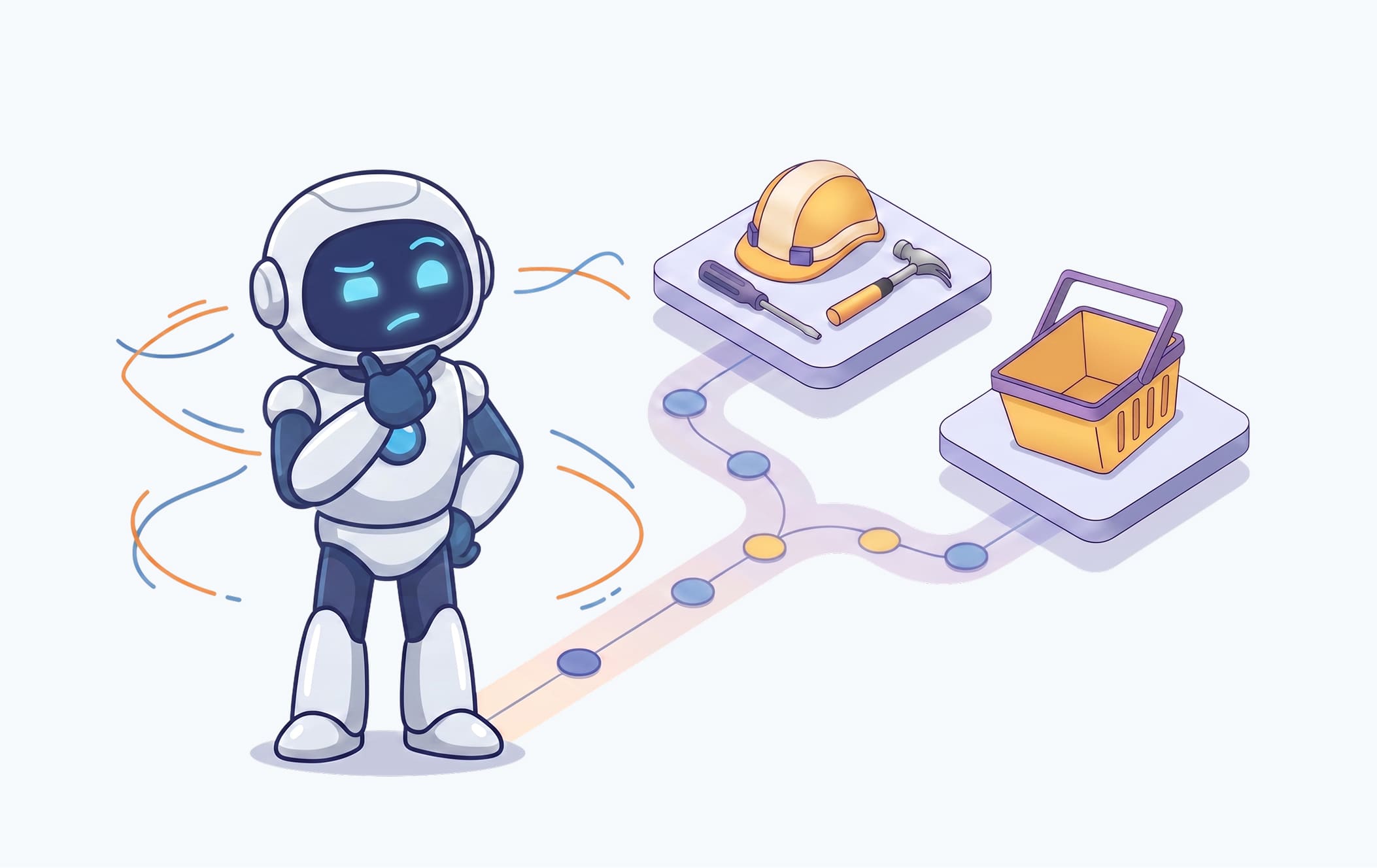
The question "Which is better, buy or build?" has no answer, just as "which is better, renting or owning?" has no answer. It depends entirely on the thing you are trying to do and the risks you can absorb while doing it.
In this article, we walk through the six doubts that actually keep this choice stuck in committee — and resolve each one with the evidence that bears on it. Then you can score your use case and read the result. By the end you won't have an opinion about buy-versus-build in the abstract.
The Question Underneath 'Buy or Build'
For orientation, the two ends:
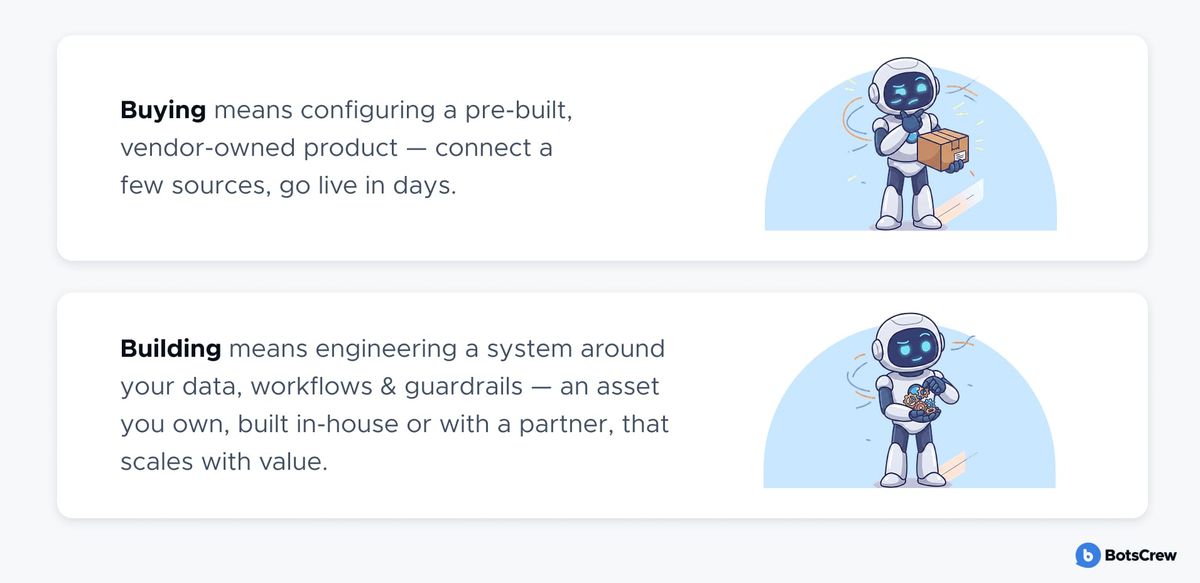
— Buying means a pre-built, vendor-managed product you configure rather than engineer. Log in, connect a few sources, set rules, go live in days. The vendor owns the model, the infrastructure, the updates, and the roadmap. You pay per seat or per use.
— Building means a system engineered around your data, workflows, rules, and objectives — a reasoning architecture, governed access to your structured and unstructured data, deep integration into your stack, guardrails, observability, and an evaluation suite that accounts for the fact that AI output is probabilistic, not deterministic.
The model, the data, and the roadmap stay yours. You can build it with an in-house team, a delivery partner, or a mix; ownership is what makes it "building." It scales with the value it produces, not with how many people you license.
Honest framing isn't "custom or off-the-shelf." It's this:
For this specific process, whose set of risks can we live with — the vendor's, or our own?
Both paths carry risk. Buying means living with someone else's roadmap, pricing, and outage schedule. Building means living with your engineering surface area, maintenance, and pager at 2 a.m. Neither path is safe. The right choice is the one whose failure modes you'd rather be holding.
The majority of organizations will run a hybrid — vendor tools for commodity work, custom components for whatever differentiates them. So the practical task is to draw the line between what to buy and what to build — and the following doubts are how you find where that line goes.
Note: this is the buy-the-tool-vs-build-the-agent question specifically. If you are still untangling agents vs. copilots vs. plain automation, we break that down separately in this blog post.
Now the doubts.
Doubt 1: "Can our team actually pull this off?"
Buying feels like the safe answer here: no ML engineers to hire, no infrastructure to stand up. But that comfort is half an illusion — the real question isn't whether you can build a model, it's whether you can own an AI solution once it's live. And that question doesn't go away when you buy.
✅ Building is the easy part; running it is the job. A working agent on day one is not a hard milestone. Monitoring it, catching drift, retraining as your data shifts, versioning prompts and permissions — that's the ongoing work, and it exists whether the system is custom or off-the-shelf. Buying a seat doesn't buy you out of owning the outcome.
✅ You don't need a research lab — you need a specification and an owner. The capability gap most orgs actually have isn't "we can't train models." It's "we don't have someone who can define what good looks like, oversee it, and hold the vendor accountable." That role is non-negotiable on both paths. The difference: building with a delivery partner transfers that capability to you and leaves you owning the asset; buying tends to keep you dependent on whoever sold it.
✅ The honest read. If you have no internal ability to specify, oversee, or govern an AI system, neither custom nor off-the-shelf saves you — off-the-shelf just hides the gap for longer. Build the ownership muscle first (in-house or through a partner who hands it over), then decide whether to build or buy.
Doubt 2: "If we build, can we finish?"
RAND found that over 80% of AI projects fail — roughly twice the rate of non-AI tech projects. That number isn't driven by bad ideas. It's driven by underestimating the engineering surface area between a working prototype and a production system. Going in clear-eyed about that surface area is most of the battle.
So be clear-eyed. A production-grade custom agent is not "a few weeks of clever prompt engineering stitched to an API." It's closer to shipping a small software product: a reasoning architecture, retrieval over your proprietary data, integrations, guardrails against hallucinations, logging that captures drift and not just errors, version control, rollback, cost controls — and an evaluation suite that tests probabilistic outputs across hundreds of edge cases.
That last part is what separates AI engineering from ordinary software: you're not debugging logic, you are proving a model clears an accuracy threshold reliably.
Two things make this finishable:
✅ Don't rewrite — harden. The failure mode isn't the first version; it's the rebuild that throws away the prompts, workflows, and edge-case handling that made the prototype work. Preserve what works; rebuild the scaffolding underneath it (auth, observability, integrations, error handling, deployment).
✅ Don't do it alone. MIT's data showed builds delivered with specialized external partners succeeded markedly more often than internal-only builds.
S&B Filters had proven an AI idea — it just needed to run reliably across the whole business. BotsCrew installed the production scaffolding a configured tool or a vibe-coded prototype never includes:
Read the caseshipped to production
Doubt 3: "Does buying hand our advantage away?"
If the same tool is sold to everyone in your industry, buying it automates the baseline, not your differentiation. You've caught up to the floor, which is fine for commodity work and fatal for the thing you actually win on.
This is the cleanest line in the whole decision:
✅ If AI capability is core to how you win, a vendor's generic roadmap means competing with a tool every rival can also license. There is no moat in a subscription anyone can buy.
✅ If the capability is table stakes — spam filtering, meeting summaries, general drafting — owning the IP buys you nothing. Rent it and move on.
The differentiation question is: if a competitor bought the exact same tool tomorrow, would we have lost anything? If yes, you're looking at something that wants to be built.
Furniture and textile leader Kravet needed employees to pull answers from a sprawling internal knowledge base — the exact scenario where a generic assistant stalls because it can’t reach proprietary content. BotsCrew built a custom internal AI grounded in Kravet’s own data and wired into how their teams actually work.
Read the caseyour own knowledge base
Doubt 4: "Can we keep control once it's running?"
An agent that needs a human to check every move isn't saving labor; it's relocating it. The real question here is: at what point does it earn the right to act alone?
Two forces sit here:
✅ Compliance can't be retrofitted. In healthcare, finance, and other regulated sectors, explainability and data control can't be bolted onto a black box after the fact. The EU AI Act and frameworks like DORA increasingly make human oversight and explainability a requirement. Custom lets you architect that in from day one — controlled data residency, audit trails, the works. Off-the-shelf gives you standard certifications and limited control over how data actually flows.
✅ The shadow-AI subplot. MIT surfaced it bluntly: while only ~40% of companies had official LLM subscriptions, ~90% of workers were already using personal AI tools for work. Buying seats doesn't make that risk disappear. Owning the workflow — with access controls, audit, and drift monitoring around it — does.
Doubt 5: "Can we trust it to act without a babysitter?"
An agent that needs a human checking every move isn't saving labor, it's relocating it. The real question here is: at what point does it earn the right to act alone? And the honest answer is that autonomy isn't a yes/no you grant on launch day — it's a level you raise as the agent proves itself.
✅ Autonomy is a dial, not a switch. The choice isn't "babysat forever" vs "fully loose." Most agents should start human-in-the-loop — every meaningful action gets approved before it fires. As the agent proves reliable on a task, it graduates to human-on-the-loop: acting on its own while a person watches and can step in. The point isn't to reach zero oversight, it's to put oversight where the risk actually is.
✅ Trust is earned per task, not per agent. An agent can be fully autonomous at drafting a reply and still require sign-off before issuing a refund or touching a production system.
That's the job of scoped permissions — defining exactly which actions it can take alone, which need approval, and which are off-limits — plus confidence thresholds that route any low-certainty decision to a human, and a clean escalation path for when it hits the edge of what it's trusted to do. Autonomy expands one action at a time, not all at once.
✅ This is where ownership sets the ceiling. Custom lets you place those checkpoints yourself: set the thresholds, decide which actions demand a human, and move the line outward as trust builds. Off-the-shelf hands you whatever autonomy the vendor baked in.
Doubt 6: "Who owns it when it breaks at 2 a.m.?"
Buy, and the pager belongs to a vendor's SLA — you wait. Build, and the pager is yours — you own both the fix and the timing.
This is where ownership, lock-in, and maintenance all converge:
✅ Buying means the vendor handles maintenance, updates, and uptime — a real relief if you lack in-house AI capacity. The flip side is dependency: their roadmap, pricing changes, data terms, their decision to sunset a product. You're leasing a capability, and if you stop paying you lose it.
✅ Building means you own the monitoring, retraining, drift, and integration upkeep — a genuine ongoing burden. The flip side is autonomy: you own the IP and the exit, you set the fix priority for mission-critical issues, and you are immune to a vendor's pricing shift or policy turn.
The Real Math Behind Buy vs. Build
The single most expensive mistake in this decision is comparing a subscription's monthly price to a custom project's upfront quote. They're not the same cost shape, and the comparison misleads every time. Think in curves instead.
The buy curve starts near zero and climbs forever, indexed to headcount. Budget the whole stack:
- The add-on license plus the required base license (e.g., an enterprise productivity suite plus its Copilot add-on lands near ~$87/seat/month all-in).
- Usage credits and cloud consumption for any agent doing work.
- Change management, enablement, and adoption programs — the line item that decides whether ROI ever appears.
- Data-readiness and governance remediation — the most underestimated prerequisite of all.
At 2,000 seats, a "$30/user" tool is a $700K+/year commitment before credits and services — and it never converts into an asset you own.
The build curve starts typically $10K–$500K+, scoped to complexity — then settles into a maintenance line (monitoring, retraining, integration upkeep). But it's indexed to usage and value, not seats, and at the end of it you own the IP.
Cumulative spend over 24 months — the curves cross, and the gap keeps widening
Buy (off-the-shelf)
Build (custom agent)
2,000 seats @ $30/user = $700K+/year before credits & services — and it never converts into an asset you own. Below the crossover: buying wins. Above it: owning the process wins and keeps winning.
The two curves cross. Below the crossing point — low volume, few seats, commodity work — buying wins on pure economics. Above it — high volume, where the per-seat tax compounds — owning the process wins and keeps winning. The entire cost decision is really "are we above or below the crossing point for this process?"
Still Debating? The 5-Minute Checklist That Ends the Buy-vs-Build Argument
Take your single hardest use case — the one this decision is actually about — and tally it.
Score +1 toward BUY for each true statement:
☐ It's commodity work any competitor could automate the same way.
☐ We're still experimenting and want to validate value before committing budget.
☐ We lack in-house AI capacity and want the vendor to own the infrastructure and updates.
☐ The use case lives entirely inside one vendor's ecosystem.
☐ We need it asap.
Score +1 toward BUILD for each true statement:
☐ The capability is part of our competitive moat.
☐ It must integrate deeply with legacy, proprietary, or many-system workflows.
☐ We are in a regulated industry where explainability and data control are mandatory.
☐ The process is high-volume, so per-seat pricing becomes a tax.
☐ We need an agent that owns a process end-to-end (or mostly end-to-end).
Reading your score:
- Lopsided toward buy → buy, and don't over-engineer. Wrap it in proper access controls and move on.
- Lopsided toward build → build, and respect the surface area.
- Split down the middle → you've found the hybrid, which is where most enterprises actually land. Buy the commodity layer, build the differentiated core, and put one governance layer — access controls, audit trails, RBAC, observability — over the whole estate so it stays auditable as agents multiply.
If you ran the pass and your score keeps drifting toward build over time, watch for the red flags that you've outgrown off-the-shelf:
🚩 You're building frequent manual workarounds to make the tool fit.
🚩 Performance or extensibility limits keep blocking you.
🚩 Vendor costs are rising faster than the value you can attribute to them.
🚩 You can clearly describe the business outcome you need — and no configured tool delivers it.
Out-of-the-Box vs. Custom AI Agents for Enterprise: Common Questions
- Is a custom agent always better than Copilot or Claude?
Off-the-shelf is the right call for commodity, individual-productivity work, fast experimentation, and single-ecosystem use cases. Custom wins when the capability is at your edge, demands deep integration, faces strict compliance, or runs at a volume where per-seat pricing becomes a tax. Most enterprises end up hybrid.
- How much does a custom agent cost?
Typically $30K–$500K+, depending on complexity — a simple single-purpose agent at the low end, an orchestrated multi-agent system at the high end.
- How fast can we deploy off-the-shelf?
Often days to a few weeks — the infrastructure already exists, so your timeline is mostly configuration and enablement.
- Are tools like Copilot or ChatGPT Enterprise secure enough for sensitive data?
They offer standard enterprise security and, on the right tiers, no-training-on-your-data commitments. Whether that's enough depends on your regulatory exposure.
- What's the lowest-risk way to start?
Buy a vendor tool for a narrow commodity task, use it to learn, and graduate to a custom build only on the workflows that hit a ceiling — armed, by then, with real usage data that makes the requirements precise.
Why BotsCrew?
If you can describe the business result you need, you're already ahead of most of the market. The next step is an honest triage of which results to buy, which to build, and which to leave alone.
We help enterprises decide what to buy, build what should be built, and turn stalled pilots into systems the business can depend on.
- Fortune 100 — trusted by enterprises
- 200+ projects — delivered end-to-end
- 10+ years — in AI development
- Bespoke AI agents — built for your stack.
We'll map each one to buy, build, or hybrid , sketch the cost shape, and show you the fastest path to a measurable outcome.