Agentic AI in Healthcare: Insights from the Real Implementations
What a decade of shipping patient- and clinician-facing for our clients taught us about what makes Agentic AI in healthcare to production, and what quietly dies once you are inside a regulated industry.

According to the RAND Corporation's numbers, roughly 80% of enterprise AI projects never reach production. The demos are dazzling. The pilots impress the steering committee. And then Agentic AI in healthcare meets a HIPAA review, an EMR integration estimate, a genetic counselor who won't sign off on an answer, or a budget that assumed all of this would cost $20,000 — and it stops.
We've been on both sides of that line. Over the last decade, BotsCrew has built several dozen conversational and generative AI systems specifically for healthcare and life sciences organizations. This is the honest version of what we saw and learned — organized as lessons, each anchored in a real deployment. If you're a CTO, a founder, or a decision-maker weighing an AI investment in a clinical or life sciences context and how agentic AI is being applied in healthcare, this is written for you.
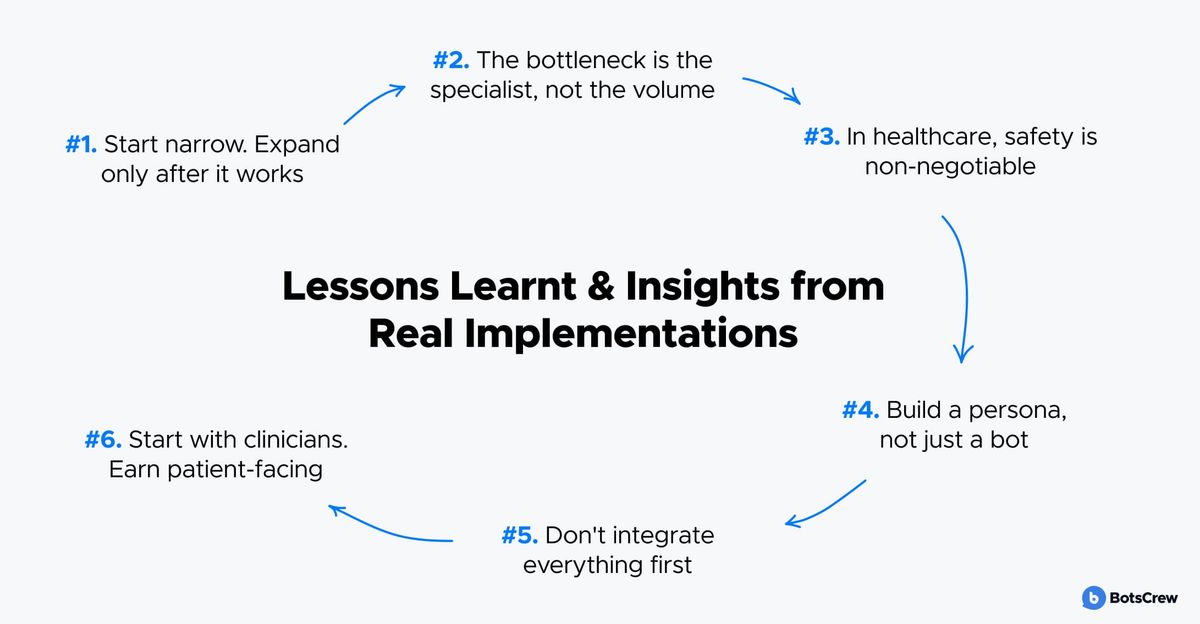
Lesson 1: Start Narrow & Expand Only After It Works
Want to know which healthcare AI projects ship? The ones that start small and unglamorous. When one of the biggest DNA diagnostics centers came to us, their call center was handling over 25,000 calls a month with a team of 38 reps, no 24/7 coverage, and customers waiting days for replies. The temptation — theirs and most vendors' — is to build "the healthcare agentic AI that handles everything."
We ran a Discovery phase, audited the actual call drivers, and launched a pilot that answered 9 questions on a single website page. That pilot automated 15% of the requests it touched. Only then did the solution expand to every page, with over 20% automation, scheduling, barcode registration, order status, and later to voice/IVR.
Today, the solution has served more than 125,000 users, automates 25% of customer-service requests, and has saved our client $131,149 in a single year — with IVR alone now covering 45% of conversations. None of that would have happened if we'd tried to build the 25%-automation system on day one.
Natera is the same story at a higher stakes level. The first generation, NEVA, didn't try to explain every genetic test. The proof of concept (PoC) automated exactly one test to validate that patients would trust a healthcare agentic AI with something as fraught as genetic information.
It drew 1,000+ conversations in the first month and 78% of patients were satisfied enough with the explanation that they didn't book a counselor. That single validated test became the foundation for a 6-year relationship, four products, and four tests automated.
When a later GenAI clinical assistant launched, the discipline was identical but sharper: it started with only negative results. Lowest clinical risk, fastest to validate, confidence built before anyone lets the model near a high-complexity oncology conversation.
For decision-makers: if a vendor's first milestone is a broad, all-encompassing assistant, push back. The correct first deliverable is a narrow proof of concept on your data whose explicit purpose is to surface accuracy gaps, contradictory documents, or unreadable scanned files — while it's still cheap to fix.
We've watched a knowledge-assistant pilot come in below 60% accuracy on real data and climb to nearly 90% once those data problems were fixed. The gap is rarely the model. It's the data and the retrieval configuration — and you only find that out by starting small.
Got an AI idea worth
shipping?
We've shipped 200+ AI products across 150+ projects. In a free 30-minute call, we'll pressure-test your idea, flag the riskiest assumptions, and sketch the smallest first version worth building. No pitch — just honest feedback on whether and how it ships.
Book a callLesson 2: The Bottleneck Is the Specialist, Not the Ticket Volume
Most automation business cases are written around volume: we get X requests, automation deflects Y%, here is the saving. In healthcare, that framing routinely undervalues the project, because the real constraint isn't request volume — it's an irreplaceable human.
There are only about 6,500 genetic counselors in the entire United States. Natera's oncology business was scaling faster than that profession could grow. Patients with anxiety-inducing results were waiting two weeks just for basic clarification, while highly trained counselors spent 30–60% of their time answering the same routine question: "what does my result mean?"
You cannot hire your way out of that. The supply doesn't exist. So the value of the agentic AI for healthcare providers wasn't "cheaper support" — it was decoupling patient growth from counselor headcount, removing the single biggest operational ceiling on the company's expansion.
The results reframe what "good" looks like:
— After talking to NEVA, only 0.5% of patients book a consultation with a genetic counselor — the rest get what they need from the assistant.
— Wait time for a basic explanation went from two weeks to zero — answers are available 24/7.
For decision-makers: wherever your scarce, expensive, hard-to-hire expert is spending their day on repetitive questions, the AI business case isn't cost reduction — it's capacity you literally cannot buy. Write the business case that way and the project gets funded.
Lesson 3: In Healthcare, Safety Architecture is Non-Negotiable
Outside healthcare, guardrails are a feature. Inside it, they're the entire reason the project is allowed to exist. The Natera assistant is the clearest example we can point to of patient-facing GenAI built for an environment with zero tolerance for inaccuracy or out-of-scope answers.
Genetic results are sensitive medical data; an Agentic AI in healthcare that improvises is not a risk, it's a non-starter. What made it shippable was an architecture where safety was load-bearing, not bolted on:
✅ A companion role, not a clinician. The conversation was designed with hard boundaries — it explains and educates, it does not give medical advice or interpret beyond scope, and escalation to a human is built into the flow rather than treated as a failure state.
✅ A multi-layer guardrail system — real-time input filtering, output validation, and risk-based request routing (a P0–P6 scheme) so the riskiest requests are handled most conservatively.
✅ RAG over fine-tuning. Responses are grounded in verified, updatable content — not baked into model weights. When clinical guidance changes, you update a document, not retrain a model. For anything with fast-moving or safety-critical content, this is almost always the right call, and if a vendor is pitching you a fine-tuned model for this use case, probe hard.
✅ An SME-approved knowledge base built from real counselor queries, patient materials, and FAQs — every entry expert-reviewed.
✅ Controlled access and provenance — authenticated patients only, fully embedded in the secure portal, with answers tied to sources.
That last point shows up in our GPT-powered assistant for nurses in skilled-nursing and assisted-living facilities. Ask the solution about a patient's medications, and it doesn't just answer; it shows its sources — the specific care plan, the clinical guideline, the policy document.
See how we built an AI assistant that solved Natera's genetic counselor shortage — without them hiring a single one.
Read the Natera case studyIn a setting where a wrong answer about a prescription is a genuine harm, a confident answer without provenance is worse than no answer at all. The solution (NDA) also hard-separates general medical Q&A from patient-specific chats, restricts patient data to authorized professionals, and is invitation-only — you cannot simply sign up.
For decision-makers: ask any healthcare AI vendor these questions first.
✍️ Can the system cite the exact source of every answer?
✍️ What happens to an out-of-scope or high-risk request — does it route to a human, and how is that decided?
Lesson 4: Design for the Human. Build a Persona, Not a Bot
There's a persistent assumption that "persona" and "tone of voice" are the soft, decorative end of an AI assistant project. In healthcare, they are often the part that determines whether anyone uses it at all.
One of our clients, a cancer research institute, came to us with a problem that no amount of model accuracy solves on its own: the African-American population has the highest cancer mortality rates in the US, and has been historically mistreated and underserved by the medical system.
Implementing agentic AI in healthcare, a technically correct product about immunotherapy and clinical trials would have been easy and useless. The actual work was designing an Agentic AI in healthcare — a persona, a tone of voice, and a conversational style built specifically for an audience with well-earned reasons to distrust medical institutions. The point was to sound friendly and rebuild a sliver of trust well enough that people would act on the information.
The outcome: 95% of users said the solution was helpful, 100% reported understanding the information clearly, and the bot scored an 85% Net Promoter Score — numbers most consumer products never see.
Another of our AI solutions makes the same point from a different direction. Built to combat loneliness among isolated seniors — a population for whom persistent loneliness is linked to up to a 56% higher risk of stroke — it connects older people with friendly volunteers.
The hard design constraints had nothing to do with NLP and everything to do with the user: many older people have poor eyesight and struggle with standard interfaces. So the work was oversized buttons, voice in, and voice out (text-to-speech and speech-to-text), and a flow forgiving enough for someone who has never used a chatbot.
For decision-makers: the principle holds across all audiences — systems with a real persona are used meaningfully more than faceless "AI assistants." But as both examples above show, a persona isn't a name you bolt on at the end.
It emerges from the details: voice, tone, scope, and accessibility, all designed around a frightened user. Those are the choices that tell someone what to ask, what not to ask, and how much to trust the answer — and in healthcare, that mental model isn't a nicety.
Lesson 5: Don't Integrate Everything First
One of the most valuable requests we get from healthcare organizations is some version of: automate our appointment booking, reminders, rescheduling, and follow-ups, so we cut no-shows and free up admin time. It's a genuinely high-impact use case — and getting it right largely comes down to sequencing it well from the start.
Doing it properly usually means integrating with the organization's electronic medical records or electronic health records(EHR). That work is substantial by nature: the data is extraordinarily sensitive, and it deserves real HIPAA compliance, correct hosting, and a security architecture that holds up to audit.
This is exactly the kind of complexity our healthcare experience is designed to absorb — and where a partner who has done it before saves you from expensive surprises. The most useful thing we bring to that first conversation is a realistic map:
🗺 what a compliant, integrated build actually involves
🗺 what it costs
🗺 how to phase it so you see value early instead of waiting on a single large milestone.
That's why our first move is always to right-size the first phase. Full EMR-integrated, multi-channel automation across web, SMS and voice is a powerful end state — but it's a roadmap, not a day-one deliverable. We help clients identify the slice that delivers value fastest, prove it, and let those results fund the deeper integration work. Setting that expectation early turns an ambitious vision into a project that actually ships, on a timeline and within a budget everyone can stand behind.
The flip side of this expertise is knowing when integration isn't the fastest path to value. Sometimes the smartest decision is no integration at all — at least to start. One of our clients was deliberately designed to need zero system integration: it works alongside the existing setup, drawing on internal policies and patient histories without touching the EMR, which is exactly why care staff could adopt it quickly without a multi-quarter IT project.
And where deep integration is the point — as with another one of our clients' CRM, where we built a chatbot management platform natively into a patient-engagement CRM across web, Facebook, and WhatsApp — we plan and resource it as the substantial, high-return piece of work it is. Reading which situation you are in, and sequencing accordingly, is most of the craft.
For decision-makers: the strongest predictor of adoption is whether the system lives where work already happens rather than as one more tab to open.
But "lives where work happens" and "integrates with everything on day one" are different claims. A strong partner will separate what genuinely needs deep, compliant integration from what can deliver value standing slightly to the side of your core systems — and ship the second first. That early win is what proves the case and funds the rest.
Lesson 6: Start with Clinicians. Earn Patient-Facing
If you're nervous about AI in a clinical setting, the lowest-risk place to start is almost always internal, clinician- or staff-facing, not patient-facing. The reasoning is the same one that makes an internal knowledge base the easiest enterprise AI use case generally: your data already exists, and your users are professionals — a far more forgiving and capable audience than a frightened patient — so an imperfect first version teaches you what to fix without putting anyone at risk.
One of the agentic AI systems for healthcare we built is an educational assistant for IBD clinical nurse specialists — a field complex enough that structured training is hard to fit into a clinical schedule. Nurses asked typed questions in everyday language and received expert-written answers organized into four progressive modules, turning scattered specialist knowledge into a self-paced program. It worked: 69% completed the full program, 84% found the learning genuinely engaging, and satisfaction reached 4.3.
For decision-makers: most providers try to confine AI to controlled internal processes precisely because patient-facing feels too risky — which is exactly why having done it, safely, with guardrails that hold, is the strongest signal a partner can offer. Start internally to build muscle. Graduate to patient-facing when your guardrails have earned it.
Most firms advise or build. We do both.
Book a call to see how and where we fit into your AI journey — and leave knowing whether your use case ships, and where the real cost and risk sit.
Book a consultationThe Fails: Projects That Don't Ship, and Why
Now, the part of the case-study PDFs never shows. Not every healthcare AI engagement works, and the failures cluster around a small number of causes that are entirely predictable in advance.
#1. The two-day-unboxing expectation. The most common reason small-clinic projects die is a fantasy timeline: the belief that a vendor can hand over a solution in 48 hours that drops perfectly into existing processes. Compliant, integrated healthcare AI does not work that way, and any vendor who agrees to it is either lying or about to fail.
#2. Budget-scope mismatch. Clients regularly want EMR-integrated, multi-channel (web + SMS + automated voice) automation while expecting it to cost less than a single quarter of a senior hire. The genuinely interesting, large-scale projects — phone-call automation, full appointment lifecycle — are real, but they aren't a small first check. When the budget assumes the trivial version of a non-trivial problem, the project stalls.
#3. Underestimating integration and compliance. Teams budget for the AI agent and forget that the cost and risk live in the EMR/EHR integration, the HIPAA work, the hosting, and the sensitive-data handling. The conversational layer is often the cheapest part.
#4. The PoC that was never designed to graduate. A pilot built to look good in a board meeting rather than to expose problems will sail through the demo and die on contact with real users and real data.
Why BotsCrew?
We've built conversational and AI systems for over a decade — for Fortune 500 organizations, through several shifts in what the underlying technology could actually do. A lot of vendors arrived three or four years ago, when AI became the obvious thing to sell.
One distinction is worth stating plainly: we have patient-facing generative AI running in production in healthcare. Getting there means solving the parts that never show up in a demo — clinical accuracy, regulatory review, and integration with systems that were never designed to talk to each other.
We also work across the full lifecycle — discovery, build, integration, maintenance, delivery — rather than a single slice of it. Much of the market specializes: strategy and analysis, data normalization, agent development, or a packaged product. We run the whole path, with the constraints of a regulated clinical environment built into how we work from the start. HIPAA and GDPR compliance, SLAs, and NDAs are part of the baseline, not items negotiated late.
The record behind that: 200+ AI projects in production, a top AI consulting ranking on Clutch, and clients including Natera, Red Cross, DDC, and Women First Digital.
If you are weighing an investment for agentic AI for healthcare in a clinical or life sciences context and want a candid read on where the highest-value, lowest-risk opportunity actually is in your environment — that's the conversation we are built for. We'll tell you where to start narrow, what to refuse to integrate yet, and what a PoC designed to break would reveal about your data.
Let's build something that ships.
BotsCrew builds bespoke conversational and agentic AI for healthcare and life-sciences organizations — patient-facing and internal, from Discovery through production and maintenance.