



Top 7 AI Agent Development Companies: How to Choose the Right One
Bitter reality: it's hard to tell who can deliver production-ready AI and who is selling polished demos. Choose the wrong partner, and you risk wasted budget, stalled pilots, and systems that don't scale or deliver ROI. In this guide, we highlight the top AI agent development companies and show you how to choose the right partner.

Everyone is building AI agents now — but very few are building ones that actually work in real business environments. For leaders, that creates a real problem: it's hard to tell who can deliver production-ready AI agents and who is just selling polished demos. Choose the wrong partner, and you risk wasted budget, stalled pilots, and systems that don't integrate, scale, or deliver ROI.
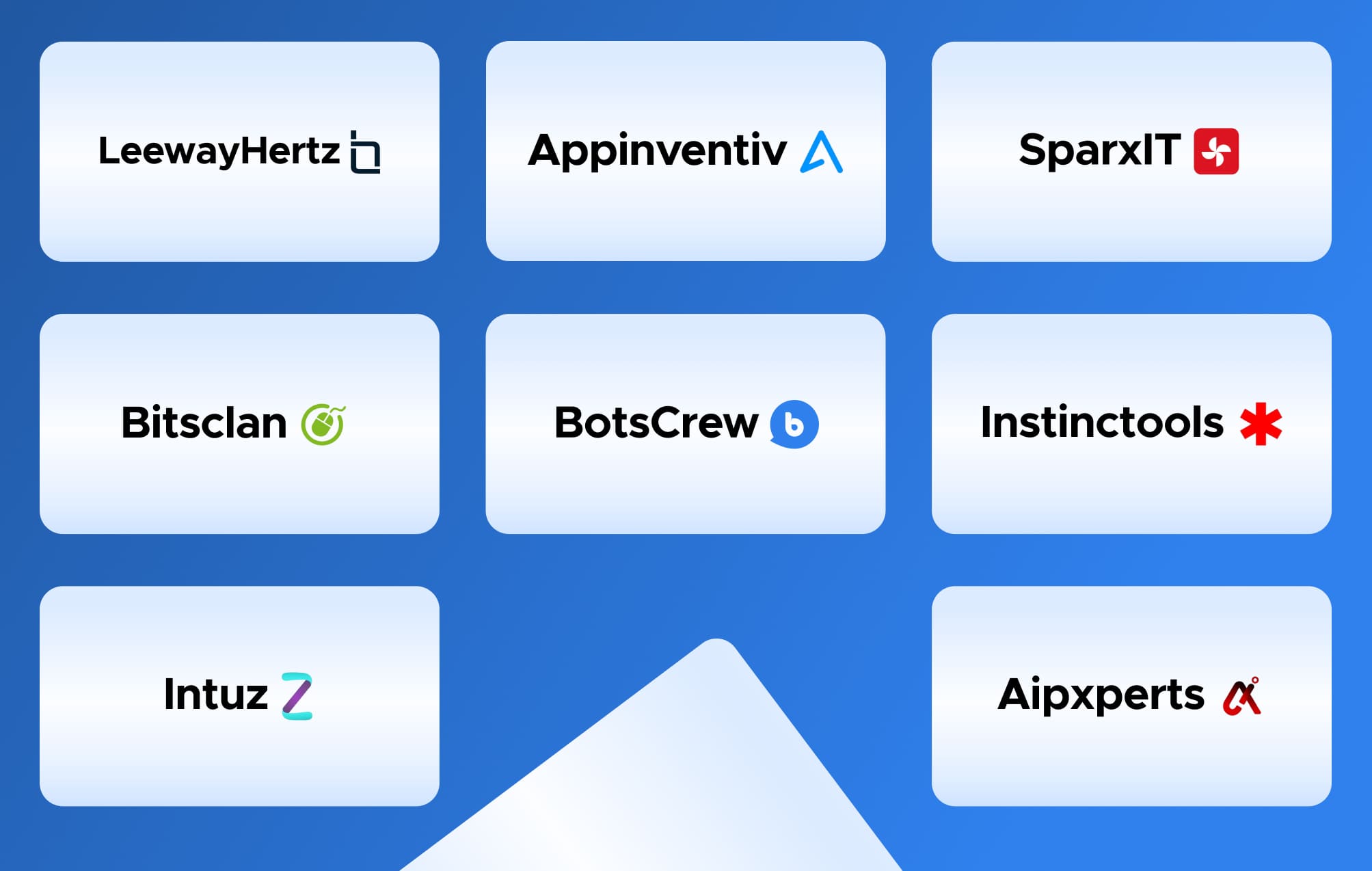
We've highlighted top AI agent development companies and show you how to choose the right partner — so your AI agents solve real problems, not just look impressive. Besides what are the top agentic AI development companies, this longread also explains:
- What defines a specialist AI agent development company
- How to evaluate potential partners
- Which companies fit this category.

Leading AI Agent Development Companies to Consider
Below are the best AI agent development companies that consistently operate in this specialist category, building custom, production-grade AI agents.
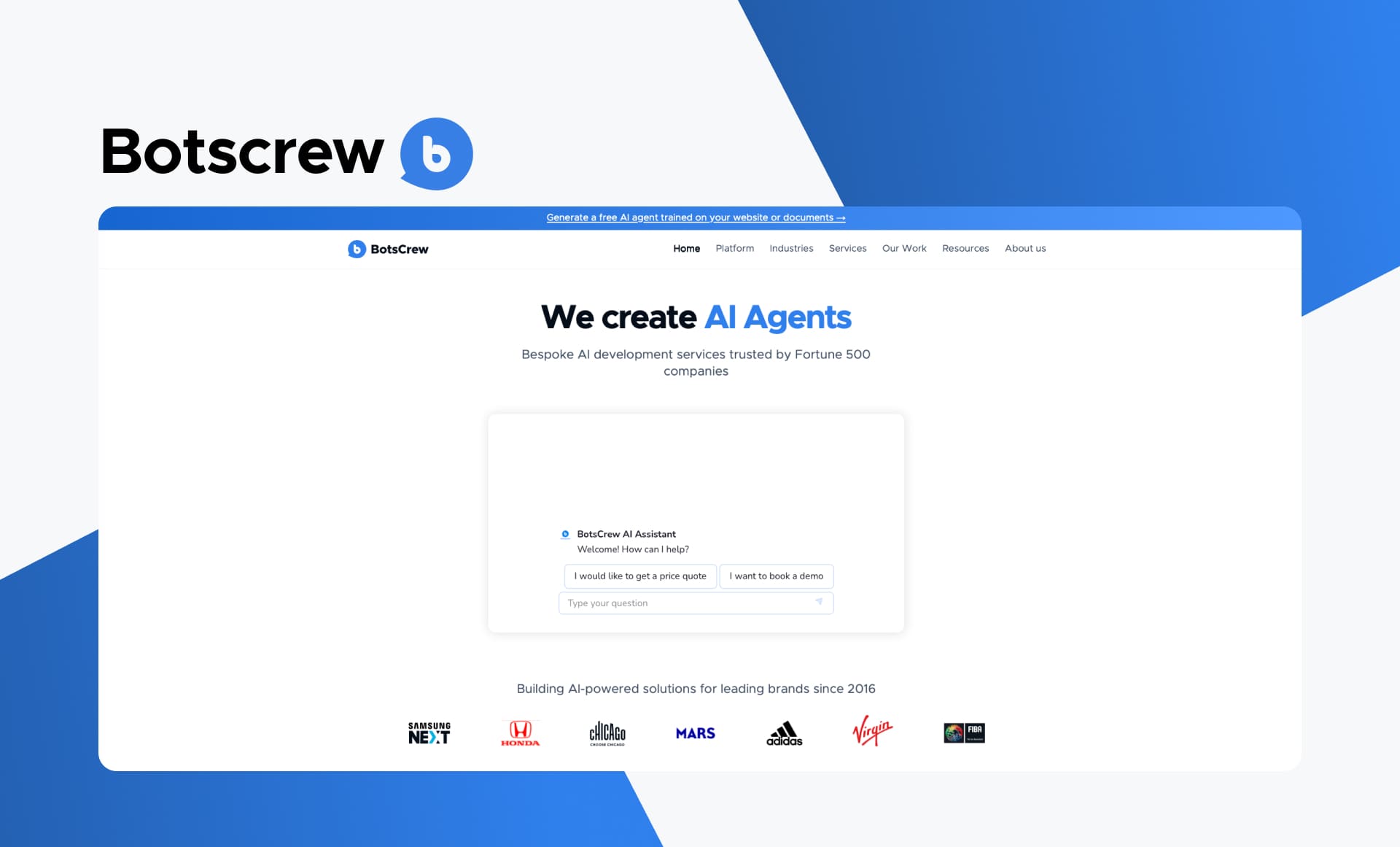
BotsCrew
Clutch Rating: ~4.7–4.8 ⭐
Location: San Francisco, CA, USA & Lviv, Ukraine
Headcount: ~50–249 employees
Year Founded: 2016
BotsCrew delivers enterprise-grade AI agents that are built to scale, operate securely, and deliver measurable business impact. Every project starts with a structured discovery and proof-of-concept phase, allowing ideas to be validated early, risks to be reduced, and success metrics to be clearly defined before full rollout.
BotsCrew takes a model-agnostic approach, selecting the right LLM based on your exact use case, data sensitivity, and compliance requirements. Whether that means commercial models, self-hosted open-source models, or hybrid architectures, the focus is always on long-term control, performance, and security.
With deep expertise in governance, access control, and production reliability, BotsCrew builds AI agents that integrate directly into enterprise systems and operate safely in real-world conditions. Trusted by Fortune 500 companies, they bring proven experience deploying AI agents across large organizations with complex data, strict privacy constraints, and high operational stakes.
Delivery strengths:
AI strategy & consultancy-first approach. Clear guidance on use case prioritization, ROI assessment, architecture decisions, and AI readiness — not just development.
Model-agnostic AI strategy. No lock-in to a single LLM. BotsCrew selects the best-fit model based on the job-to-be-done, data sensitivity, deployment constraints, and compliance needs.
Deep integration with enterprise systems. Agents tightly integrated with CRMs, ERPs, internal knowledge bases, APIs, and workflows.
Transparent cost & lifecycle planning. Clear separation of development, deployment, and ongoing support costs, with realistic forecasting of maintenance and operational expenses.
Long-term support & ownership models. Flexible post-launch support options, including SLAs, dedicated account management, QA, business analysis, and ML expertise to continuously adapt and improve agent performance.
Use cases:
- Internal knowledge assistants for employees
- Customer support and service desk agents
- Secure enterprise copilots for daily workflows
- Operations and process automation agents
- Multilingual internal and external assistants.
Clients: Honda, Adidas, Samsung, Mars, Red Cross
Best suited for: enterprises and regulated industries needing secure, internal, production-grade AI agents.
Book a Free 30-Minute AI Strategy Consulting Session. Turn your AI ambitions into a clear, actionable roadmap with BotsCrew's enterprise AI experts. Trusted by global brands like Adidas, Honda, Samsung NEXT, and Mars, we help you assess opportunities, validate use cases, and plan for measurable impact.
LeewayHertz
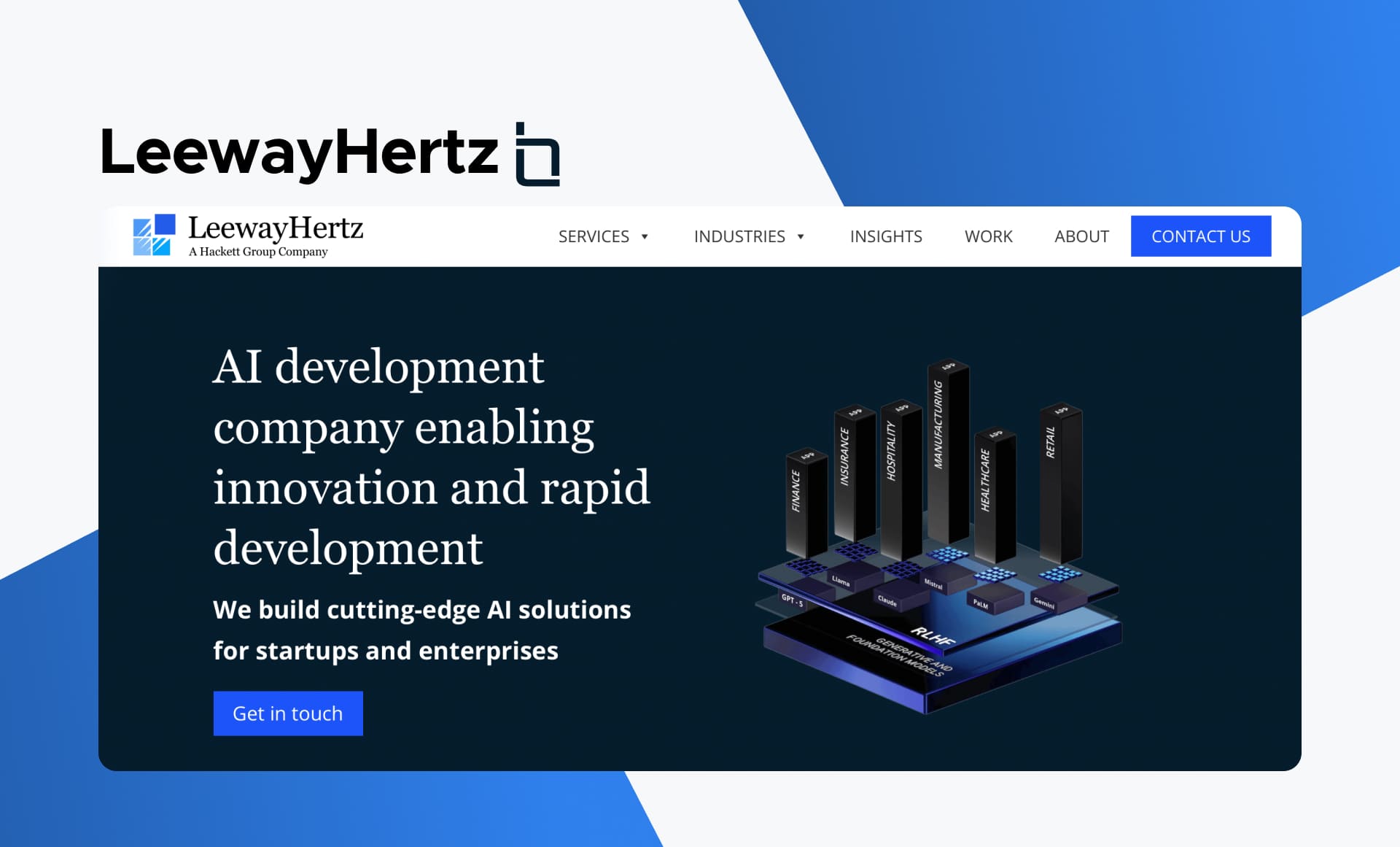
Location: San Francisco, CA, USA (HQ) & operations in India (Gurgaon)
Headcount: ~118 employees
Year Founded: 2007
LeewayHertz has over 15 years of experience delivering custom AI and software solutions for startups and Fortune 500 companies. The company operates across the full AI lifecycle — from strategy and data engineering to model development, system integration, and long-term scaling.
They handle complex, data-heavy environments where model performance and reliability depend on robust upstream pipelines. The company is consistently featured on platforms like Clutch and GoodFirms, with industry recognition for AI development, digital transformation, and enterprise software delivery.
Delivery strengths:
- Full-cycle AI delivery, from early strategy to production rollout
- Experience designing multi-agent and multi-step workflows
- Strong focus on enterprise scalability and system robustness
- Experience working with data-heavy and regulated environments.
Use cases:
- Cross-department enterprise AI agents
- Healthcare and finance automation (e.g., process support, decision assistance)
- Enterprise workflow automation and orchestration
- AI assistants supporting complex business operations.
Clients: P&G, Hershey's, Siemens.
Best suited for: large organizations seeking a long-term AI partner capable of designing, building, and scaling multiple AI agent use cases across departments.
Appinventiv
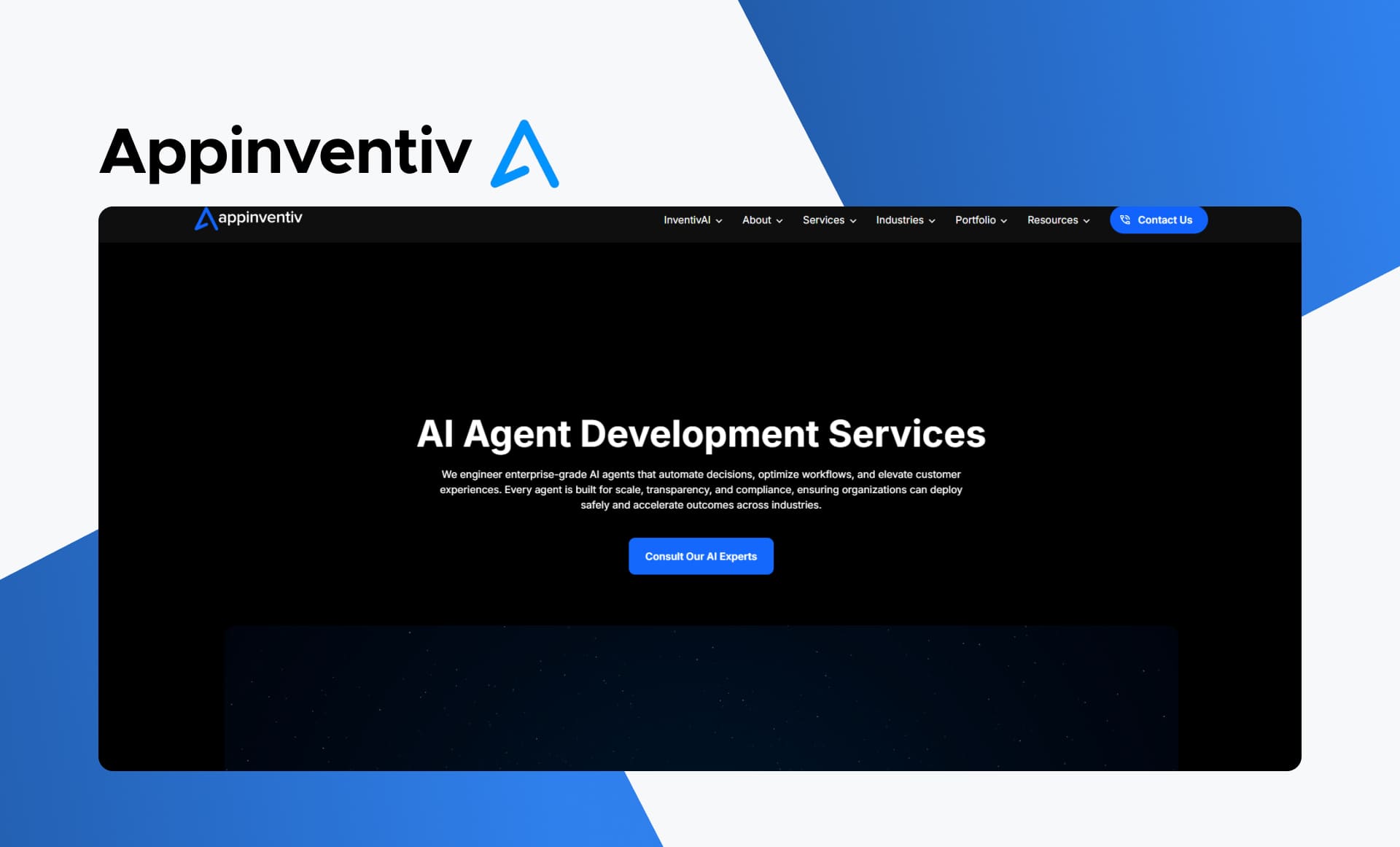
Location: Global (offices in USA, UK, UAE)
Headcount: ~1600+ employees
Year Founded: 2015
Appinventiv is a large digital product and transformation firm with extensive experience delivering complex software solutions across mobile, web, and enterprise platforms. While they offer AI agent development, this capability is embedded within a broader product engineering portfolio — meaning their strength lies in building AI as part of a larger digital ecosystem, not as isolated automation components.
Delivery strengths:
- Strong engineering and UX orientation: integrating AI into complex user journeys, designing intuitive interactions around AI capabilities, and ensuring performance and reliability across platforms.
- Intelligent assistants that support transactions or workflows
- Context-aware search and recommendation experiences
- Conversational interfaces tied to business logic.
Use cases:
- AI agents embedded in mobile or web apps
- Customer-facing assistants
- Platform-level AI features.
Clients: KFC, KPMG, Domino's
Best suited for: companies where AI agents are part of a larger digital product, not standalone systems.
Aipxperts
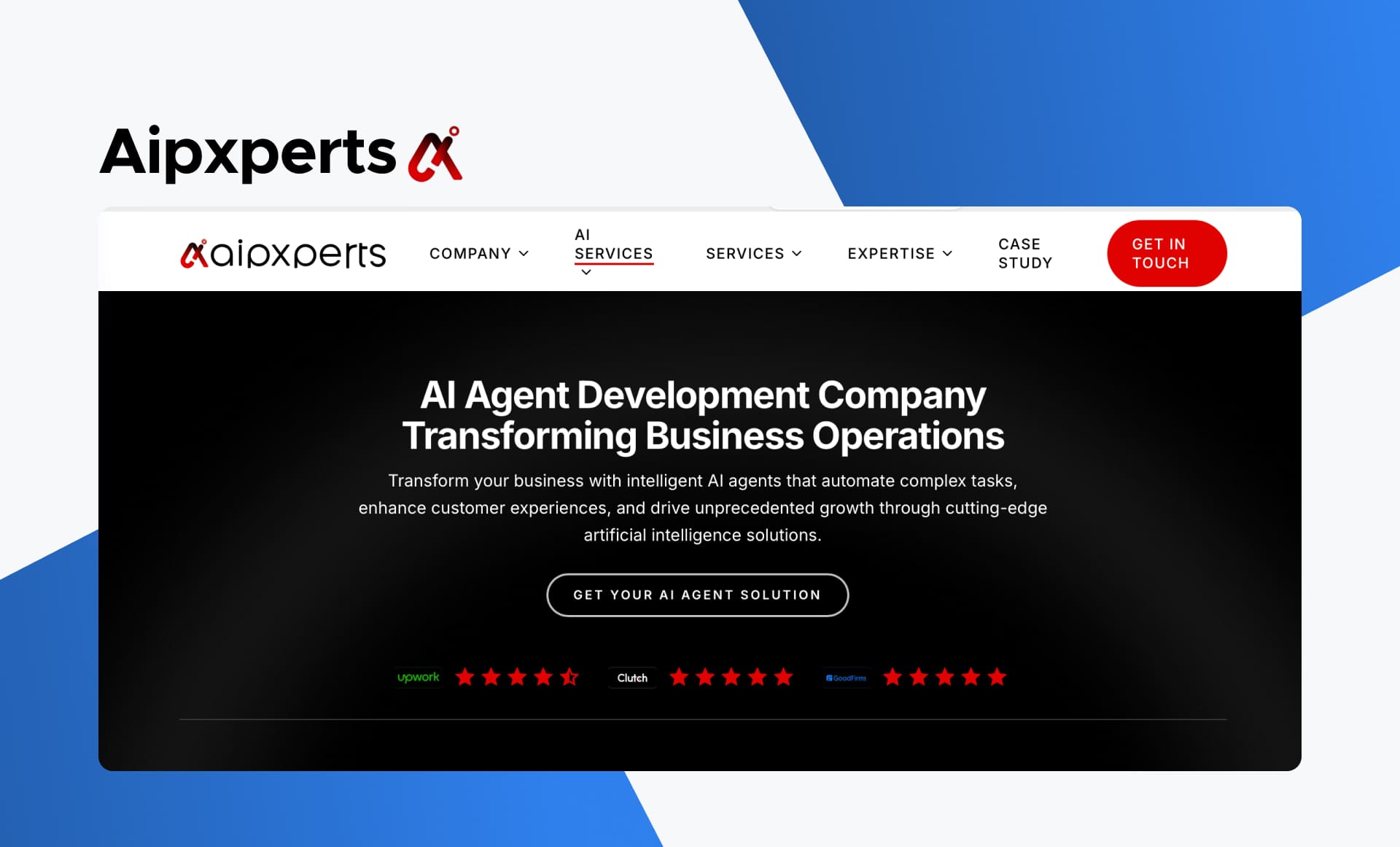
Location: Ahmedabad, Gujarat, India
Headcount: ~11–50 employees
Year Founded: 2011
Aipxperts blends agent logic with full-stack web and mobile development, making them particularly strong for automation that is tightly tied to business workflows and user interfaces. Their typical engagement model suits teams that want working software quickly, without the overhead of formal enterprise governance frameworks, deep compliance structures, or heavyweight architecture reviews.
Aipxperts excels in scenarios where AI agents are tools for productivity and automation, not standalone AI platforms. Their delivery model emphasizes:
+ Lean, agile execution — short cycles, iterative delivery, and early working results
+ Practical business impact — agents that automate real tasks rather than theoretical use cases
+ Seamless integration with custom apps — bots and agents that live inside the systems users already work with.
Delivery strengths:
- UI-centric agents within internal tooling
- The delivery model tends to be more flexible and lightweight
- Full-stack + AI under one roof: Aipxperts combines standard web and mobile app development with AI capabilities, meaning engineering teams don't have to coordinate across multiple vendors.
Use cases:
- Internal automation agents that handle routine tasks
- Task execution bots tied directly to existing business apps
- AI-enhanced tools that augment internal workflows (e.g., dashboards with AI insights)
- Support bots for business processes.
Clients: TelemetryTV, Legiit Freelance Marketplace. Primarily SMB and mid-market clients
Best suited for: SMBs and mid-market teams with agile delivery expectations, companies needing practical automation rather than AI strategy consulting, and organizations that want AI embedded into existing apps and workflows.
Instinctools
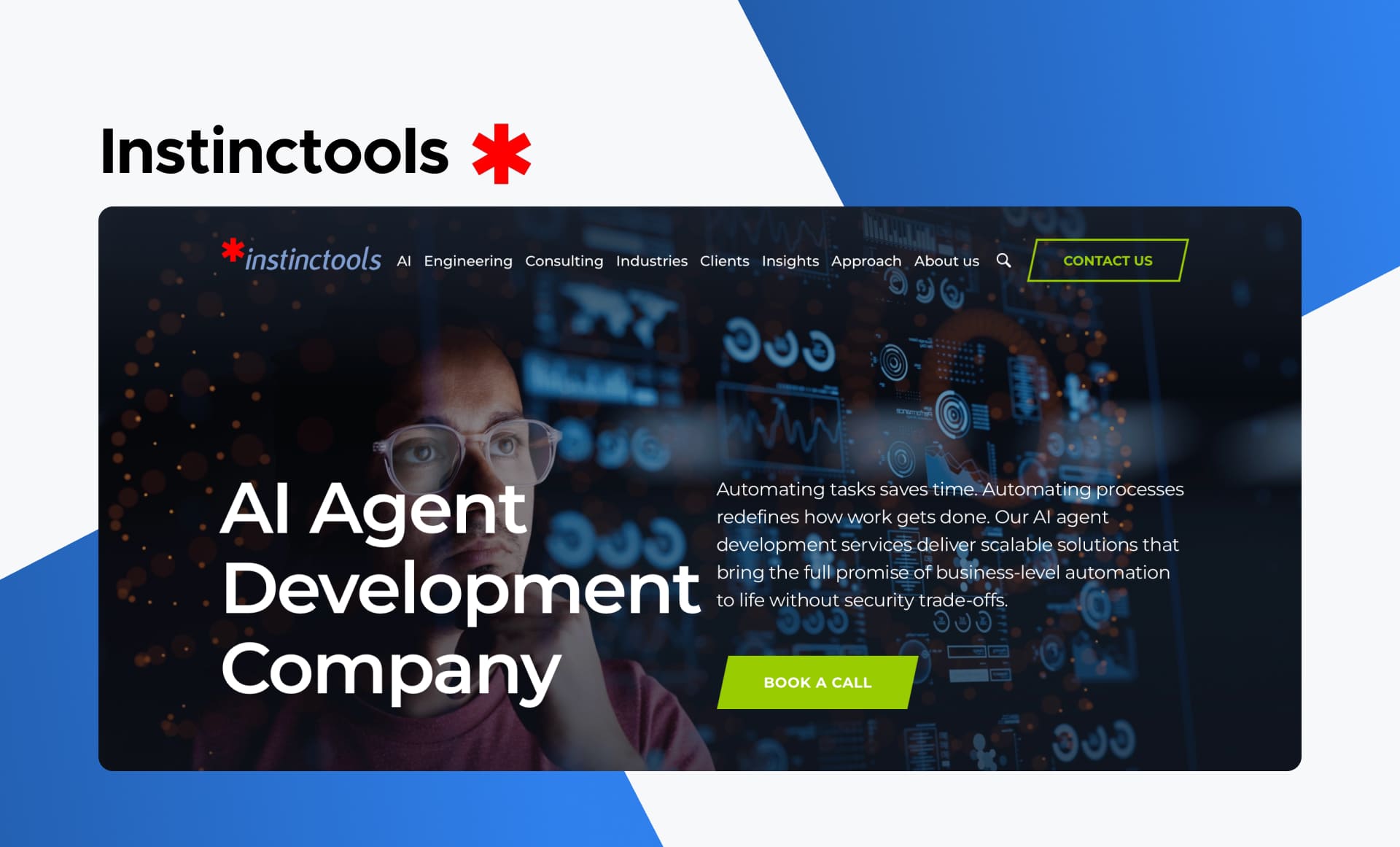
Clutch Rating: ~4.7 ⭐
Location: Stuttgart, Germany; USA (Maryland/Wilmington) & dev centers worldwide
Headcount: ~250–999 employees (Clutch estimate)
Year Founded: 2000
Instinctools builds AI agents as part of larger enterprise systems, especially where modern capabilities must be married to existing infrastructure and workflows. This makes the company a strong choice when the challenge isn't just to build an AI agent, but make this agent work reliably inside a complex, highly-entrenched environment.
Delivery strengths:
- Legacy & ecosystem integration expertise
- Maintainable and scalable architectures: their engineering teams focus on well-structured microservices, observability (logging, tracing, monitoring), automated testing, and CI/CD
- Cross-disciplinary delivery capacity: Instinctools blends AI engineering with backend, frontend, DevOps, and data engineering.
Use cases:
- AI agents embedded within legacy enterprise platforms
- Internal automation tied to complex business systems
- Workflow support where multiple systems must coordinate
- Production-grade bots integrated into backend processes.
Clients: Fujitsu, Mercedes-Benz, Burda Digital
Best suited for: mid-to-large enterprises with multi-system complexity, organizations modernizing decades-old systems.
Intuz
Location: San Ramon / San Francisco, CA, USA; Ahmedabad, India
Headcount: ~50–249 employees
Year Founded: 2008
Intuz is known for delivering cost-effective, production-ready solutions that help internal teams improve operational efficiency and reduce manual work. Their agent work is typically embedded within backend services, dashboards, or internal tools, rather than standalone intelligent products.
Delivery strengths:
Cost-effective execution. Intuz is often selected by teams with budget constraints who still want to deploy production-ready AI capabilities. Their pricing range (~$25–$49/hr on Clutch) is significantly lower than many enterprise firms.
Backend automation expertise. Their strength is in backend-heavy workflows and data processing, meaning agents fetch and manipulate data reliably, integrations with databases, APIs, and business systems are smooth, automation logic is implemented with maintainability in mind.
Reliable execution for defined scopes.
Use cases:
- Process automation agents that handle routine backend tasks
- Data-driven internal tools that generate insights or summaries
- Operational efficiency bots for internal teams (e.g., reporting, data syncs)
- Agents tied to backend workflows rather than public-facing interfaces.
Clients: Bosch, Holiday Inn, Mercedes-AMG
Best suited for: small to mid-market organizations, businesses piloting internal automation, projects with modest scope but precise operational payoff.
SparxIT
Clutch Rating: ~4.8 ⭐
Location: Noida, Uttar Pradesh, India (HQ) & presence in USA/UK/UAE
Headcount: ~100–999 employees
Year Founded: 2007
Delivery strengths:
- End-to-end AI delivery
- Enterprise workflow support.
Use cases:
- Internal workflow agents that reduce manual effort
- Operational support assistants for teams (e.g., HR, operations, customer ops)
- AI-enhanced business tools integrated into enterprise workflows.
Clients: Toshiba, Walmart, Accenture
Best suited for: organizations focused on workflow automation, not highly autonomous or reasoning-heavy agents.
How to Choose Between AI Agent Development Companies
Choosing the right partner between the best companies for custom AI agent development matters as much as the technology itself. The wrong choice can lock you into brittle architectures, unclear ownership, or agents that never make it beyond a pilot.
The right one becomes a long-term extension of your team. Here is a practical shortlisting framework to help you compare specialist AI agent companies side by side — focusing on what actually matters: technical depth, delivery maturity, and business impact.
Agent architecture maturity
What to check:
✅ Do they build tool-using agents (APIs, DBs, RPA, search)?
Tool access is what turns AI from a conversational layer into an operational one — able to fetch data, trigger actions, and integrate with your existing systems.
✅ Can they design multi-step/multi-agent workflows?
Multi-step and multi-agent designs allow agents to plan, coordinate, and handle complex tasks reliably instead of failing outside narrow use cases.
✅ Do they support memory, context, and state management?
AI agents must stay consistent over time. Memory and state are what prevent repeated questions, lost context, and unpredictable behavior, making agents usable in production.
🚩 Red flag: “We keep the architecture lightweight and let the LLM handle most of the decision-making.”
This usually means the system lacks explicit orchestration, guardrails, and state control. Business logic lives inside prompts instead of code, workflows aren't deterministic, and failures are hard to reproduce or debug. As complexity grows — more tools, longer processes, higher reliability requirements — the agent becomes unpredictable and fragile, making it unsuitable for production use.
Integration depth
What to check:
✅ CRM, ERP, ticketing systems, data warehouses
Without deep, reliable access to these systems, agents can't execute meaningful actions or support real operational workflows.
✅ Internal docs, permissions, role-based access
AI agents must respect the same access rules as humans. Proper permissioning prevents data leaks, ensures compliance, and makes agents safe to deploy across teams.
✅ Event-driven or async workflows
Real systems don't wait for prompts. Event-driven and asynchronous designs allow agents to react to changes, handle long-running tasks, and operate reliably at scale.
Production readiness
What to check:
✅ Monitoring, logging, fallbacks, human-in-the-loop
Visibility and fallback paths are what make AI systems safe and operable in real environments.
✅ Versioning, prompt & model management
Without proper versioning and controlled updates, small changes can silently break workflows or alter behavior in production.
✅ Latency, cost controls, rate limiting
Performance and spend scale fast. Production-ready teams design for predictable response times and cost ceilings from day one.
🚩 Red flag: No discussion of post-launch operations, monitoring, or long-term ownership once the agent goes live.
Security, privacy & compliance
What to check:
✅ Data isolation, PII handling
Agents often touch sensitive data. Strong isolation and clear PII handling are essential to prevent leaks, misuse, and compliance violations.
✅ On-prem / VPC / private cloud options
Many enterprises can't send data to shared environments. Flexible deployment models are critical for meeting internal security and regulatory requirements.
✅ Experience in regulated industries
Teams that've worked in healthcare, finance, or enterprise environments understand audits, controls, and real-world constraints.
Must-have for: Healthcare, finance, and enterprise internal agents.
Model & stack flexibility
What to check:
✅ Multiple LLM providers (OpenAI, Anthropic, open-source)
No single model stays best forever. Flexibility lets you switch based on performance, cost, data sensitivity, or regulatory needs.
✅ Vector DB choices, orchestration frameworks
Different use cases require different infrastructure. A one-size-fits-all stack limits scalability, retrieval quality, and long-term adaptability.
✅ No hard vendor lock-in
Dependencies compound over time. Avoiding lock-in keeps you in control as tools, pricing, and capabilities change.
Why it matters: Agent stacks evolve fast — and rigid architectures age even quicker.
Use-case understanding
What to check:
✅ Can they map business processes → agent flows?
Agents should automate real work, not abstract ideas. Strong partners translate messy, human workflows into clear, reliable agent logic.
✅ Do they challenge bad requirements?
Not every process should be automated as-is. The right partner pushes back, simplifies flows, and prevents you from building the wrong thing faster.
✅ Evidence of similar real-world agents
Production experience matters. Prior deployments show they understand edge cases, failure modes, and operational reality.
🚩 Red flag: Over-focus on demos, under-focus on outcomes. It shows up as polished walkthroughs and scripted success paths, with little discussion of metrics, adoption, error rates, or business impact. The focus is on what the agent can do, not what actually improves once it's live — often a sign of limited production experience or accountability for real KPIs.
Ownership & maintainability
What to check:
✅ Clean handover, documentation
Agents don't stop evolving after launch. Clear documentation and structured handover prevent long-term dependency on the vendor.
✅ Your team can maintain & extend agents
Internal teams need control. If only the original builder can make changes, velocity drops and costs rise.
✅ Clear IP ownership
You should clearly own the code, data, and agent logic you are paying to build.
Interested in AI that actually drives results? Book a call and we'll uncover high-impact opportunities and map a roadmap for measurable ROI.
2️⃣ Mapping Specialist Companies to Use Cases
Helps buyers quickly see who fits what — and why.
🧑💼 Customer Support & Service Agents
Automated resolution, tier-1/2 support, knowledge access.
Best fits:
- BotsCrew — Enterprise-grade conversational agents with deep system integrations, access control, and compliance
- Appinventiv — Customer-facing support agents embedded into mobile and web products with strong UX
- SparxIT — Support agents tied to internal workflows and operational processes.
🏢 Internal Operations & Enterprise Copilots
HR, IT ops, finance, policy & procedure agents.
Best fits:
- BotsCrew — Secure internal assistants with permissions, governance, and production reliability
- LeewayHertz — Cross-department enterprise copilots spanning multiple systems and workflows
- Instinctools — Internal agents embedded into legacy platforms and complex enterprise architectures
- Intuz — Cost-effective internal automation and operational efficiency bots.
📊 Analytics & Decision-Support Agents
Forecasting, planning, recommendations, data-driven insights.
Best fits:
- BotsCrew — Analytics and insight agents integrated with enterprise data sources, including solutions delivered for one of the world's largest beverage company
- LeewayHertz — Decision-support agents built on strong data engineering and ML foundations
- Intuz — Backend-heavy, analytics-driven internal tools for operational teams
- Aipxperts — Practical analytics agents embedded into custom business tools.
🧩 Embedded AI Agents (inside products & platforms)
Agents shipped as part of SaaS, mobile, or enterprise applications.
Best fits:
- BotsCrew — Embedded AI agents integrated into enterprise platforms with governance, access control, and production reliability
- Appinventiv — AI agents built as native features inside prominent digital products
- Aipxperts — Embedded automation agents in custom web and mobile apps
- SparxIT — Workflow-centric agents integrated into enterprise platforms
- Intuz — Budget-friendly embedded agents for internal or operational products.
3️⃣ Quick Decision Matrix
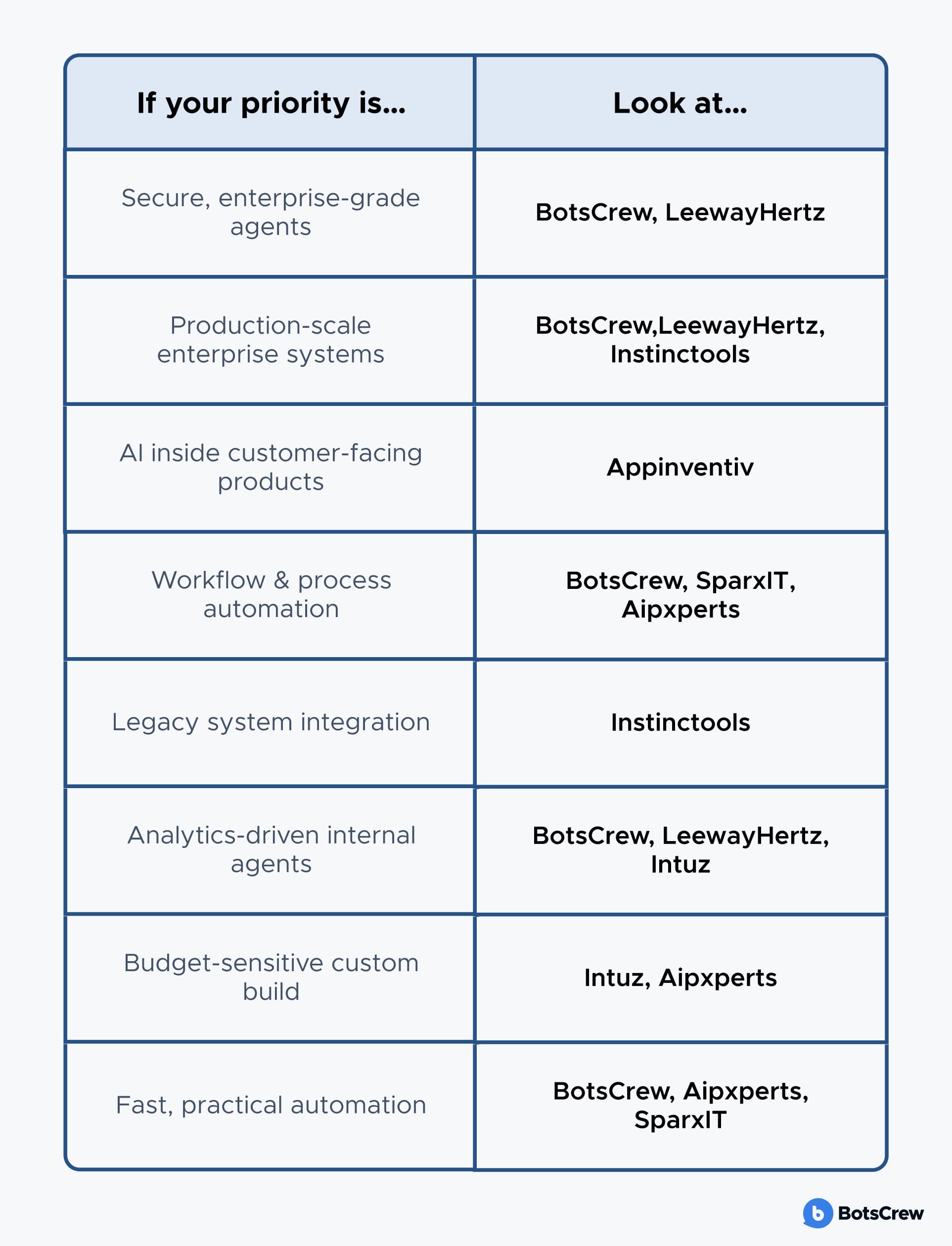
Why This Framing Works (Editorial Note)
- Moves the discussion from "who's biggest” to "who's right.”
- Separates agent builders from consultants & directories.
- Helps buyers avoid PoC hell.
Avoid Costly AI Mistakes. Book a free consultation with BotsCrew and ensure your AI initiatives succeed from day one.