





Data Types in AI: Structured vs Unstructured Data & Why It Matters
The bitter truth: most AI initiatives don't fail because of the model. They fail because of the data. In most board-level AI discussions, the focus quickly shifts to models, vendors, tools, and use cases. Should we build or buy? Which LLM should we integrate? How do we stay competitive? Yet in practice, the success or failure of an AI initiative is rather determined not by the model alone, but by the type of data (structured vs unstructured data) the company actually operates on — and whether its architecture aligns with it.

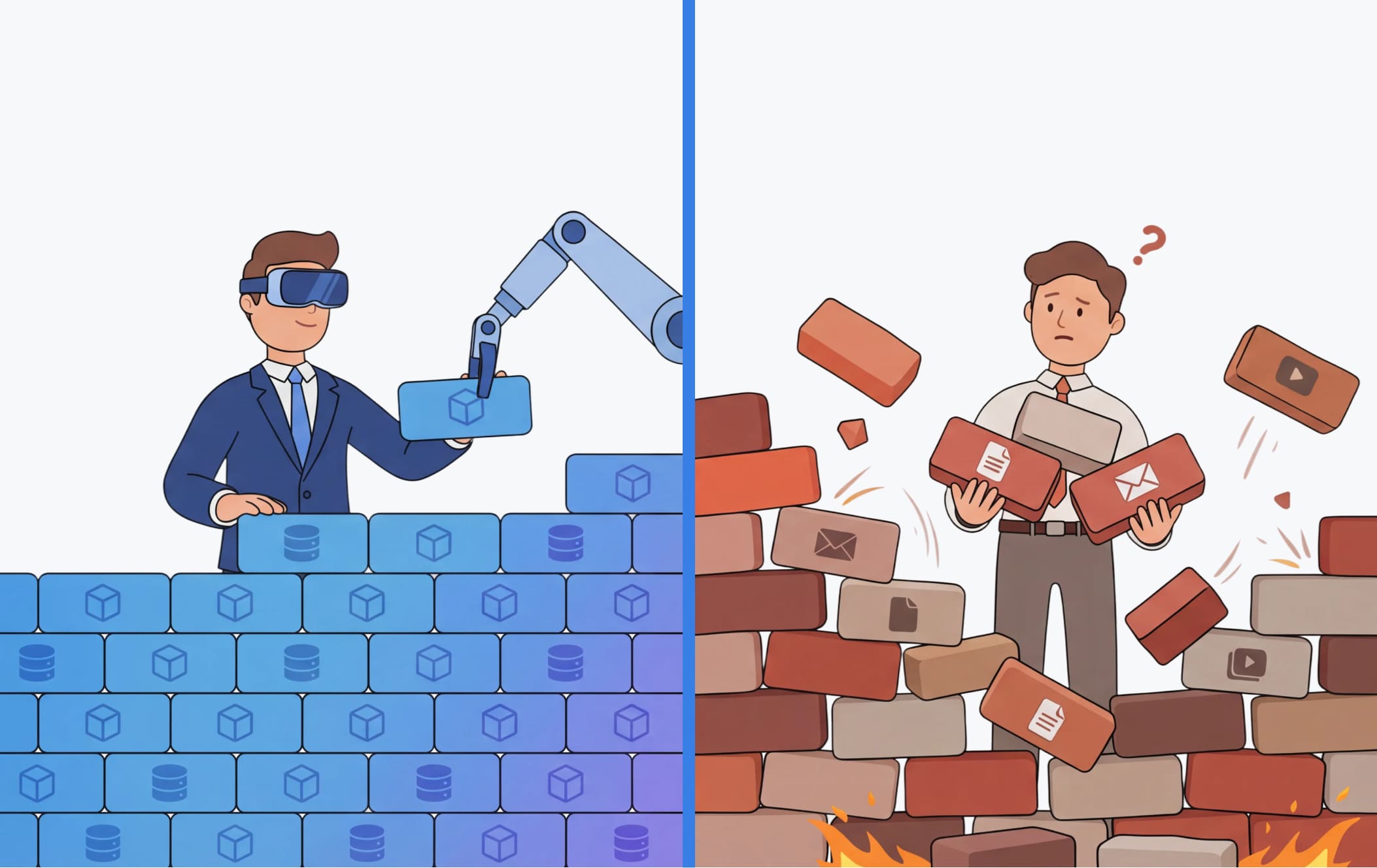
For C-level leaders across mid-size businesses and large enterprises, the pressure is clear: deploy AI, automate processes, unlock insights, and drive measurable ROI. Boards expect transformation. Investors expect efficiency. Competitors are experimenting aggressively.
Yet behind the scenes, many businesses face the same uncomfortable truth: data is fragmented across systems.
- Critical knowledge lives in PDFs, emails, contracts, and call transcripts.
- Analytics teams rely heavily on clean dashboards — while the majority of enterprise data remains untouched.
- AI pilots stall when moving from proof-of-concept to production.
The root cause is rarely discussed at the executive table: most enterprises don't fully understand the strategic difference between structured vs unstructured data — and how that difference directly impacts AI performance, cost, risk, and scalability.
In this article, you'll learn what is the difference between structured and unstructured data — and why that distinction fundamentally shapes your AI strategy, investment requirements, and long-term ROI.
The Hidden Imbalance in Enterprise Data
Enterprise leaders often assume their company is data-driven because they have ERP systems, CRM platforms, BI dashboards, structured reporting, and SQL-based data warehouses. But here is the strategic paradox:
While traditional enterprise systems still lean heavily on structured formats, over 80% of business-relevant data is unstructured.
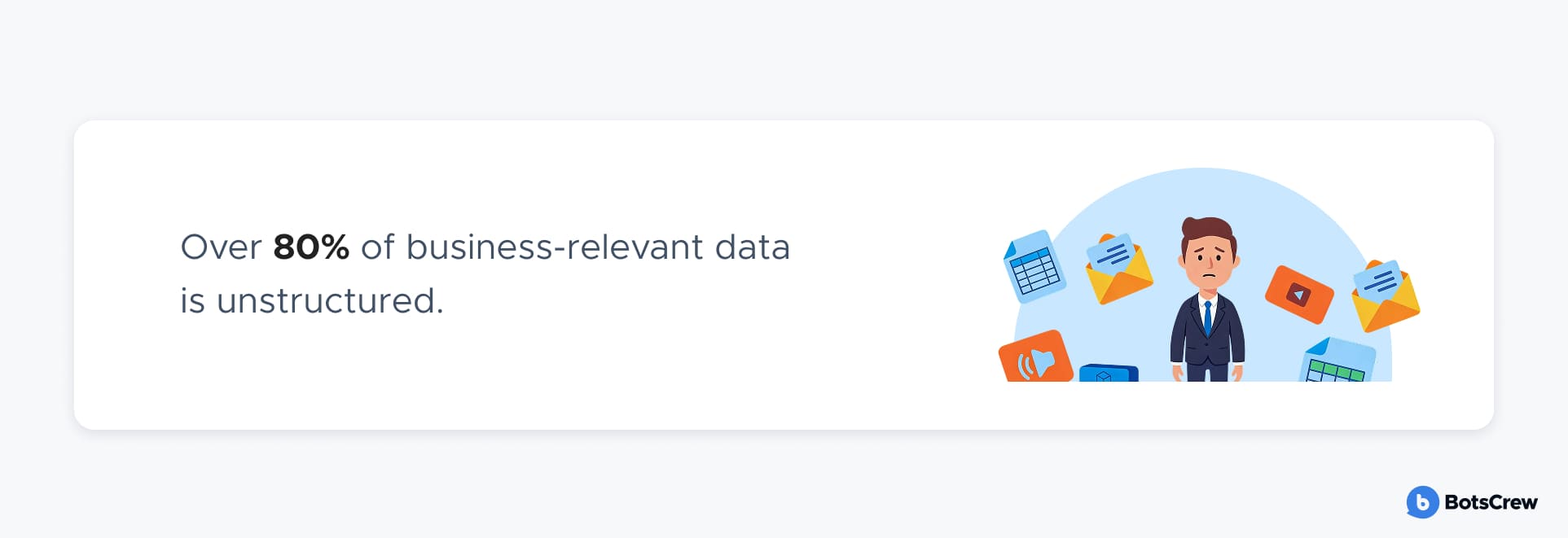
Structured data — the numbers in your ERP, CRM, and finance systems — powers dashboards, forecasts, and compliance reports. It is clean, organized, and query-ready. However, it represents only a fraction of your total data footprint.
The rest? Customer emails, contracts, support tickets. Product documentation, images, audio files. Internal chats, operational logs, and supplier communications. This is unstructured data — and it often contains the most valuable signals about customer sentiment, operational risk, compliance exposure, and market opportunity.
When companies launch AI initiatives without addressing this imbalance:
☹️ Models are trained on incomplete information.
☹️ Automation is limited to surface-level tasks.
☹️ Generative AI deployments struggle with accuracy and hallucinations.
☹️ Data governance risks multiply.
In short: you cannot build enterprise-grade AI on a partial view of your data.
Ready to unlock the full potential of your data? Schedule a free 30-minute consultation to explore AI solutions tailored to your business goals.
What Is Structured Data?
What is structured and unstructured data? Structured data refers to information that is organized according to a predefined schema — typically in tables with clearly defined:
📄 Rows (records)
📊 Columns (attributes)
🔢 Data types (numbers, dates, strings, etc.).
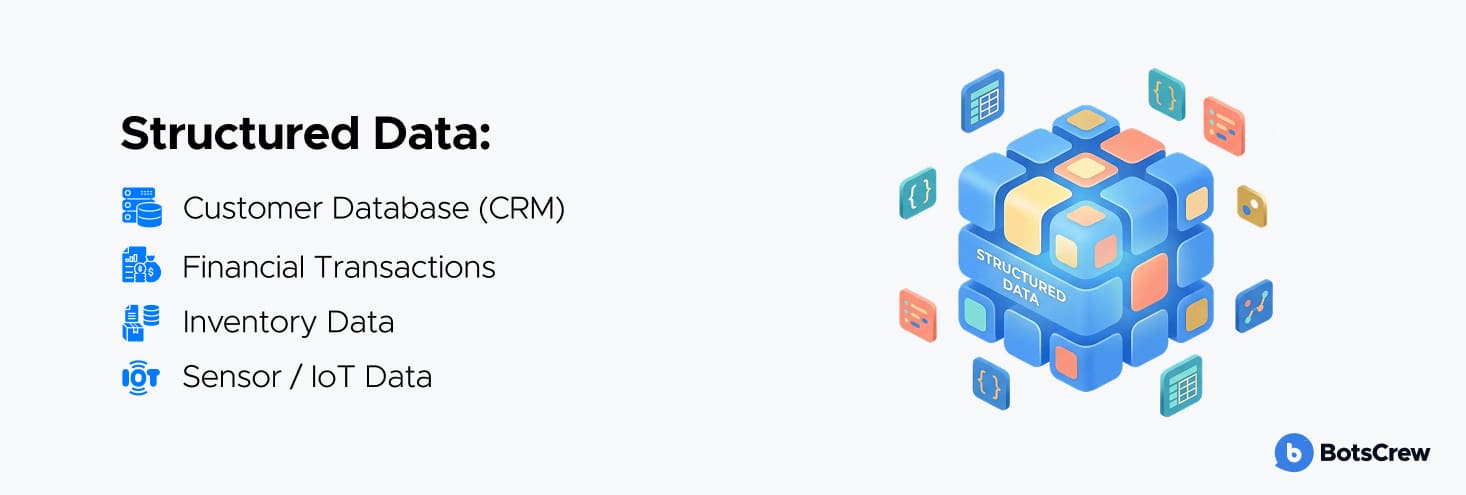
Each data field has a fixed meaning, format, and validation rule. The structure is defined before the data is stored, which makes it highly predictable and machine-readable.
In most enterprises, structured data originates from core transactional systems such as:
- CRM systems (customer records, deal stages, revenue forecasts)
- Financial records (invoices, general ledger entries, balance sheets, payroll data)
- Operational KPIs (inventory counts, production metrics, delivery times, SLA tracking)
- ERP systems (procurement, supply chain, resource planning)
- HR systems (employee IDs, compensation bands, attendance logs).
These systems are intentionally designed to enforce consistency and reduce ambiguity. Every record fits into a known format.
For instance:
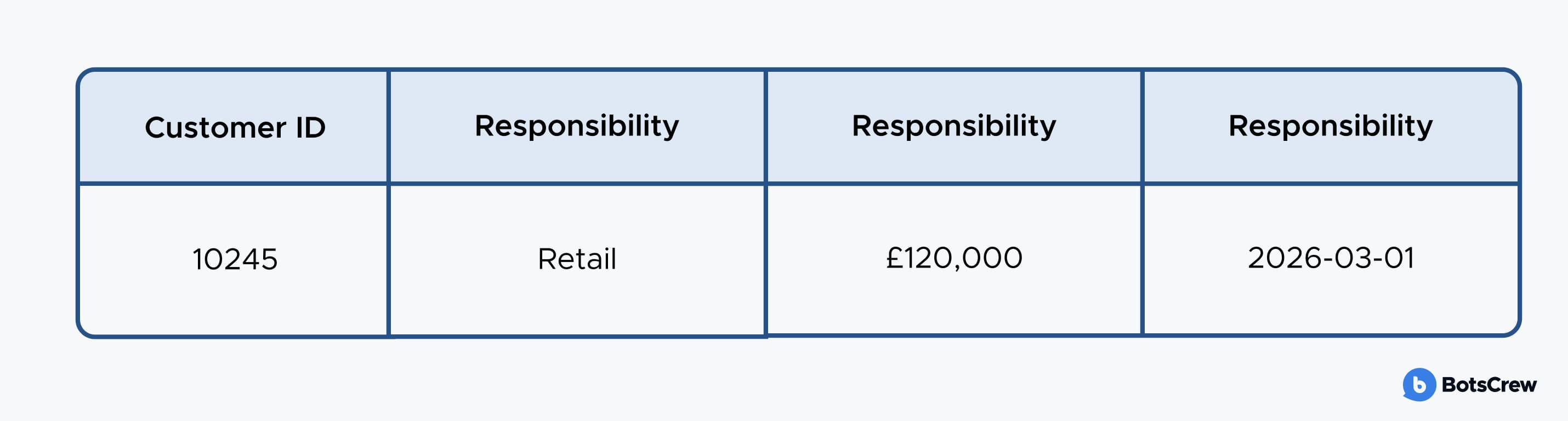
There is no ambiguity about what each field represents.
The Business Value of Structured Data
Structured data built the modern analytics stack — and its strengths remain strategically important.
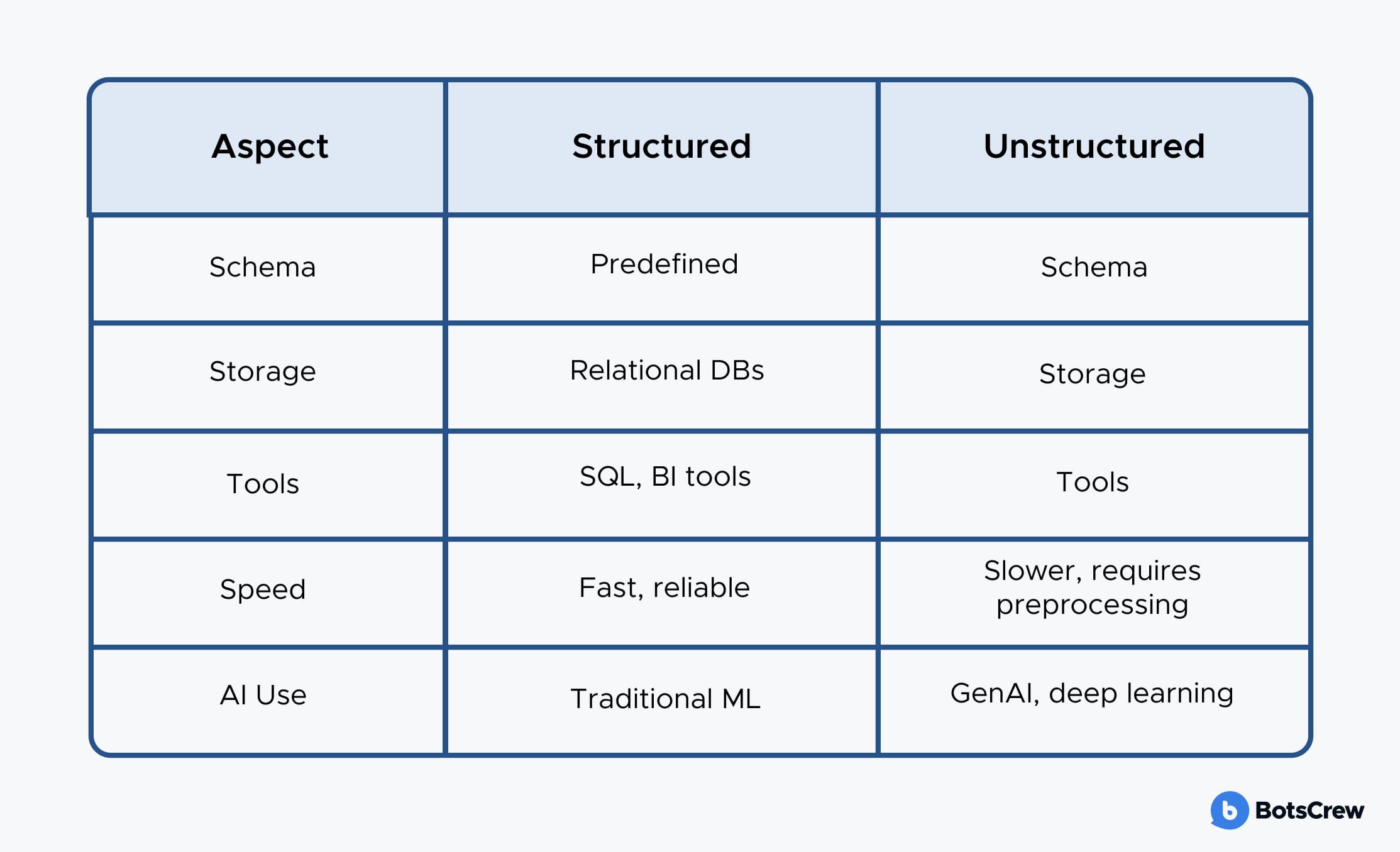
Fast Analytics. Because data is standardized, queries are efficient, aggregations are predictable, dashboards update in real time, and performance scales reliably. This enables revenue forecasting. margin analysis, cohort analysis, and operational performance tracking. Executives can answer predefined questions quickly and with confidence.
Reliable Reporting. Structured data is ideal for monthly board reporting, regulatory filings, audit trails, and financial consolidation. The schema enforces consistency across time. This reduces interpretation risk and increases trust in numbers. For finance and compliance teams, this reliability is non-negotiable.
Easier Compliance and Governance. Structured systems allow for role-based access control, clear ownership of fields, validation constraints, and standardized retention policies. From a governance standpoint, structured data is easier to control and audit than free-form text or multimedia content.

What Is Unstructured Data?
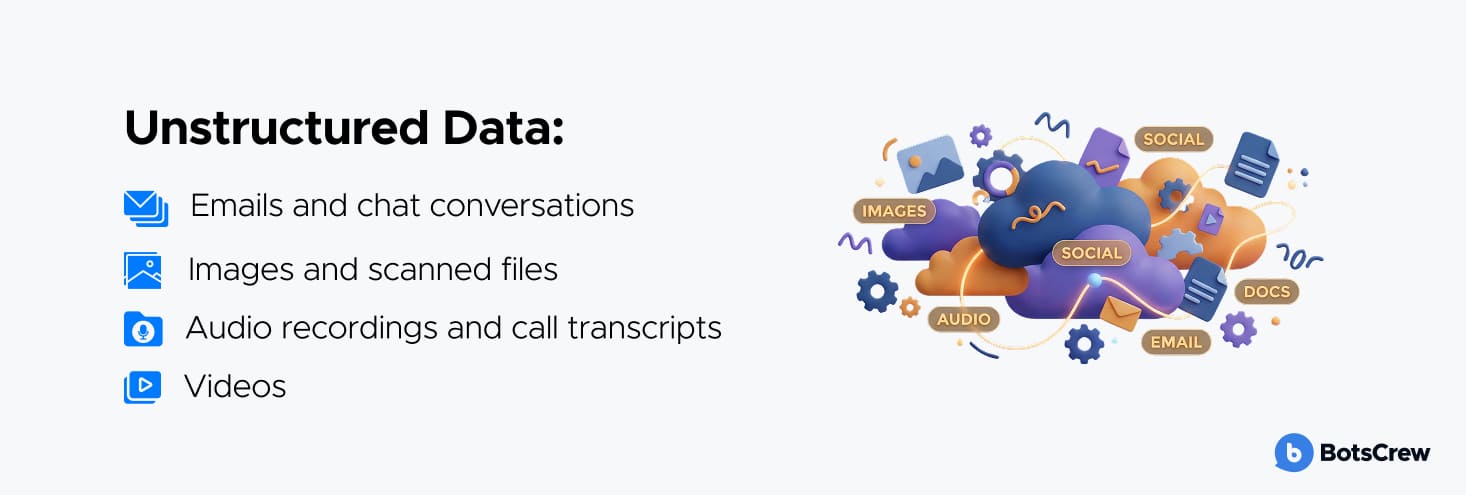
Unstructured data refers to information that does not follow a predefined schema or tabular structure. Unlike structured datasets — which neatly fit into rows and columns — unstructured data is free-form, context-rich, and often ambiguous. It doesn't conform to rigid field definitions, and its meaning is typically embedded in language, visuals, sound, or sequence. Common formats include:
- Emails and chat conversations
- PDFs and contracts
- Images and scanned files
- Audio recordings and call transcripts
- Videos.
This data does not live comfortably inside relational tables. Its value is embedded in narrative, semantics, tone, and context rather than predefined attributes.
Why Unstructured Data Is So Pervasive
Unstructured data dominates modern enterprises for a simple reason: most business communication and operational knowledge is not generated in tables.
💬 Customer Feedback and Communication
- Support tickets
- Chat conversations
- Sales emails
- NPS responses
- Product reviews
- Complaint descriptions.
Customers rarely respond in structured formats. They explain problems, frustrations, and expectations in natural language. The most important signals — dissatisfaction, churn risk, upsell potential — often exist in narrative form.
📂 Internal Documents and Knowledge Assets. Companies generate massive volumes of:
- Policy documents
- Training materials
- Technical manuals
- Contracts
- Meeting notes
- Strategic memos.
This is institutional memory. It defines how work actually gets done. Yet most of it is stored in shared drives, knowledge bases, or document management systems without deep semantic indexing.
🌍 Social Media and Public Signals. Brand perception, competitive intelligence, and market sentiment are expressed through:
- Social posts
- Comments
- Blogs
- News articles
- Online forums.
These inputs are inherently unstructured — but strategically powerful.
The Business Value of Unstructured Data
If structured data tells you what happened, unstructured data often explains why it happened.
Contextual Depth. Tables show:
- Revenue decreased by 7%.
- Churn increased by 3%.
Unstructured data explains:
- Customers are frustrated with onboarding.
- Delivery delays are damaging trust.
- Product documentation is confusing.
Context is where strategic insight lives.
Hidden Competitive Intelligence. Patterns in support conversations may reveal emerging product defects, repeated feature requests, regulatory concerns, and operational bottlenecks. These insights rarely appear in dashboards until it's too late. Businesses that systematically mine unstructured data gain earlier visibility into risks and opportunities.
Knowledge Activation. Internal documentation, expert notes, and archived communications contain accumulated experience. Without AI, accessing this knowledge is manual and inefficient. With the right systems, it becomes searchable, summarizable, actionable, and embedded into workflows. This transforms static documentation into a strategic asset.
Structured vs Unstructured Data: Why This Matters for ROI
AI ROI is not just a function of model accuracy. It depends on:
1. Data Accessibility
If 80% of your enterprise knowledge is not indexed, embedded, or retrievable by AI systems, your model operates on a fraction of reality.
2. Data Preparation Costs
Unstructured data requires ingestion pipelines, cleaning, chunking, embedding strategies, governance frameworks, and access controls. Ignoring this inflates costs later.
3. Operational Scalability
An AI pilot may work with clean, structured datasets. Scaling across departments means integrating emails, documents, chats, PDFs, and legacy systems. If your data architecture isn't designed for scale, performance degrades, maintenance costs rise, and expansion slows — directly limiting long-term ROI.
The competitive edge in the AI era will not belong to organizations that merely “use AI tools.” It will belong to those that:
- Design hybrid data architectures
- Activate unstructured knowledge at scale
- Embed governance into AI pipelines
- Treat data strategy as a board-level priority.
Companies that deliberately manage both structured and unstructured data — aligning architecture, governance, and talent — transform AI from experimentation into sustained economic advantage.
With BotsCrew, you unlock the full potential of both structured and unstructured data. We help Fortune 500 companies, mid-size businesses, and large enterprises to apply AI and machine learning to unstructured data, streamline operations, and elevate the overall user experience, turning fragmented data into actionable intelligence.
Looking for a strategic partner with over 8 years of experience? Book a call to discuss your goals and see how our AI expertise can support them.