



A Synthetic Audience: The New Normal in User Research?
You spend weeks recruiting users, running surveys, and analyzing feedback — only to end up with insights that are already outdated. Real customers are expensive to reach, slow to respond, and often can't articulate what they actually want. Meanwhile, decisions still have to be made. This is the gap a synthetic audience is filling: instant, scalable access to consumer thinking — without the delays, costs, and guesswork of traditional research.


Imagine testing a new product idea and seeing how your audience reacts before launch, without recruiting a single real user. With synthetic audiences, that's now possible. The approach works by applying AI to a brand's or publisher's existing audience data to recreate behavioral patterns that can be used for market research. While the term “synthetic audience” has only recently gained traction in the media and advertising world, its adoption is accelerating.
Publishers like The Times use synthetic audiences to validate product and editorial concepts. At the same time, agencies such as Dentsu apply them to media planning and audience targeting — faster and at a lower cost than traditional methods.
At the same time, misreading your audience can have immediate consequences — shrinking basket sizes, lower conversion rates, and reduced retention — especially in fast-moving e-commerce environments. Now is the right moment to take a closer look at AI-powered consumer research and the role synthetic audience/synthetic personas are starting to play.
What is a Synthetic Audience?
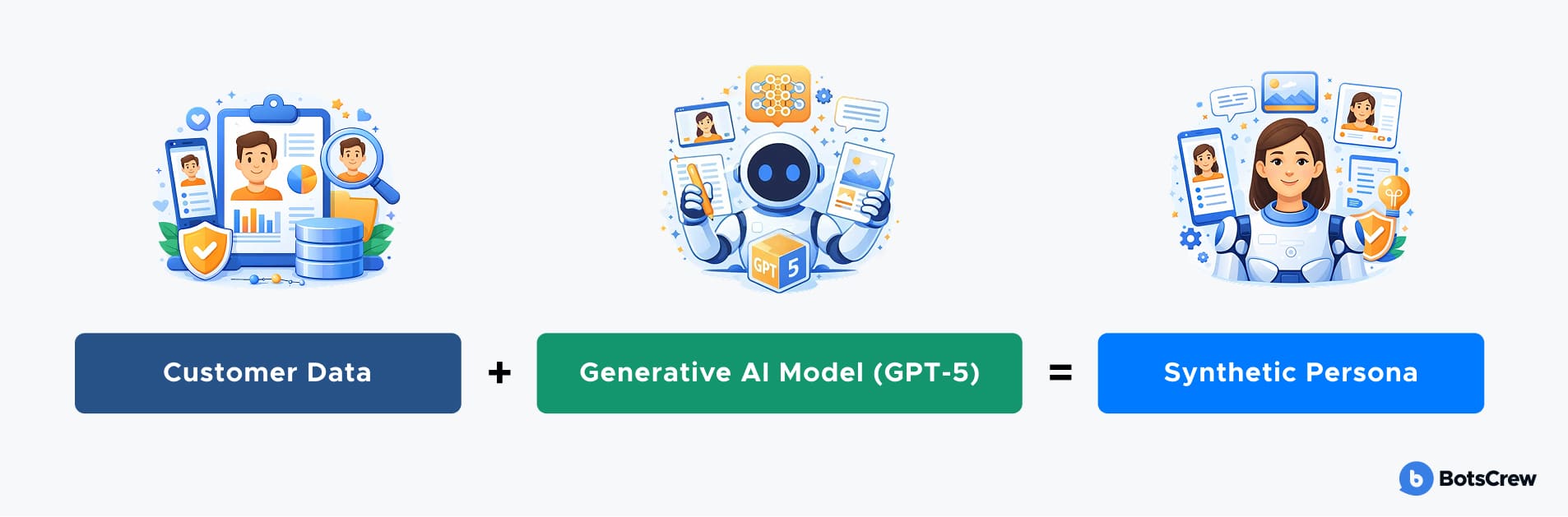
A synthetic audience, or persona, is an AI-generated consumer profile designed to represent how a real customer segment thinks, feels, and behaves. Built using data, fine-tuning, prompting, or LLMs, these personas act as digital stand-ins for real users. They can be custom-built or created through specialized platforms, making research faster, more scalable, and more cost-effective.
Each persona typically includes core demographic and psychographic details — such as goals, motivations, pain points, values, and jobs to be done — along with insights into preferred platforms, brands, media, tools, and interests.
Compared to surveys and interviews, synthetic personas offer a faster and more cost-effective way to explore audience segments before launching a product or campaign. Teams can upload surveys or interview questions and receive quantitative results in minutes, then dig deeper by asking personas to explain the reasoning behind their choices.
Because these personas are modeled on real customer data, their responses often closely mirror those of actual users at scale.
Benefits of AI Synthetic Audience Modeling
Synthetic audiences help teams move faster without losing focus. They let teams pressure-test ideas early, play with edge cases, and preview how different segments might respond, even when time is tight, and data isn't perfect. Instead of waiting weeks for answers, you get signals fast enough to act on.
What makes them powerful:
- Speed: Directional feedback in hours, not weeks.
- Scale: Explore mass markets, micro-segments, or hard-to-reach audiences — no recruiting required.
- Flexibility: Try different messages, visuals, tones, and value props before locking anything in.
- Safety: Stress-test sensitive or high-risk scenarios without putting real users on the spot.
- Efficiency: Fewer long research cycles, more focus on what actually moves the needle.
Synthetic models won't replace lived experience, but they give you a sharp, structured way to see how ideas might land and catch weak spots before launch day.
Synthetic Personas vs. Traditional Personas
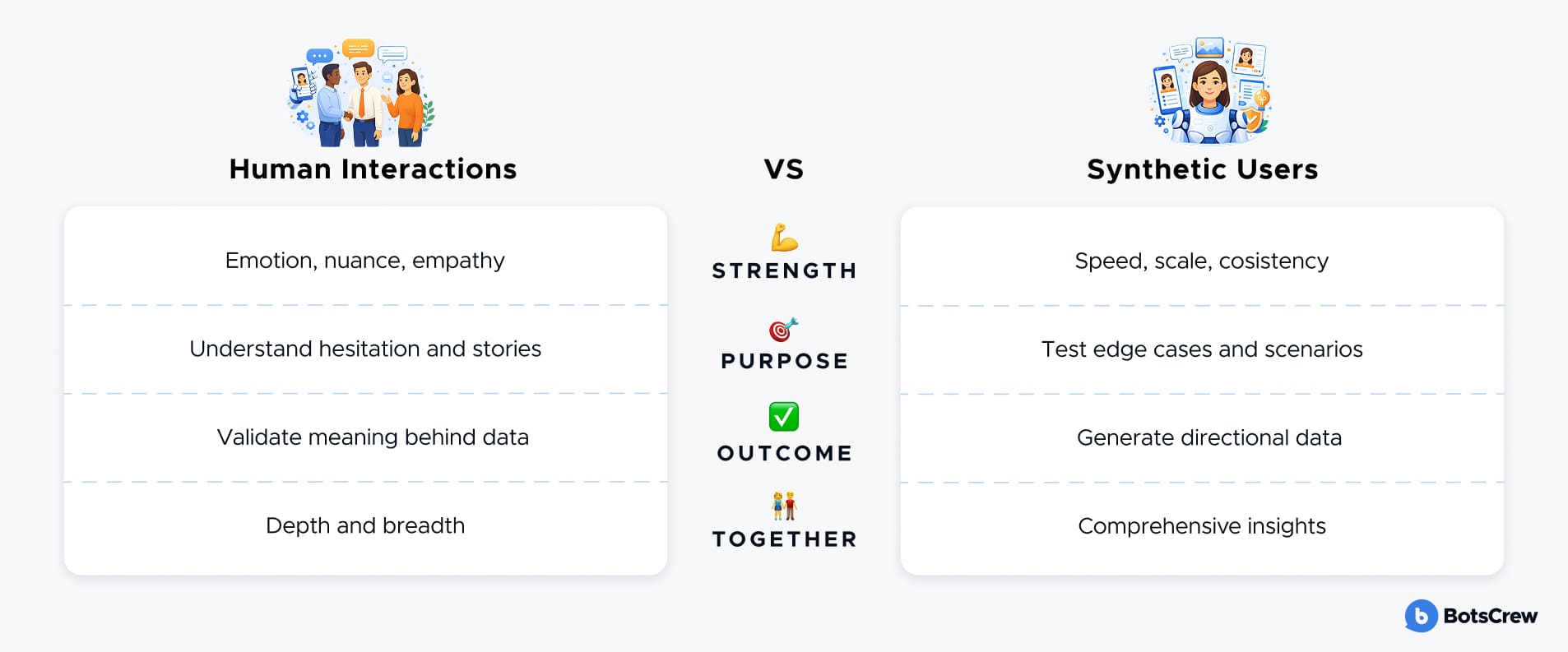
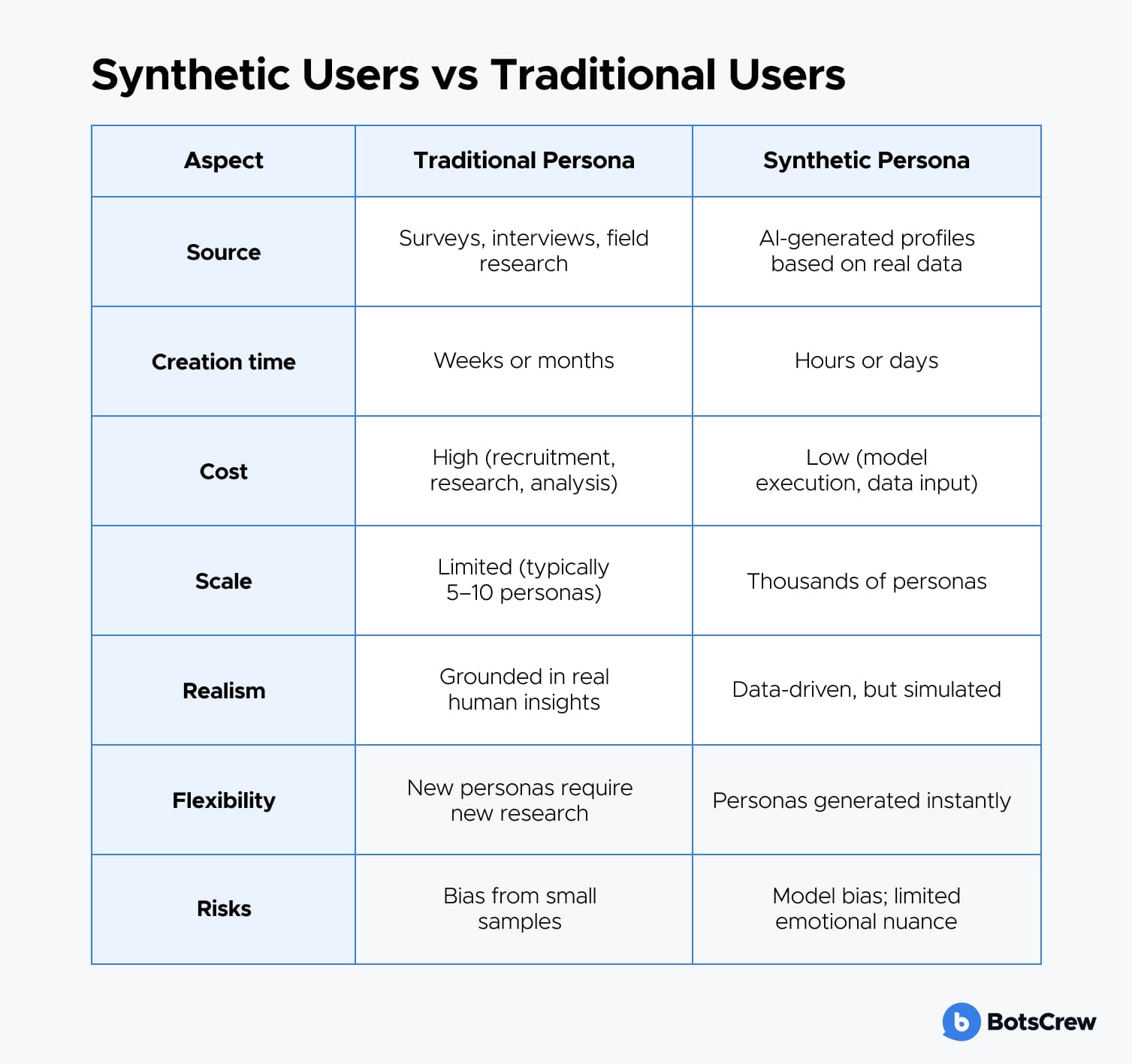
Traditional personas follow a familiar rhythm: surveys, interviews, fieldwork, observation. They are rich, human, and hard-won — but they also take weeks or months to produce, cost a lot, and usually stop at a handful of profiles. Once published, they often freeze in time while markets and behaviors keep moving.
Synthetic personas flip that model. Powered by AI and trained on real behavioral data, they can be generated in hours or days, scaled across hundreds or thousands of segments, and reshaped on demand. Need a new audience angle? A sharper segment? A different context? Spin it up and test it.
They are especially effective early on, when teams are exploring ideas, testing hypotheses, pre-validating messaging, or drafting initial personas and journey maps. At this stage, speed and direction matter more than perfect emotional fidelity.
That said, synthetic personas are still simulations. They don't fully capture intuition, emotion, or the unexpected moments that surface in honest conversations. Overconfidence in AI outputs — or biased data and prompts — can quietly skew decisions. Used well, synthetic personas don't replace human research. They make it faster, bolder, and more focused — so when you do talk to real people, you know exactly what to ask and why.
How Synthetic Users are Created
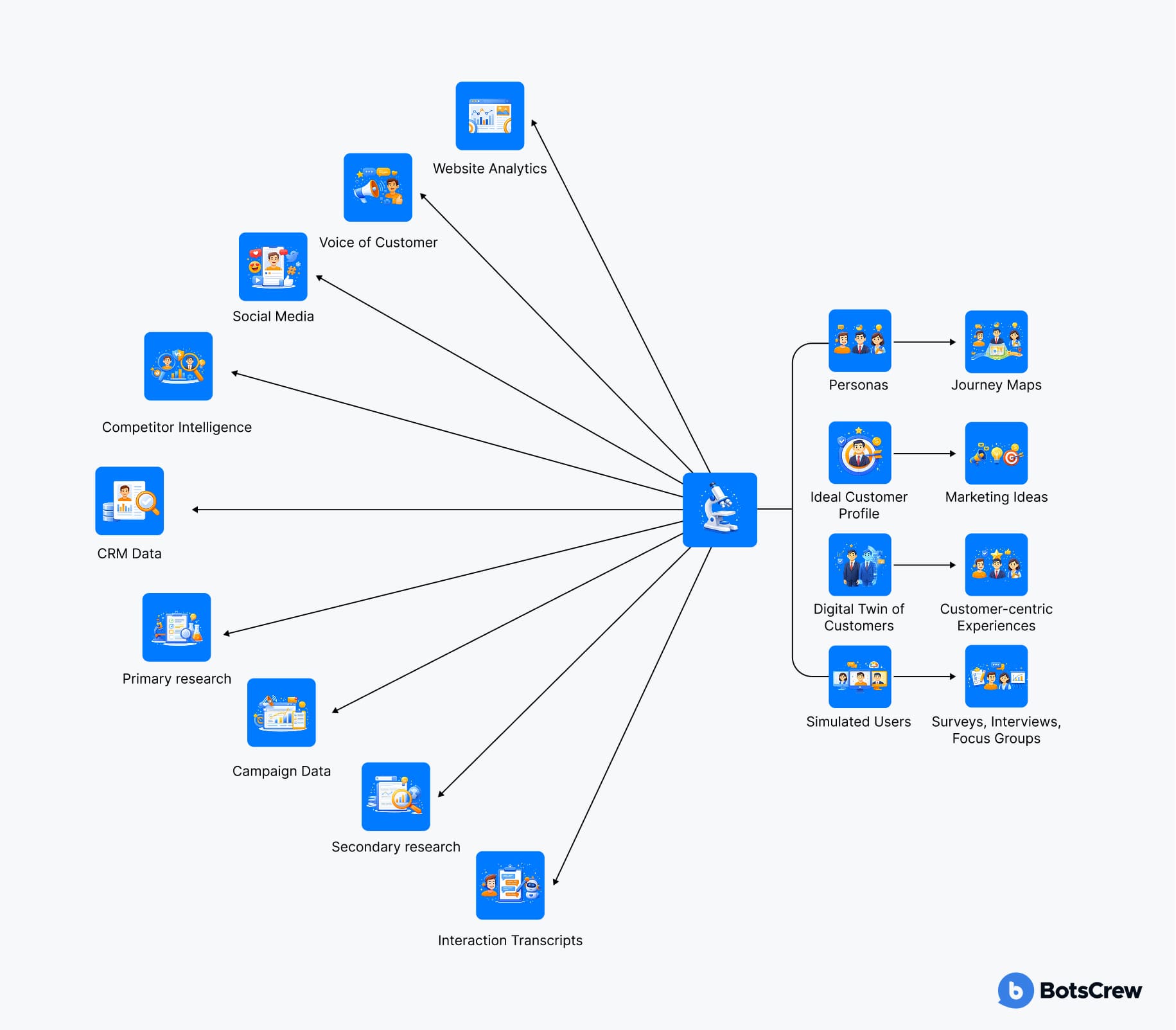
At the heart of synthetic personas is artificial intelligence — specifically, machine learning techniques like clustering, neural networks, and behavioral modeling. These systems ingest signals from across the customer ecosystem, including:
- Website analytics and campaign data
- CRM data and ideal customer profiles (ICPs)
- Existing personas and journey maps
- Voice of Customer sources, such as surveys, interviews, focus groups, and interaction transcripts
- Social media signals and digital behavior
- Primary and secondary research
- Competitor intelligence and market context.
Large volumes of real human data are collected and used to train large language models. These models learn how different traits, motivations, and contexts influence decision-making.
Next comes persona architecture. Each synthetic user is built around a core personality profile: values, motivations, goals, and psychological tendencies that shape behavior. On top of that, the system layers demographics, professional context, lifestyle factors, beliefs, and communication preferences — creating a coherent, realistic identity rather than a loose collection of attributes.
Then AI moves into behavioral modeling. The system learns how this persona processes information, evaluates risk, reacts emotionally, and responds to influence. Consistency algorithms ensure the persona behaves logically across scenarios, so answers don't contradict each other and interactions feel human, not random.
To make these users usable, interactive capabilities are added. Natural language processing allows synthetic users to hold conversations, explain their reasoning, express uncertainty, and maintain context over prolonged interactions. More advanced systems can simulate behavior across formats — surveys, interviews, UX testing, or scenario-based simulations.
Before deployment, personas go through validation and refinement. Their responses are compared against real user data to ensure realism and accuracy — often aiming for what teams call “synthetic–organic parity,” where synthetic answers are statistically indistinguishable from those of humans. Feedback loops allow the models to improve continuously over time.
Finally, synthetic users are tailored to meet specific research needs. They can be tuned to match a brand's ideal customer profile, industry language, regional or cultural context, or familiarity with a product or service.
Ready to Build Your Consumer Personas? Turn your consumer research data into custom synthetic personas — and validate them against real audiences using our scientifically proven methodology for actionable insights.
Instead of looking at these inputs in isolation, AI identifies patterns, correlations, and behavioral signals that explain not just who users are today, but how they are likely to act tomorrow. Some platforms take it a step further, simulating how users might respond to changes in pricing, messaging, features, or content — before anything is shipped.
What You Can Do with Synthetic Audiences
An AI synthetic audience enables teams to explore ideas, test assumptions, and refine their direction before real budgets, media pressure, or market expectations take effect.
Stress-Test Creative Before It Goes Live
Creative work is expensive to produce and even more expensive to fix once it's in the market. A synthetic audience allows teams to pressure-test ideas while everything remains flexible. You can run different headlines, visuals, tones, and CTAs across audience segments and see what resonates emotionally and cognitively. This helps uncover early signals around clarity, relevance, and motivation.
Typical scenarios include:
- Comparing bold vs. conservative headlines
- Synthetic audience testing whether visuals spark curiosity or confusion
- Evaluating if a CTA feels empowering — or pushy
- Checking whether humor, urgency, or authority works better for a given segment.
Forecast Media Impact Across Channels
Instead of waiting for campaign data to roll in, an AI synthetic audience allows you to simulate how different segments might engage across channels before launch. You can explore likely reactions to the same message on LinkedIn versus Instagram, or test how frequency, format, and tone affect attention and fatigue.
Common scenarios include:
- Predicting how Gen Z vs. enterprise buyers respond to the same concept
- Testing which channels feel most natural for a given message
- Identifying early signs of message fatigue before scaling spend.
This makes media planning more intentional and less reactive.
Refine Multicultural and Regional Messaging
Global and multicultural campaigns carry high upside and high risk. A synthetic audience makes it easier to test how language, tone, imagery, and cultural cues resonate across different contexts. You can explore whether messaging feels aspirational, awkward, or tone-deaf long before it reaches real audiences.
Typical use cases:
- Localizing global campaigns without diluting the core message
- Testing emotional cues across cultures
- Avoiding unintended cultural friction or misinterpretation.
Run Privacy-Safe Simulations
As privacy expectations and regulations tighten, synthetic audiences offer a way to experiment without touching personal or identifiable data. Teams can explore ideas in clean-room or synthetic environments while staying compliant and reducing risk.
Useful scenarios include:
- Working under GDPR or industry-specific regulations
- Testing sensitive topics or regulated products
- Running research when customer data access is restricted.
This makes experimentation safer and easier to scale.
Pressure-Test Strategy Before the Stakes are High
Beyond creative and messaging, synthetic audiences are powerful for strategic “what if” scenarios. They enable teams to rehearse decisions before committing. You can explore how users might react to pricing changes, feature trade-offs, or shifts in positioning.
For example:
- How would customers respond to a price increase?
- What objections emerge when a feature is removed or delayed?
- Which parts of a value proposition create friction or confusion?
These simulations won't replace real-world validation, but they surface risks early, when course correction is still cheap.
From insight to impact. Custom-built AI solutions designed to help you understand your customers, innovate faster, and create experiences that truly resonate.
- Analyze millions of qualitative and quantitative signals at once
- Engage in real-time conversations with digital twins of your customers
- Securely ingest first-party data in any structured or unstructured format
- Stress-test campaigns, concepts, and value propositions before launch
- Explore hard-to-reach, high-cost, or emerging segments without recruitment
- Compare scenarios and outcomes across markets, cultures, and channels
- Run privacy-safe research without exposing or relying on personal data.
Zero Trust Architecture: Every access request is verified, encrypted, and logged. Your data stays within your secure perimeter at all times.
Bias Monitoring: Quarterly fairness audits to assess demographic balance, with clear guidance that synthetic insights augment — not replace — human research.
Talk to us to see how AI-generated personas fit into your existing data and research stack
Great Power, Real Responsibility: What to Watch Out For
Synthetic audiences are one of the most exciting additions to the modern research stack — but they are not a magic solution.
Synthetic Doesn't Mean Objective
Synthetic audiences are built on data, models, and prompts. That means every output reflects what went in: the datasets used, the assumptions made, the segments defined, and the questions asked.
They're directional, not definitive. Their real strength lies in exploration, helping teams compare options, surface risks, and narrow down ideas. They are not designed to predict exact outcomes or replace real-world feedback.
Lack of Depth and Specificity
When prompts are too broad — or models are under-constrained — responses in synthetic models tend to converge toward safe, generic territory. You'll get clean summaries, reasonable trade-offs, and well-articulated opinions that feel “right,” but lack the sharp edges needed for real decisions.
This becomes especially problematic in areas like:
- Emotional drivers and latent needs
- Purchase hesitation and irrational behavior
- Edge cases that define failure modes.
Bias Doesn't Vanish
AI doesn't eliminate bias. Every synthetic model carries implicit assumptions about behavior, norms, and priorities. Those assumptions may come from historical data, incomplete samples, or even the way prompts are framed. Left unchecked, they can subtly shape conclusions and reinforce blind spots.
This doesn't mean synthetic audiences are untrustworthy — it means they demand scrutiny. Strong teams actively question results, stress-test scenarios, and look for inconsistencies rather than convenient answers.
Reliance on Outdated Data
If a model is trained on historical data, past behaviors, or lagging signals, its outputs may reflect a world that has already moved on. This shows up subtly: familiar mental models, recycled narratives, and assumptions that feel plausible — but slightly out of sync with reality.
This matters most when:
- Markets are shifting quickly
- New platforms or behaviors are emerging
- Cultural norms are evolving in real time.
Without careful updating and validation, synthetic users risk reinforcing yesterday's truths while today's signals are still forming.
Humans Are Irrational, Models Are Polite
Synthetic users tend to be cooperative. They answer every question. They try to be helpful. They reason logically and explain themselves clearly. In research terms, they can be a little too good.
Humans aren't like that. People are contradictory. They act emotionally. They care deeply about a few things and ignore the rest. They change their minds mid-conversation. They respond differently depending on mood, context, and timing. A synthetic persona worth listening to should reflect some of this messiness. But it will never fully replace lived experience.
Governance is Part of the Product
Privacy, security, and transparency are essential to the credibility of synthetic research. Responsible use means:
- Clear documentation of assumptions and limitations
- Explicit labeling of synthetically generated insights
- Guardrails around use cases and decision thresholds
- Strong PII detection and privacy-safe infrastructure
- Ongoing bias monitoring and review.
Without them, synthetic audiences risk becoming opaque systems that produce answers no one can fully explain or trust.
Synthetic Research Still Needs Rigor
Synthetic audiences belong in the same category as any serious research method: they require discipline, governance, and critical thinking. That means applying the same rigor you'd expect from traditional research, product development lifecycles, or design thinking practices. Document decisions, define intent, validate outcomes, and revisit assumptions.
How to Validate That a Synthetic Audience Accurately Reflects Real Customer Behavior?
Validation is the bridge between AI-generated insight and actionable business decisions. Without it, synthetic outputs are directional at best and misleading at worst.
1. Benchmark Against Real-World Data
The first step is comparing synthetic behavior to actual customer signals:
Historical transaction data: For example, if a synthetic audience predicts that millennials spend 30% more on subscription products than Gen X, you can check this against your CRM purchase history to see if it aligns.
Campaign performance: Suppose a synthetic segment indicates high engagement with a new email promotion. You can test this against the open and click-through rates of past campaigns targeting a similar segment.
Behavioral analytics: Compare predicted user flows with actual website behavior. If a synthetic persona “navigates” from a product page to checkout in three clicks, does your analytics show real users following a similar path?
This benchmarking identifies which synthetic personas are accurate and where they need refinement.
2. Multi-Method Validation
Relying on a single metric is risky. Combine approaches:
A/B testing: If a synthetic audience predicts high conversion for a new landing page design, run a small-scale test to validate it with real users.
Surveys and interviews: For example, if a synthetic persona highlights “price sensitivity” as a top concern, check whether real customers express the same sentiment in surveys or focus groups.
Panel comparisons: If you have access to a consumer panel, see if synthetic predictions about content preferences, engagement, or loyalty match actual panel behavior.
This triangulation ensures synthetic outputs align with real-world complexity, not just internal model logic.
3. Scenario Stress-Testing
Synthetic audiences shine at modeling edge cases:
Extreme conditions: For instance, simulate how customers might react to a 50% price hike or a product delay. Do the predicted responses make sense given historical reactions?
Multiple campaign scenarios: Test different messaging tones or visual creatives. If one synthetic segment suddenly reacts in a way that contradicts real-world patterns, it signals a model gap.
Identify inconsistencies: If a person's predicted age or spending behavior clashes with other known attributes, it may indicate bias or insufficient data coverage.
Stress-testing ensures outputs are robust, not brittle.
4. Continuous Feedback Loops
Validation is ongoing:
Incorporate live feedback: Compare predicted outcomes to actual campaign results. For example, if a synthetic persona predicted 20% engagement with a video ad but real engagement is 10%, refine the model.
Refine data inputs: Add recent behavioral data, new survey responses, or updated demographics to ensure the model reflects evolving trends.
Continuous learning keeps synthetic audiences accurate as markets and customer behaviors evolve.
Ready to Reach the Right Personas — Real or Synthetic?
At BotsCrew, we help enterprise teams leverage AI to understand audiences at scale, test ideas before they go live, and turn insights into action. Whether you're experimenting with synthetic personas or grounding strategy in real user data, we help you move faster — with confidence. Let's explore how AI-generated personas can sharpen your messaging, reduce uncertainty, and drive measurable business outcomes.
Make better decisions — before the market forces your hand.