Generative AI vs. Agentic AI: The Key Differences Business Leaders Need To Know
Dive into the nuts and bolts of Generative AI vs. Agentic AI and master the divide between these paradigms. Or let it dictate the future of your business — and your survival.


Two years ago, the boardroom conversation was about whether to adopt AI. Today, it's about which kind — and what the difference will cost you if you choose wrong. Generative AI and Agentic AI are not synonyms. They are architecturally distinct, operationally different, and strategically incompatible when applied to the wrong problems.
This guide cuts through the noise. We'll dive deep into Generative AI vs. Agentic AI's key differences, show you what industries are most likely to benefit from Agentic AI and Gen AI, when to deploy each, and give you a practical framework to start building now.
What Is Generative AI?
Generative AI refers to models trained on vast amounts of data — text, images, audio, code — that can produce new content in response to a prompt.

Large language models (LLMs) like GPT, Claude, and Gemini are the clearest examples. You provide an input; the model generates an output. The interaction is fundamentally reactive.
Generative AI excels at tasks with well-defined inputs and expected outputs:
→ drafting,
→ summarizing,
→ translating,
→ generating code,
→ producing marketing copy.
Its power lies in the quality and fluency of the output — not in the ability to decide what to do next.
Think of Generative AI as a supercharged autocomplete. It guesses what comes next — whether a word, a sentence, or even an image — based on the context. However, it is not thinking for itself.
What Does Agentic Mean in AI
What is an Agentic AI? And what does agentic mean in AI?
Agentic AI refers to AI systems designed with the capability to reason, plan, act, and adapt autonomously to achieve a specific goal. How does Agentic AI work? Agentic AI is a fundamentally different architecture.
AI agents can perceive their environment, set or receive goals, plan sequences of actions, execute those actions using tools, and adjust their behavior based on feedback — all with minimal human intervention between steps.
It is the next big leap in artificial intelligence. Where Generative AI answers the question "What should the next word be?", Agentic AI answers "What should I do next to achieve this goal?" The shift from output generation to goal-directed action is profound.
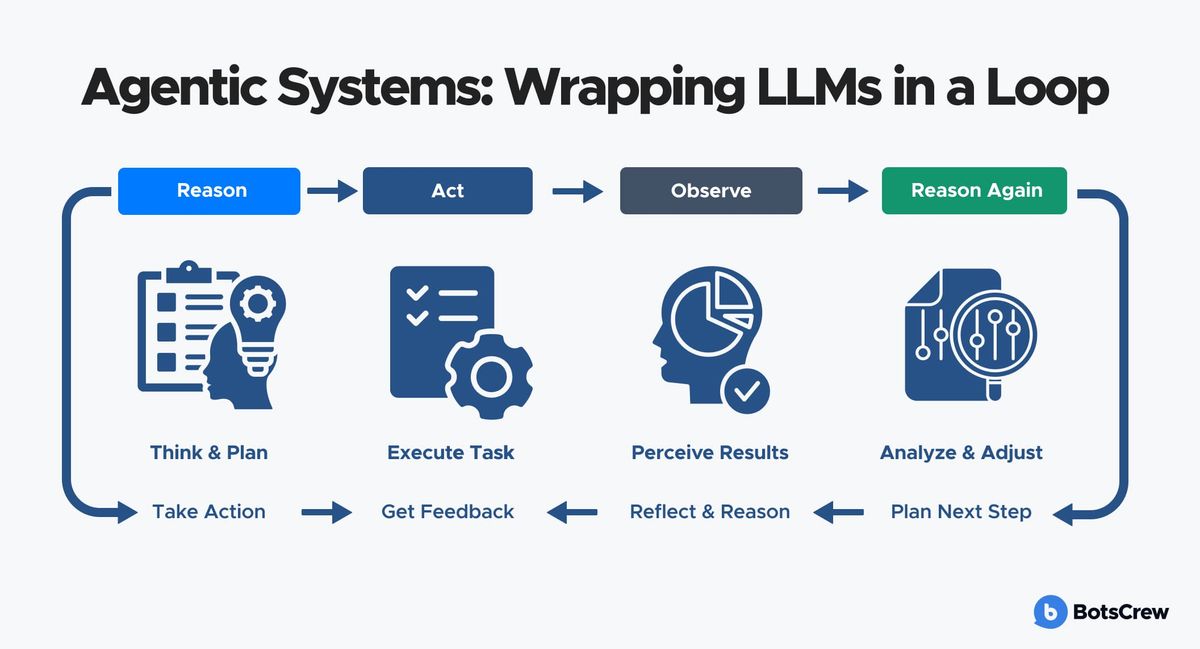
Agentic systems typically wrap LLMs in a loop:
reason → act → observe → reason again.
They can call APIs, browse the web, write and execute code, query databases, send emails, and orchestrate other AI models — all within a single workflow.
Big players like IBM and Microsoft are already deploying these digital go-getters across the enterprise, automating everything from customer service triage to task execution.
Generative AI vs. Agentic AI: What's the Real Difference?
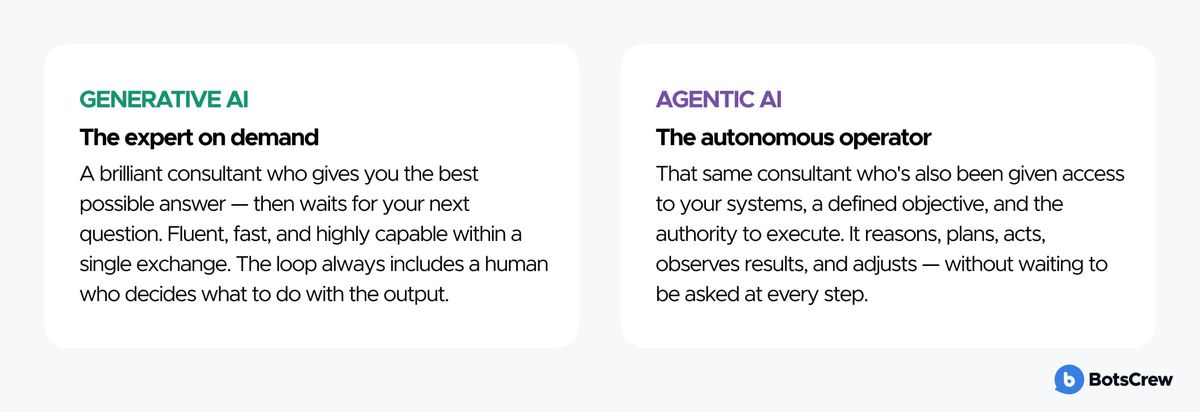
How does Agentic AI differ from traditional AI? Both technologies run on large language models. Both process language. But they are architecturally and operationally distinct in ways that matter for enterprise strategy. How does agentic AI differ from traditional AI? The distinction is technical and is about how much of your process you're willing to hand over to a machine:
| Dimension | LLM (Traditional Model) | Agentic System |
|---|---|---|
| Core Behavior | Responds to user prompts. No prompt, no output. | Autonomously performs tasks, makes decisions, and drives outcomes toward goals. |
| Interactivity | Reactive — waits for user input. | Proactive — initiates actions, plans steps, validates results, involves humans if needed. |
| Complexity | Manages content complexity — strong at creative generation, weak at decision-making. | Handles end-to-end workflows, decomposes complex tasks, adapts dynamically. |
| Adaptability | Limited to training data and predefined patterns. | Learns and adapts to new situations through feedback and interaction loops. |
| Examples | Text generation, image creation, music composition. | Systems that improve via reinforcement learning and continuous feedback loops. |
| Decision Layer | Does not make decisions — predicts next token; human decides actions. | Selects tools, retrieves data, chooses workflow paths autonomously. |
| Memory | Limited to context window (~200K tokens). No persistence unless externally implemented. | Combines short-term, episodic, and long-term memory (e.g., vector DBs, logs). |
| Error Handling | Errors appear in output; human must detect and correct via re-prompting. | Self-monitors, retries, adjusts parameters, escalates or rolls back when needed. |
| Multi-Agent | Single model operation. | Supports multi-agent setups (planner + specialized agents working in parallel). |
Generative AI vs Agentic AI
In simple terms:
- Agentic AI → The best answer to your question, delivered instantly, requiring your judgment to act on it.
- Generative AI → The completed task you described, executed autonomously, with results delivered to your inbox.
Real-World Use Cases by Industry
Both paradigms are already delivering measurable ROI across sectors. The key is understanding which problems each is actually solving.
Generative AI in production
📝 Legal: Contract drafting, clause summarization, and first-pass due diligence review
💊 Pharma: Clinical trial report generation and regulatory submission drafts
🛍️ E-commerce: Product description generation at catalog scale — thousands of SKUs per hour
🏦 Financial services: Earnings call summarization, analyst report drafting, and client communication templates.
Agentic AI in production
🔍 Sales: End-to-end lead research — finds prospects, enriches profiles, drafts outreach, logs to CRM
📦 Supply chain: Monitors inventory signals, places reorders, flags supplier risk, and escalates to procurement
🎯 Marketing: Campaign orchestration — pulls performance data, reallocates budget, generates new creative, reports outcomes.
Generative AI vs. Agentic AI: Three Companies, Three Business Scenarios
Choosing between Generative AI and Agentic AI comes down to the nuts and bolts of your business problem, what you are aiming to achieve, and how much risk you're willing to take on. The scenarios below break it down, helping you figure out which approach best fits your needs.
Scenario 1: Dynamic Marketing Content Generation for E-commerce
Business Problem: An e-commerce company, "StyleSphere," needs to rapidly create diverse and engaging marketing copy for thousands of new product listings each week across various platforms (website, social media, email campaigns). The content needs to be unique, SEO-optimized, and tailored to different target audiences. However, human writers cannot keep up with the volume and demand for variety.
Chosen AI Approach: Generative AI
Justification:
— Primary Objective. The core requirement is the creation of text content (product descriptions, ad copy, social media posts). Generative AI, specifically large language models (LLMs), are purpose-built for this task, synthesizing information and generating creative outputs based on prompts.
— Level of Autonomy. The process involves generating content that will be reviewed and refined by human marketing specialists. The AI is not expected to autonomously publish content or interact with external systems without human oversight. The human remains in control of the final output.
— Risk Tolerance. While errors in generated content (e.g., factual inaccuracies, awkward phrasing) could impact brand perception, they are generally reversible and correctable before publishing. The cost of failure is low compared to actions that directly affect financial transactions or customer accounts.
— Workflow Structure. The task is largely a single-step process: input product details and audience parameters, and receive marketing copy. While iterative refinement might occur, the fundamental interaction is prompt-response.
Scenario 2: Autonomous Fraud Detection and Resolution in Financial Services
Business Problem: "SecureBank," a large financial institution, faces an increasing volume of sophisticated fraudulent transactions. Manual review processes are slow, costly, and often reactive, leading to significant financial losses and customer dissatisfaction. The bank needs a system that can detect suspicious activities in real-time, investigate them, and take immediate, appropriate action.
Chosen AI Approach: Agentic AI
Justification:
— Primary Objective. The goal is to identify potential fraud (which Generative AI might assist with through anomaly detection) and to autonomously execute a multi-step process that includes investigation, decision-making, and taking corrective actions (e.g., freezing accounts, initiating chargebacks, notifying customers).
— Level of Autonomy. The system requires a high degree of autonomy to act independently and swiftly in response to detected threats. Delays for human intervention could result in greater losses. The agent needs to reason, plan, and adapt its actions based on real-time data and predefined rules.
— Risk Tolerance. This scenario involves high-stakes, irreversible actions (e.g., freezing customer funds). While the risk of an incorrect action is significant, the Agentic AI is designed with robust governance, human-in-the-loop (HITL) checkpoints for critical decisions, and comprehensive logging to mitigate these risks.
— Workflow Structure. Fraud resolution is a dynamic, multi-step process. An agent might first query transaction databases, then cross-reference customer profiles, then check external fraud databases, and finally decide on an action, potentially escalating to a human for review if confidence is low.
Scenario 3: Personalized Customer Onboarding and Proactive Support
Business Problem: "ConnectTel," a telecommunications provider, struggles with high churn rates during customer onboarding and reactive customer support. They want to create a highly personalized onboarding experience, proactively address potential issues, and offer tailored solutions without overwhelming their human support staff.
Chosen AI Approach: Agentic AI (with Generative AI components)
Justification:
— Primary Objective. The overarching goal is autonomous orchestration of a personalized customer journey, involving multiple interactions and system updates. While content generation is part of this, it's subservient to the broader goal of managing the customer relationship and taking actions.
— Level of Autonomy. The system needs to independently monitor customer activity, trigger personalized communications, update customer profiles, and initiate support workflows. For example, if a new customer struggles with modem setup, the agent should proactively send troubleshooting guides, schedule a technician, or even adjust their service plan.
— Risk Tolerance. While some actions (e.g., sending an incorrect troubleshooting guide) are low-risk, others (e.g., modifying a service plan or scheduling a technician) have material consequences. The Agentic AI would incorporate HITL for high-impact decisions and robust logging for all actions.
— Workflow Structure. This is a dynamic and multi-step workflow. The agent continuously assesses customer state, identifies needs, and executes a sequence of actions. Generative AI components would be embedded within this agentic framework to create personalized messages or summarize complex support tickets.
This demonstrates how the two AI paradigms can complement each other, with Agentic AI providing the framework for autonomous action and Generative AI enhancing the quality of interaction.
Generative AI vs. Agentic AI: A Strategic Decision Checklist
This checklist provides 10 strategic questions to guide business leaders in making an informed decision, ensuring the chosen AI solution aligns with operational needs, risk appetite, and strategic objectives.
Is the goal to create or transform content?
Text, images, code, summaries, translations — anything where the deliverable is a generated artifact.
Will a human review the output before it causes any effect?
If the AI generates a draft and a person approves it, you're in generative territory.
Can errors be caught and corrected before they matter?
Bad copy can be edited. A misfire in a single-step output rarely cascades.
Is the task fundamentally one-shot — prompt in, output out?
No tool calls, no system interactions, no need to adapt based on intermediate results.
Does the AI need to take real-world action?
Updating records, executing transactions, sending emails, calling APIs — anything that changes state outside the model.
Is constant human prompting impractical or too slow?
If the system must operate at machine speed or over hours without supervision, you need agentic autonomy.
Could an error at step one propagate into serious harm by step seven?
The "compounding risk" test. Irreversibility is the alarm bell — frozen accounts, deleted data, sent emails.
Does the workflow require deep integration with multiple systems?
CRM + billing + external APIs + communication channels = a tool layer that only agentic architecture can orchestrate.
Does compliance require a step-by-step audit trail?
Regulators and security reviews need to know exactly what the AI decided, why, and what it touched.
Must the AI adapt its plan based on what it discovers mid-task?
If intermediate results should change the approach — that's dynamic reasoning, and it needs an agent.
By carefully considering these questions, companies can better determine whether their specific needs are best met by the creative power of Generative AI or the autonomous execution capabilities of Agentic AI, paving the way for more effective and responsible AI adoption.
Whether you're assessing your first Generative AI deployment or architecting enterprise-scale agentic workflows, our team delivers solutions that actually ship.
Talk to our AI team