



AI Vendor Due Diligence Checklist for AI Projects
Choosing the right AI development partner can determine whether your enterprise AI initiative succeeds or stalls. This guide provides a practical vendor evaluation framework and due diligence checklist to help CTOs select the right AI partner with confidence.

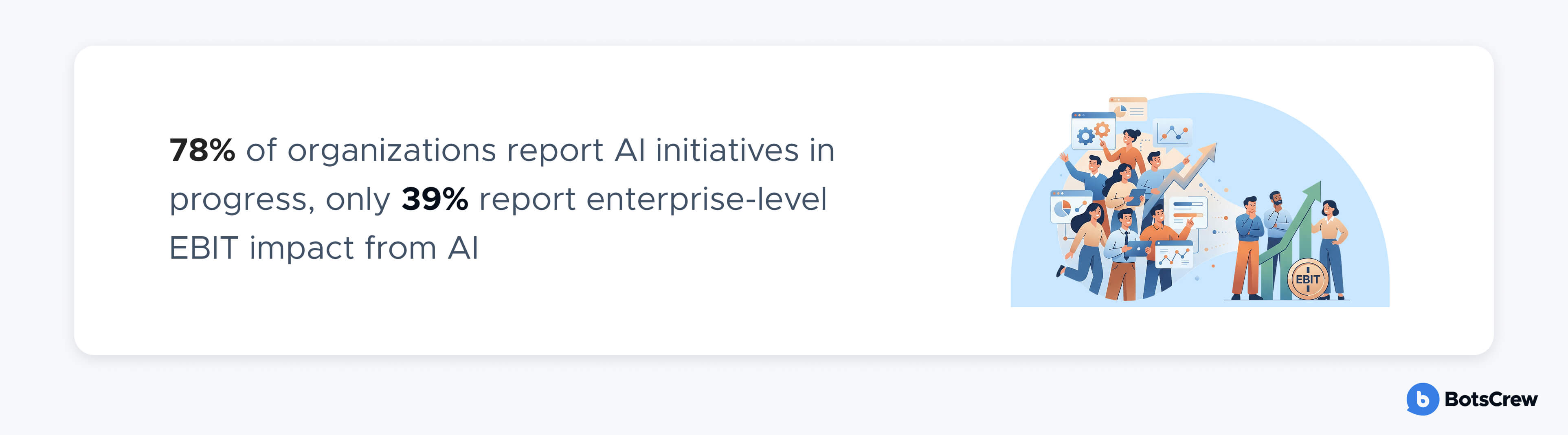
Enterprise AI adoption has reached a critical inflection point. While 78% of organizations report AI initiatives in progress, only 39% report enterprise-level EBIT impact from AI. The difference often lies not in the technology itself, but in the partnership decisions made during implementation.
Selecting the right AI development partner can determine the success or failure of your enterprise AI initiatives. Yet many CTOs approach this decision with the same criteria they’d use for traditional software development, missing the unique complexities that AI projects demand.
The stakes are particularly high because AI implementations touch multiple business functions, require specialized expertise, and often become foundational to competitive advantage. A poor partnership choice doesn’t just delay projects—it can set back your organization’s AI maturity by years while competitors advance.
Understanding how to systematically evaluate potential partners is essential for any technology leader responsible for AI strategy and execution.
Planning an AI project? Schedule a consultation to evaluate vendors and avoid costly mistakes.
This guide provides a practical framework for enterprise AI vendor selection, helping organizations understand how to choose an AI development partner and what factors truly determine long-term success. From technical expertise to governance and scalability, the following AI vendor due diligence checklist will help you evaluate potential partners with confidence.
The Current AI Development Landscape
The AI development company market has exploded in recent years, creating both opportunities and challenges for enterprise buyers. For technology leaders, the challenge is determining how to choose an AI development company that can deliver production-ready systems rather than experimental prototypes. A structured AI vendor due diligence checklist helps organizations evaluate potential partners based on technical capabilities, scalability, and long-term strategic alignment.
Not every AI development company has the expertise to handle complex enterprise requirements, despite marketing claims suggesting otherwise.
Three distinct categories have emerged in the market. Established consulting firms offer broad business expertise but may lack deep AI specialization. Pure-play AI startups bring cutting-edge technical knowledge but often struggle with enterprise-scale implementations. Technology vendors provide platforms and tools but may not offer the strategic guidance needed for successful adoption.
This fragmentation means that evaluating AI development services requires a systematic approach to technical and business criteria. The traditional vendor selection process—focused primarily on cost and timeline—proves insufficient when dealing with AI’s inherent uncertainties and evolving requirements.
Enterprise AI projects also face unique challenges that standard software development doesn’t encounter. Data quality issues, model performance variability, and regulatory compliance requirements all demand specialized experience that not all providers possess.
How to Choose an AI Development Partner: Key Evaluation Criteria
When evaluating vendors, organizations should follow a structured AI vendor evaluation framework that examines technical capability, team expertise, governance, and long-term partnership potential.
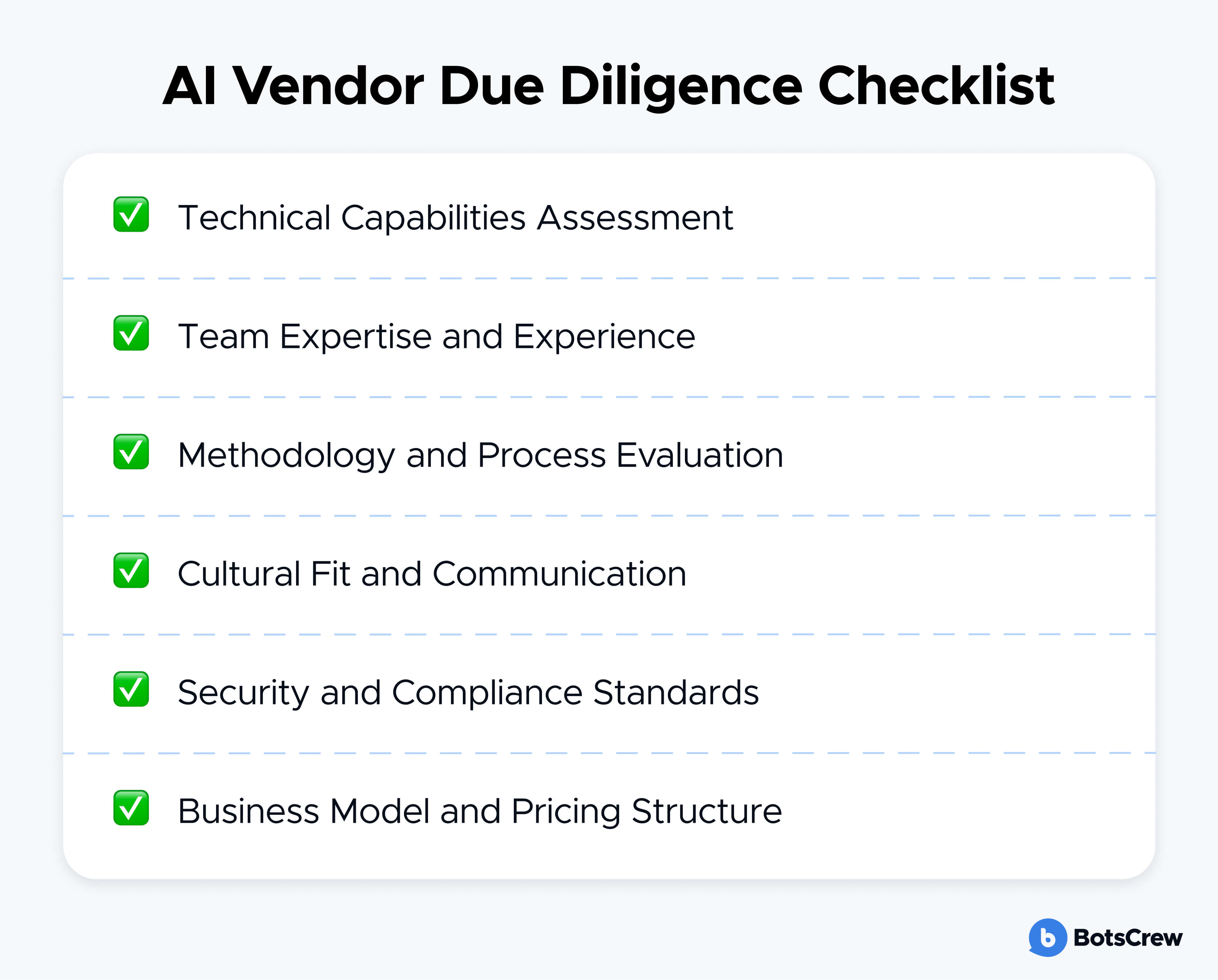
Below is a practical AI vendor due diligence checklist that CTOs can use when comparing providers.
Technical Capabilities Assessment
Core AI/ML Expertise
A critical part of the AI vendor due diligence checklist is evaluating the partner’s technical capabilities. Your potential AI development partner should demonstrate proven experience with the specific AI technologies your projects require. This goes beyond general machine learning knowledge to include expertise in relevant frameworks, model architectures, and deployment patterns.
Look for evidence of work with enterprise-grade AI systems, not just proof-of-concept demonstrations. Ask for detailed case studies that show how they’ve handled data pipeline complexity, model versioning, and production monitoring. The ability to explain technical trade-offs in business terms often indicates both deep expertise and communication skills.
Pay particular attention to their approach to model interpretability and bias detection. These capabilities are increasingly critical for enterprise AI applications, especially in regulated industries where algorithmic decisions must be explainable.
Infrastructure and Scalability
For enterprise AI vendor selection, scalability is essential. Enterprise AI implementations must handle production workloads that dwarf typical development environments. Your partner should have demonstrated experience with cloud-native AI architectures, containerization strategies, and auto-scaling implementations.
Evaluate their understanding of MLOps practices, including automated testing, continuous integration for ML models, and production monitoring systems. These operational capabilities often determine long-term project success more than initial model performance.
Consider their experience with your preferred cloud platforms and any hybrid or multi-cloud requirements your organization may have. Infrastructure decisions made early in AI projects can significantly impact future scalability and cost optimization.
Team Expertise and Experience
Industry-Specific Knowledge
When evaluating what to look for in an AI development partner, team composition is often the most important factor. AI applications vary dramatically across industries, and generic approaches rarely deliver optimal results. Your AI development partner should demonstrate relevant industry experience, including understanding of domain-specific data types, regulatory requirements, and business processes.
Look for team members who have worked on similar use cases within your industry. This experience accelerates project timelines and reduces the risk of overlooking critical AI requirements that only become apparent during implementation.
Ask about their approach to knowledge transfer and how they ensure your internal teams can maintain and evolve AI systems after initial deployment. The best partnerships build internal capabilities rather than creating long-term dependencies.
Team Composition and Stability
Successful AI projects require diverse skill sets, from data scientists and ML engineers to domain experts and project managers. Evaluate the completeness of your potential partner’s team and their track record of retaining key personnel.
High turnover in AI teams can be particularly disruptive because of the specialized knowledge required. Ask about team stability, career development programs, and how they handle knowledge management when team members transition.
Consider the seniority levels within their team. While junior team members can contribute valuable energy and current academic knowledge, complex enterprise AI projects typically require senior practitioners who can navigate ambiguous requirements and technical challenges.
Methodology and Process Evaluation
Development Approach
AI development differs significantly from traditional software development in its iterative, experimental nature. Your partner should have established methodologies that account for the uncertainty inherent in AI projects while still providing predictable business outcomes.
Look for structured approaches to problem definition, data assessment, and AI success criteria establishment. The best AI development services providers use frameworks that help translate business objectives into measurable AI outcomes while managing stakeholder expectations about timelines and deliverables.
Evaluate their approach to risk management and how they handle projects that may not achieve initial technical goals. Mature AI partners have contingency planning processes and can pivot strategies when initial approaches prove insufficient.
Quality Assurance and Testing
AI systems require specialized testing approaches that go beyond traditional software QA. Your partner should have established practices for data quality validation, model performance testing, and bias detection across different demographic groups.
Ask about their approach to A/B testing for AI systems and how they measure real-world performance against laboratory results. The ability to design and execute proper evaluation frameworks often distinguishes experienced AI practitioners from those with primarily academic backgrounds.
Consider their practices around model versioning, rollback procedures, and gradual deployment strategies. These operational capabilities become critical when AI systems are integrated into business-critical processes.
Cultural Fit and Communication
Collaboration Style
AI projects require close collaboration between technical teams and business stakeholders. Your AI development partner should demonstrate strong communication skills and the ability to translate technical concepts into business language.
Evaluate their approach to stakeholder management and how they handle the inevitable scope changes that occur as AI projects evolve. The best partners act as AI consultative advisors, helping you refine requirements and expectations throughout the development process.
Consider their willingness to challenge assumptions and provide honest assessments of project feasibility. Partners who only agree with client requests may avoid difficult conversations that could prevent project failures.
Knowledge Transfer Approach
Long-term AI success requires building internal capabilities within your organization. Your partner should have structured approaches to knowledge transfer, documentation, and training that enable your teams to maintain and evolve AI systems independently.
Ask about their approach to code documentation, model documentation, and operational runbooks. These artifacts become critical for ongoing system maintenance and future enhancements.
Consider their willingness to work closely with your internal teams and provide mentoring opportunities. The best partnerships result in increased internal AI capabilities, not just delivered systems.
Security and Compliance Standards
Data Protection and Privacy
AI systems often process sensitive business and customer data, making security and privacy considerations paramount. Your AI development partner should have established practices for data handling, encryption, and access control that meet or exceed your organization’s requirements.
Evaluate their understanding of relevant regulations like GDPR, HIPAA, or industry-specific compliance requirements. This includes not just technical implementation but also documentation and audit trail capabilities.
Ask about their approach to data minimization, anonymization techniques, and secure data sharing protocols. These capabilities become particularly important when working with external partners who may need access to sensitive datasets.

Audit and Governance
Enterprise AI implementations require robust governance frameworks that support regulatory compliance and internal risk management. Your partner should understand enterprise governance requirements and have experience implementing appropriate controls.
Look for established practices around model governance, including approval workflows, performance monitoring, and regular model reviews. These processes become critical as AI systems scale across your organization.
Consider their experience with regulatory audits and their ability to provide documentation and evidence required for compliance reporting. This capability can significantly reduce your organization’s compliance burden.
Business Model and Pricing Structure
Engagement Models
Different AI projects require different partnership structures. Your AI development partner should offer flexible engagement models that align with your project requirements and risk tolerance.
Consider whether fixed-price, time-and-materials, or outcome-based AI pricing models best fit your specific situation. Each approach has advantages depending on project scope clarity, timeline constraints, and success criteria definition.
Evaluate their approach to intellectual property ownership and licensing. These decisions can significantly impact your organization’s ability to modify, extend, or commercialize AI systems in the future.
Long-term Partnership Potential
AI implementation is rarely a one-time project but rather an ongoing capability development process. Your partner should demonstrate the ability to support long-term relationships through maintenance, enhancement, and scaling services.
Ask about their approach to ongoing support, including response times for critical issues, regular performance reviews, and proactive optimization recommendations. These services often determine the long-term success of AI implementations.
Consider their roadmap alignment with your organization’s AI strategy and their ability to support future projects as your AI maturity evolves. The best partnerships grow and adapt over time rather than ending after initial implementation.
Strategic Insights for Partnership Success
The most successful AI partnerships share several common characteristics that go beyond technical capabilities. They begin with clear success criteria and maintain regular communication about progress against those metrics. They also establish governance frameworks early that support both innovation and risk management.
Risk mitigation becomes particularly important in AI partnerships because of the technology’s experimental nature. The best approaches include pilot projects that validate partnership effectiveness before committing to larger initiatives. They also include clear exit strategies and knowledge transfer protocols that protect your organization’s interests.
Consider the partnership’s strategic value beyond immediate project delivery. The most valuable AI development partners become trusted advisors who help shape your organization’s AI strategy and capabilities over time. They bring market insights, technical innovations, and best practices that extend far beyond individual project implementations.
Conclusion
Selecting the right AI development partner is one of the most important decisions technology leaders make when launching or scaling AI initiatives. The success of an AI project depends not only on algorithms or tools, but on the partner’s ability to deliver secure, scalable, and production-ready systems aligned with business goals.
By applying a structured AI vendor evaluation framework—assessing technical capabilities, team expertise, development processes, and security standards—organizations can significantly reduce implementation risks and build AI solutions that deliver measurable value.
If your team is currently evaluating vendors, a clear comparison framework can make the decision process faster and more objective. The next step is to use a structured checklist to compare potential partners and identify the best fit for your organization.
If you want expert guidance tailored to your project, 👉 book a consultation with our AI experts to discuss your AI strategy and vendor evaluation process.